Obituaries
Zhu Rongji, who drove China's 1990s economic reforms, has died at 97 Updated August 12, 20268:36 AM ET Originally published August 12, 20268:36 AM ET
 Enlarge this image
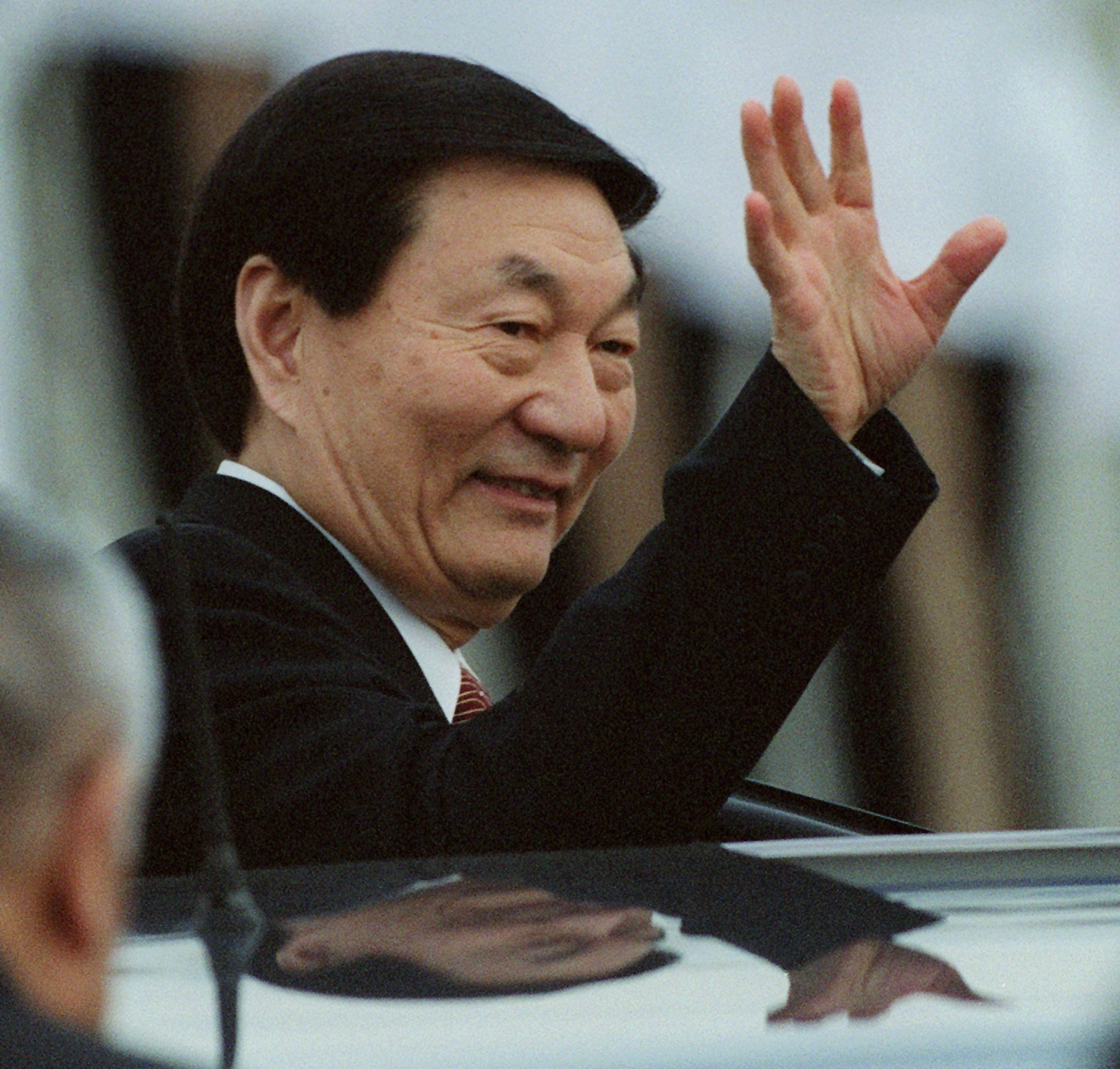
 Then-Chinese Premier Zhu Rongji arrives at Hong Kong's international airport on Nov. 18, 2002, for the opening of the World Congress of Accountants. K.Y. Cheng/South China Morning Post via Getty Images hide caption
toggle caption K.Y. Cheng/South China Morning Post via Getty Images
Then-Chinese Premier Zhu Rongji arrives at Hong Kong's international airport on Nov. 18, 2002, for the opening of the World Congress of Accountants.
K.Y. Cheng/South China Morning Post via Getty ImagesZhu Rongji, former premier of China, has died at age 97. The cause of death was given as illness, according to state media.
Zhu, an acerbic technocrat and a trained engineer, was renowned for far-reaching economic reforms throughout the 1990s that sought to transition China from the chaos of its post-Maoist years to a more global market-oriented financial system, without completely ceding the Communist Party's control over the economy.
Despite staying almost completely out of the public eye after retiring from the premiership in 2003, he remains both loved and reviled in the country indelibly shaped by him. His reform legacy remains contested in China; in freeing up the country's enormous labor and financial resources, he helped to create vast amounts of wealth over the next three decades while also seeding institutions with future vulnerabilities.
"From the point of view of a policymaker, [he] embraced the notion of a China whose economic system was more compatible with that of the West. And by compatible, I mean vastly reformed, more open, less state-dominated, very limited state intervention," said Charlene Barshefsky, a lawyer and former U.S. trade representative who sat across the negotiating table from Zhu over years-long talks to let China enter the World Trade Organization (WTO).
In order to join the WTO, China first needed to get preferential trading status with the United States — which in turn demanded hard concessions and that it open up its closed economy to American companies. Zhu was under huge pressure to find compromise, and he let his views be known.
 Enlarge this image
 Zhu Rongji (left) answers reporters' questions during a joint news conference with then-President Bill Clinton on April 8, 1999, in Washington, D.C. Joyce Naltchayan/AFP via Getty Images hide caption
toggle caption Joyce Naltchayan/AFP via Getty Images
Zhu Rongji (left) answers reporters' questions during a joint news conference with then-President Bill Clinton on April 8, 1999, in Washington, D.C.
Joyce Naltchayan/AFP via Getty ImagesIn 2000, the U.S. Senate voted to give China that preferential trading status, and the following year, China joined the WTO. The agreement was a windfall for the nascent Chinese economy. The country became an export powerhouse, and foreign businesses rushed to China to establish a foothold.
The 6 1/2-year process let Zhu show off his flinty personality, though he struck U.S. officials as inquisitive and flexible. "This was not talking points. It was a lot of give and take," said Kenneth Lieberthal, a China expert who was a national security adviser for then-President Bill Clinton. He met Zhu multiple times during the negotiations.
Zhu was born in 1928 in the city of Changsha, in China's Hunan province. He graduated from Beijing's Tsinghua University, where he was also chosen as president of the student union, with a degree in electrical engineering, the winter before the Communist Party won control over China. In October 1949, when the new Communist-led republic was founded, Zhu officially joined the Chinese Communist Party.
His blunt, say-it-like-it-is style got him in trouble
Zhu's father died before he was born, and his mother died when he was 9 years old. Being an orphan, the need to survive helped shape his strong personality: thick-skinned and extremely direct.
"My defining characteristic is independent thought," he told bureaucrats in 1987, right before becoming mayor of Shanghai. "I say what I think."
When Chinese troops fatally fired on pro-democracy protesters in Beijing's Tiananmen Square in 1989, Zhu did not issue the standard propaganda line denying the tragedy. "The event that occurred recently in Beijing is a historical fact, and historical facts cannot be covered up by anybody. The truth will always come out," he wrote in an essay published in a Shanghai newspaper.
His blunt, say-it-like-it-is style got him in serious trouble. In 1958, he was labeled an ideological "rightist" and briefly expelled from the party for criticizing Chairman Mao Zedong's economic policies, but managed to hold on to a job in state planning. In 1970, he was purged again during the Cultural Revolution and sent to do five years of manual labor at a party reeducation school.
Zhu was rehabilitated after Mao died in 1976 and Deng Xiaoping came to power as China's leader. Zhu then worked his way back up the bureaucratic ladder with the same pragmatism he had learned as an engineer.
"Regardless of what country your company is from, when you arrive in China, you should receive fair and equal treatment. I just want you to pay taxes," he joked in 1999 to an audience of American businessmen, explaining that China was open for foreign investment.
A career state planner, Zhu nevertheless quickly adjusted to the economic chaos of the 1990s, as China careened between capitalism and state-led socialism. As central bank governor, Zhu successfully tamed runaway inflation. While vice premier, he also led a dramatic centralization of the tax system that incentivized land sales and huge wealth creation, along with hugely unsustainable levels of debt.
After being appointed premier in 1998, he entered office with a bold promise: He would reform the indebted state banks within two years and inefficient state enterprises within three. That earned him both instant enemies and fans.
"No matter whether what lies ahead is a minefield or a bottomless abyss, I will carry out my duties until the last breath in my body," he vowed.
Zhu's most controversial legacy by far remains restructuring China's bloated state-owned enterprises. He axed smaller, inefficient companies, leaving an estimated 30 million state workers suddenly jobless.
Worker protests erupted all over China. Zhu had the willpower — or callousness, as his critics would say — to ignore them.
"The central government decided that the laid-off worker problem could just be ignored and forgotten," said Dorothy Solinger, a professor emeritus of political science at the University of California, Irvine, who studies migrant labor in China.
Zhu tried to offset the layoffs' impacts. He created a basic social welfare system that exists to this day and made steps to boost basic health care, which had crumbled in rural areas. But pockets of China, especially in the northeast region of the country, where workers were reliant on state employment in heavy industry sectors, never fully recovered economically.
"I think their children also have a problem because they miss out on the things that the better-off part of the population could do, such as hiring tutors or going on extracurricular activities, going to the better schools," said Solinger. "It's a growing underclass."
Zhu took the criticism in stride. Unlike most Communist leaders, who read off staid and carefully prepared scripts, he loved engaging with and ad-libbing to the press.
"He loved answering all the questions, no matter how tough or sensitive," remembered Rose Luqiu, a former journalist for Hong Kong outlet Phoenix News who spent 10 years covering Zhu during his international state visits. "The only way he refused to answer was using a quite humorous way to dodge the questions."
His gallows humor allowed him to weather intense periods of criticism from senior ideologues within the Communist Party, once quipping during an anti-corruption campaign: "I have prepared 100 coffins: 99 for the corrupt officials and one for myself."
Other reforms of his did not materialize, in part because an austere Zhu never managed to cultivate the political patronage networks that would have allowed him to overcome fierce opposition within party ranks to his proposals. His efforts to reduce bad debt at China's state banks and reform the pension system floundered.
 Enlarge this image
 Chinese leaders and former leaders including Zhu Rongji (center) listen to The Internationale at the end of the closing session of the 19th Communist Party Congress at the Great Hall of the People in Beijing on Oct. 24, 2017. Greg Baker/AFP via Getty Images hide caption
toggle caption Greg Baker/AFP via Getty Images
Chinese leaders and former leaders including Zhu Rongji (center) listen to The Internationale at the end of the closing session of the 19th Communist Party Congress at the Great Hall of the People in Beijing on Oct. 24, 2017.
Greg Baker/AFP via Getty ImagesZhu "represented really a different time, a different era for China"
Zhu is now invoked with pleasant nostalgia. Under China's current leader, Xi Jinping, the country became more nationalistic, more beholden to the state and more closed off to the outside world.
"I think that Zhu Rongji represented really a different time, a different era for China: the time when China wanted to find its way in what, due to that time, was the best possible way, which was to move towards Western-style economics, to move toward Western-style rules," said Barshefsky, the former U.S. trade negotiator.
Zhu Rongji spent the last years of his life at his Beijing home in the western hills of the Chinese capital. He loved Peking Opera and spent much of his days listening to music — and quietly advising some of the newest generation of technocrats running China, though not all appear to have listened to him.