
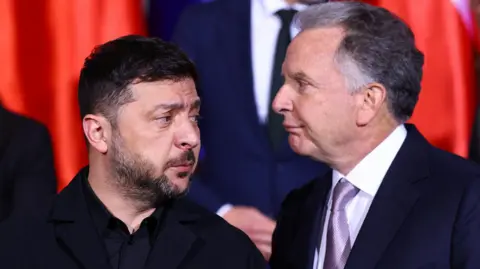
 Getty ImagesUS envoy Steve Witkoff (right) has travelled to Moscow eight times but never to Kyiv
President Volodymyr Zelensky has said he considered visits by US envoys Steve Witkoff and Jared Kushner to Moscow but not Kyiv "disrespectful".
The pair visited the Russian capital late last year as ceasefire talks aimed at ending the war in Ukraine gained pace, and again in January.
Witkoff, who has been to Moscow eight times, met Vladimir Putin on many occasions.
Neither he nor Kushner, however, has ever visited Kyiv in an official capacity.
"It's disrespectful [for them] to come to Moscow and not Kyiv, it's just disrespectful," Zelensky said in an interview with a Ukrainian outlet.
"I understand we have complex logistics... If they don't want to, we can meet in other countries," he added.
Witkoff, a former real estate magnate, is Donald Trump's special envoy and Kushner is the US president's son-in-law.
Earlier in April Zelensky said the two were planning on visiting Ukraine, but that trip never materialised amid the US-Israel war with Iran.
The last trilateral summit between Russia, the US and Ukraine was in mid-February.
Less than two weeks later, the US and Israel began striking Iran and attention switched away from ending the Ukraine war, which has been raging for more than four years.
Witkoff and Kushner are part of the US negotiating team travelling to Pakistan for ceasefire talks with Iran, and Zelensky acknowledged that the attention of the US was on the Middle East.
"But... in any case, for us it is important to continue cooperating with the Americans," he added.
Ceasefire talks gained pace in autumn 2025, when it emerged that Russian and US officials had been working on a plan to end the war in Ukraine that appeared to include several terms unfavourable to Kyiv.
Ukraine pushed to be involved in the talks, and several meetings and summits ensued.
By February, both Moscow and Kyiv said they had reached an agreement on some "military issues", including the location of the front line and ceasefire monitoring.
Other issues remain unresolved, including Ukraine's demand that Russia returns the Ukrainian children it forcibly deported since the start of the war, and Moscow's insistence on a "regime change" in Kyiv.
But the key matter is the status of Ukraine's eastern Donbas region. Moscow's demand for sovereign Ukrainian territory in exchange for an end to the war is unacceptable to Kyiv, and neither side is willing to budge - leaving the talks at a dead-end.
"We are looking for a compromise between two completely polar positions," said Kyrylo Budanov, Zelensky's chief of staff, in February. "We have not yet found it."
The war, which started when Russia launched its full-scale invasion of Ukraine in 2022, has been an everyday reality for Ukrainians for over four years.
Large swathes of eastern Ukraine are under Russian control, and Kyiv and Moscow's troops continue to engage in direct battle on a long front line stretching from Luhansk in the north-east to Kherson in the south.
Cities across Ukraine come under regular aerial attacks, with Russia employing hundreds of drones and missiles that kill civilians and damage infrastructure.
On one night last week Russia launched more than 700 drones and missiles in multiple waves, killing at least 18 people.
Meanwhile Ukraine has ramped up its attacks on Russian energy infrastructure with long-range drones, hitting ports, factories, depots and oil terminals far into Russian territory.
According to Reuters calculations, at least 20% of Russia's total export capacity was out of order in early April following the attacks. But the energy crisis caused by the war Iran - has so far resulted in financial gains for Russia as it boosted its oil revenue, although the country's GDP continues to fall.
War in UkraineRussiaUkraine