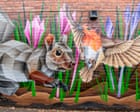
 A Bit of Parklife by Annatomix, displayed in Alcester Road, Birmingham. Photograph: David Blower / Art UKA Bit of Parklife by Annatomix, displayed in Alcester Road, Birmingham. Photograph: David Blower / Art UKWriting on the wall: Art UK digitises thousands of murals as street artworks go mainstream
From medieval church wall paintings to Liam Gallagher’s viral X post, charity has catalogued more than 6,600 pieces
Some of the UK’s smallest public murals are on bollards in Shrewsbury while one of the biggest is on a 1960s 16-storey block of flats in Gosport.
Perhaps the funniest though is in Cardiff. Ahead of last summer’s Oasis concerts it was a straightforward copy of Liam Gallagher’s viral post on X declaring: “Because Cardiff is the bollox.”
The murals are among more than 6,600 that have been identified, photographed and digitised in an ambitious project which launched in January 2024, the charity Art UK said.
It is part of their mission to catalogue as much of the nation’s public art as possible, whether oil paintings, watercolours or statues. There are mural examples from Penzance to Orkney, Lowestoft to County Fermanagh and it includes columns that look like Rolo packets under the M4 in south Wales, a grazing giraffe on the side of a tenement building in Glasgow and Alan Bennett riding a bike on the side of BBC Radio Leeds.
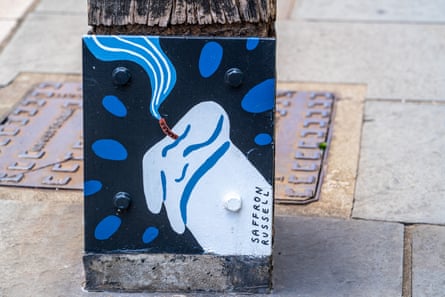 The Phantom Coach of the Lion Hotel by Saffron Russell on a bollard in Wyle Cop, Shrewsbury, Shropshire. Photograph: Michael and Janet Richardson / Art UK
Katey Goodwin, the deputy chief executive of Art UK, said the number far exceeded the target of finding 5,000, reflecting the explosion of murals in the UK.
“It has gone from seeing a few murals here and there to them being everywhere,” she said.
The rising number is down to many more councils and regeneration bodies commissioning them, often to encourage people into town and city centres post-Covid, as well as there being more street art festivals.
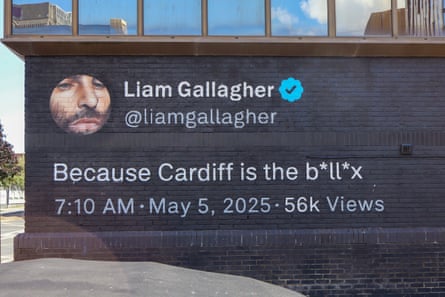 Cardiff is the B*ll*x by Rmer One in Churchill Way, Cardiff city centre. Photograph: Steph Roberts / Art UK
Murals have gone from being subversive and underground to being more mainstream, said Art UK.
Another reason for their ubiquity is cost, said Goodwin, with a mural being a lot cheaper and quicker than commissioning an artist to create a statue.
The project has identified a number of themes with 19% of the recorded murals identified as commemorative, reflecting national events, sporting triumphs, protest movements and mourning.
Wildlife and animals appear in 23% of murals – including a nuthatch, squirrel and robin among spring crocuses on a wall in Moseley, Birmingham, and a spray-painting raccoon in Worcester.
Art UK said 11% reflected heritage and industry, often recalling industries in decline or gone altogether such as an impressive, large mural of a miner holding a canary in a cage in Wrexham.
Other murals explore big issues such as the climate crisis and women’s safety while there are also plenty that are just there to “make you smile”, said Goodwin.
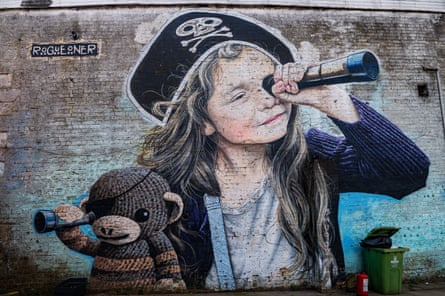 Lola the Barras Pirate, c.2020, by Rogue-one in Ross Street / Suffolk Street, Glasgow, North Lanarkshire. Photograph: © the artist. Image credit: Gordon Baird / Art UK
An example of that is a little girl dressed as a pirate, Lola the Barras Pirate, on a wall in Glasgow. No deep message apart from it being a girl having fun dressed as a pirate.
“A lot of murals are there to add a bit of colour and life to the streets,” said Goodwin. “Others are actually incredibly poignant.”
“Some of my favourites are the really massive murals which can stop you in your tracks,” she said. “Some of the skill involved in creating a mural is very, very impressive.”
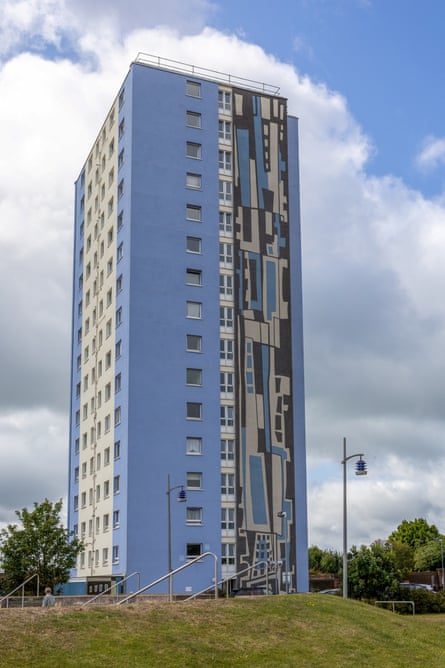 Seaward Tower, 1963, by Poole Pottery, Kenneth Barden (1924–88), George Wimpy (active 1880–2007) and more Trinity Green, Gosport, Hampshire. Photograph: Michael Parry/Mike Parry / Art UK
The project has relied on an army of volunteers willing to go out and find and photograph the murals as well as online searching and working with the rising number of street art festivals.
The charity said it had not included graffiti and tagging “as this would have made the project too large and expensive, but also because of the fleeting nature of many such works”.
That is also true of murals in that some get painted over, buildings get demolished and so on.
“There’s just under 6,700 on the website now and we can’t say this is every single mural in the UK because things come and there will be new ones which weren’t there last week,” said Goodwin.
Some of the oldest catalogued murals are medieval church wall paintings at St Thomas’ church in East Shefford, Berkshire while among the dozens of 2025 murals are two columns supporting the M4 at Junction 41 in south Wales. They look like Rolo packets but instead say Port and Talbot.
The public murals project has been welcomed by street artists including Essex-based Scotty Irving who said street art “connects people to true stories”.
He added: “Just this week I was painting a new mural and a local school passed by in a big group, on foot. The kids were buzzing and the teacher immediately used it as a live lesson, gathering the children and encouraging their interests. By that evening, through social media, they were already aware of Art UK’s free resources.”
Explore more on these topicsShareReuse this content