
This World Cup, man. Last-minute winners, upsets that nearly weren't, red cards that very obviously were, and yet everyone is losing their mind anyway. Adding another round of knockout games might be flaying an already exhausted player pool, but goodness these tired minds and tired legs are producing a lot of late drama.
Might that continue today? On the face of it, you'd think not. There just aren't many games that look as imbalanced as England vs. DR Congo. Switzerland and Algeria could be a tight one, the former a side who can control a game very well but don't necessarily blow by opponents, the latter a team that has indulged in slightly too many low-value long-range efforts during the tournament. Spain should really back themselves to breeze past Austria -- we'll come to them later -- but the tie of the night is intriguing precisely because it seems so balanced on first glance. Croatia vs. Portugal, two great powers of European football. This should be a cracker.
Can Croatia fluke a deep run again?
If you've had a passing relationship with the last 30 years of World Cup history, you'll know plenty about Croatia. With a population that at its most recent estimate was a little under four million, this nation has punched above its weight on the global footballing stage like no other. Since independence in 1994, the national team has finished third at two World Cups, second at another. With Luka Modric pulling the strings, in the last two World Cups England, Brazil, Denmark, Japan and Russia have all fallen to the Checkered Ones.
If your relationship has been one in passing then it might surprise you to discover that this team has not won a single knockout game in normal time since Davor Suker and Roberto Jarni blew past 10-man Germany at the quarterfinals of the 1998 World Cup. One of the great stories of European football this century has been one of defying the odds quite literally. Since the start of the 2018 tournament, at World Cups this team has taken shots worth 20.7 expected goals, as per Wyscout. They have allowed shots worth 22.6 xG. There is naturally some slightly unhelpful cross-pollination in a small sample size of games stretching across eight years, but still the point remains: if the World Cup were some pan-global league, a good return for Croatia might be upper midtable. Instead they can enter today's tie with Portugal with the air of perennial contenders, something aided by the fact that their best players simply will not retire.
Croatia's successes have been a tale of grinding out games into extra time, where they either nick a goal or cling on for penalties. And no, we're not counting the third-place playoff in 2022. It's not a knockout game if you've already been knocked out.
Contained within that multitude of shootouts and late winners are, of course, plenty of games where Croatia have been the better side, slowly chipping away at their opponents before breaking through. That was often the case in 2018, the tournament which makes the most compelling case for the mental resilience of this team. The composure required to dispatch Russia on penalties in their own backyard is immeasurable; the iron will to end the England fairytale almost as remarkable.
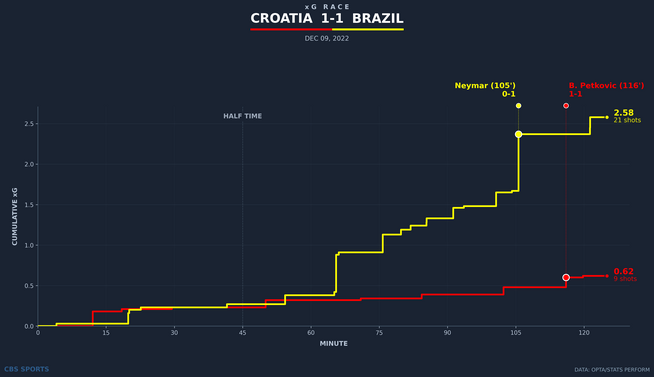
Four years later, the sense was that those qualities had endured. They really did not. Japan froze up from 12 yards out in the round of 16, both Brazil and Argentina crushed Croatia but only the latter finished their chances. And even if you chalk up the win over the former to mental resilience on Croatia's side, it must be acknowledged that there is good fortune in this team's penalty record.
 CBS Sports
 Even if you routinely produce players of the technical and mental qualities of Suker, Modric and Ivan Rakitic, even if you believe that penalties are something that can be prepared for and improved, you have to acknowledge the element of lottery in which team converts more of their 79% chances at the end of two hours of football. At the moment, Croatia's lucky number keeps coming up, four shootouts in World Cups resulting in four wins.
It is worth focusing on penalties given that in 2026 this team's best hope of advancing looks like stopping the other team scoring for 120 minutes. You wouldn't fancy them to do much at the other end. Their 4-2 defeat to England is looking worse every time the Three Lions take the pitch, and although they scored twice they were the sort of brilliantly executed moves that even Croatian players can't consistently replicate. The things that result in replicable goals are not what Croatia is turning in this tournament. Their per-game xG of 0.9 ranks 28th in the competition. It gets worse from there. Eight shots per game is 40th out of 48, level with Jordan. When you zoom in on the penalty area, you see a team that took 11 shots in three games, 43rd ranked in the tournament behind the likes of Iraq, Cabo Verde, Curacao and Jordan.
This is not a recipe for winning football matches. Then again, it has been a while since Croatia had to concern themselves with such things. Maybe there is just some magic at play by the Adriatic and they can just grind their way through two hours of sufferball and win the game on pens.
Time for Spain to take care of business
Spain's World Cup so far is a bit of a tough one to get a grasp on. The 0-0 draw with Cabo Verde was so unforgettable because it was a once-in-a-generation sight, to see so many half-chances and nearly-moments snaffled up by the brilliant Vozinha and his defense. Saudi Arabia were brushed aside because Lamine Yamal was back in an attack that now had the oomph that probably would have got La Furia Roja across the line in the opener. In their final game, Uruguay melted down to a soup of recrimination and rage at Marcelo Bielsa. Spain just had the best seat in the house.
So there has been nothing that has really suggested you ought to change your view on Spain, particularly as Nico Williams has started to join Yamal on the pitch. This team's ability to monopolize possession -- a tournament-leading 69% -- is the key ingredient in what looks like being the best defense in the tournament. They could still do with a forward who offers a bit more finishing while still providing the interplay of Mikel Oyarzabal. Still, everything seems broadly fine. If you thought Spain were going to win the tournament, you wouldn't have changed your mind.
A game against Austria might afford Spain a chance to win over some floating voters. Ralf Rangnick's side are going to ask questions that in principle their opponent should find difficult, but they are going to do so while playing at a level that should mean Spain still win well. Austria play in the sort of high-pressing fashion that their head coach has spread across Germany with zealotry. That should ask questions of a Spanish backline that is not blessed with the best ball-players, but can of course be supplemented by Rodri, who is quite good at this sort of thing.
Austria, for their part, are not that good at their thing either. They tried to get the ball back high up the field against Argentina and occasionally did, but not so often that it was not worth the holders continually looking to play through, find Lionel Messi between the lines and do their damage there. Expect Spain to do the same. And a high-functioning version of Spain really should be looking at this as a game they win with some authority. That is what champions do, face off against an opponent playing in a way tailored to disrupt them and simply overwhelm them with their quality. Spain have not had a chance to do that yet. They probably will today.
Add CBS Sports on Google Join the Conversation comments