

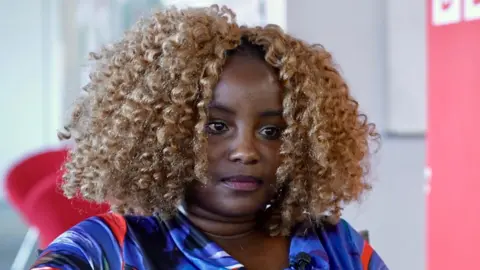
 BBCJoy Kalekye said she was approached by a man on the street but did not know she was being filmed
On Valentine's Day, Joy Kalekye says she received a call from a friend who sounded really worried. She told her to check social media because someone had posted a video of her.
The clip shows Kalekye, then a 19-year-old student, standing on her own by the side of a busy road in the Kenyan capital, Nairobi, looking down at her phone. Whoever is filming walks towards her, and says: "Hi, I like how you look."
It was an encounter Kalekye had forgotten all about.
"I realised, oh, it's this Russian guy that I met last year," she told the BBC World Service. After watching the video, she understood that he had been recording her.
Kalekye features in one of several videos posted online, showing a man approaching women in Kenya and Ghana, who don't appear to know they are being filmed.
He touches their hair, holds their hands, asks for their number, and to meet up with him later.
The women are victims of a global trend where men with hidden cameras film interactions without their consent and publish the videos online, sometimes amassing millions of views.
Some of the creators of the videos earn money by posting them on social media platforms, or profit by selling guides which claim to help men approach women.
There has been outrage among activists and politicians in both Kenya and Ghana, calling for the man, who says in the videos he is from Russia, to be arrested.
But online, the women have also been blamed, ridiculed and abused.
"It's like being a celebrity, but not in such a good way," says Kalekye.
This public reaction, says Brenda Yambo, legal counsel at the Federation of Women Lawyers in Kenya (FIDA-Kenya), reinforces harmful gender stereotypes and shifts the blame to the victims.
Instead of focusing on the wrongdoing - the non-consensual recording and distribution of the clips - society scrutinises the woman's behaviour, she says.
"They will talk about her choices, her morality, her dress code," she says, explaining that this increases the harm caused to women and discourages victims from coming forward.
After the man approached her in March last year, Kalekye turned down his invitation to meet up.
But it was only this year that her video and others went viral. Kenyan and Ghanaian social media accounts re-uploaded clips, some including explicit captions in local languages in an apparent effort to drive traffic to their profiles.
Kelvin Karume, 22, who is currently unemployed and says he is trying to build an online presence as a content creator in Nairobi, says he found the videos on a Russian YouTube channel.
 Kelvin KarumeKelvin Karume says he downloaded the videos from a Russian YouTube channel and uploaded them on his TikTok page
He recalls posting one of the videos to his own TikTok page one Sunday, just before going to church. Then he switched off his phone.
"For me it felt okay to post the videos because people were looking for them and I had downloaded them," Karume told the BBC World Service.
In two hours, he says it got about a million views and about 3,000 comments.
After Karume and others had shared the video of Kalekye, as she was walking outside her house, she says a man called out "enda umeze dawa". In Swahili, this implies she needs to take anti-retroviral medication, which is used to treat HIV.
"He said: 'Uta kufa wewe' [you're going to die]. It was so depressing. And then he was shouting, people are looking at me," she says.
Karume says he removed the video of Kalekye because she left a comment underneath it and also took down another woman's video after she asked him to. He told the BBC it was not OK "exposing them like that" with the videos going viral.
Despite this, two other videos of women filmed without their consent are still up on his channel.
Karume said he did not believe there was a need to delete them because no-one had complained and the videos did not get as much attention as the other two.
As more social media accounts reuploaded the videos, Kenya's Directorate of Criminal Investigations (DCI) issued a statement, warning that resharing the non-consensual videos constitutes secondary victimisation and could lead to criminal prosecution.
Ghanaian authorities named the man responsible for filming the videos as 36-year-old Vladislav Liulkov, released his passport photo and said they want to bring him back to Ghana to face charges under their cybersecurity laws, alleging he recorded private encounters without consent and monetised the content online. His whereabouts are unknown.
None of the videos we reviewed reveal the man's face so it's hard to tell if Liulkov is the one who approached Kalekye.
We geolocated three of the recordings of the women to the Sarit Centre and TRM Mall in Nairobi, and others to Nyali Mall in the coastal city of Mombasa.
In Ghana, some women were approached near the Accra Mall in the capital.
The voice in all these videos is very similar and while his face is not visible, his arm appears in shot and the man is wearing what appears to be a blue Casio watch.
In some clips, both hands are clearly free, suggesting he is not holding a camera.
A woman in Ghana, who asked to remain anonymous, told BBC Pidgin she was approached in January but says she rejected the offer to follow him.
She is not aware of any recording of this particular encounter online, but believes it was the same man in the viral videos.
"I feel bad seeing those images. It gives me flashbacks. That could have been me," she says.
We found profiles on a Russian dating site with photographs resembling Liulkov, including one where the man is wearing what looks like a blue watch very similar to the man who recorded the videos.
There is also a picture that was posted in April 2025, of him wearing what appears to be Meta's Ray Ban branded smart glasses and a hat traditionally found on the East African coast. He is standing outside a mosque in Mtwapa, a town outside Mombasa.
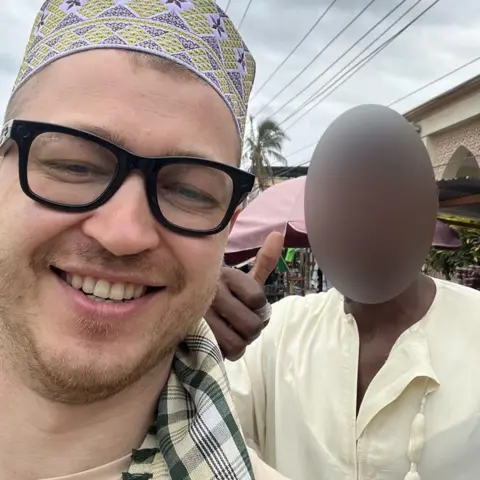 Photo via Fotostrana.ruAn image posted on a dating website that appears to show Vladislav Liulkov, wearing glasses that may be fitted with a camera
Russian media reported that the videos were posted by social media channels using a handle combining the words for male genitals and glory in Russian.
There is also a website under this pseudonym, which have all now been removed. On an archived version of the website, its owner sells a personalised guide to approaching women, priced at 250 rubles (about $3; £2.30).
Compilations of similar style videos have circulated with this account name as the watermark, including some that appear to be from other parts of the world.
In one, a man with a similar accent and a blue watch speaks to two women in Cuba.
Contacted by the BBC, Liulkov said he was not behind any social media handles or websites being referenced in the media and denied having approached women in Kenya, Ghana or Cuba using smart glasses, or posting intimate videos on paid or other public channels.
To the Russian media outlet Vot Tak, he admitted having met women in Kenya and Ghana but denied having filmed them.
A significant portion of the online commentary focused on the behaviour of the Kenyan and Ghanaian women, mocking them and using misogynistic slurs and insisting they were not victims at all.
Kalekye says she is talking about her ordeal publicly to counter what has been said about her.
She says she considered locking herself away but thought: "I'm strong. I don't have to stay here because of just something someone said."
She believes the negative reaction was self-righteous because the recordings captured an everyday occurrence and says people should stop judging.
"They don't know how that small negative comment, that you can write down without caring, can affect someone's life."
Women filmed secretly for social media content - and then harassed online
'I was secretly filmed with smart glasses and then trolled online'
 Getty Images/BBC
Go to BBCAfrica.com for more news from the African continent.
Follow us on Twitter @BBCAfrica, on Facebook at BBC Africa or on Instagram at bbcafrica
BBC Africa podcasts