
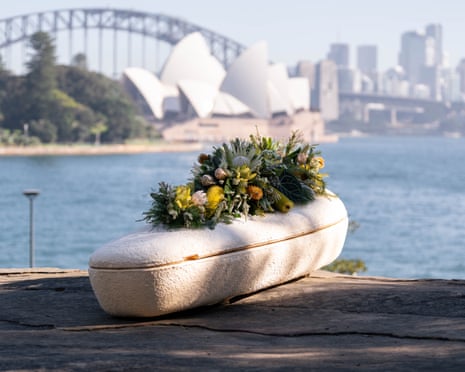
 The mushroom coffin, created by Loop Biotech, pictured in Sydney Harbour. Photograph: Loop BiotechThe mushroom coffin, created by Loop Biotech, pictured in Sydney Harbour. Photograph: Loop BiotechWoman laid to rest in coffin made from mushrooms in Australian first
The casket, grown from mycelium and hemp fibres, takes just 45 days to break down, enriching the soil in the process
-
Get our breaking news email, free app or daily news podcast
A woman has been buried in a coffin made from mushrooms in New South Wales in an eco-friendly first for Australia.
Carolyn, aged in her 70s, was laid to rest on Friday by friends and family at Springwood Cemetery in the Blue Mountains.
The mushroom coffin, created by the Dutch firm Loop Biotech, was grown from mycelium – the root network of fungi – and hemp fibres.
The coffin is grown in mould in a climate-controlled room, taking just a week to fully form. Once buried, it takes about 45 days to become part of the soil.
The process is akin to composting, as the body and coffin gently biodegrade and transform into nutrient-rich soil in far less time than a traditional wooden casket, which can take up to 50 years to break down.
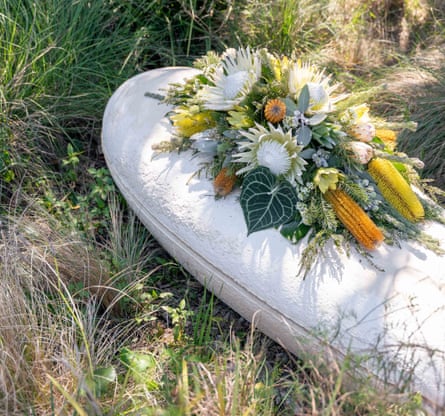 The biodegradable coffins weigh about 30kg. Photograph: Loop Biotech
Carolyn’s husband, David, said picking the mushroom coffin aligned with his wife’s values of giving back.
“She was always there to help others. It feels very true to who she was that even after her death, she can still do something for others while giving something back to nature,” he said.
While Carolyn is the first to be buried in the coffin in Australia, Loop Biotech’s founder Bob Hendrikx said there had been thousands of others across Europe and the US.
“Five years ago when I started, there was lots of interest from Australia,” Hendrikx said. “It was a little bit harder to ship overseas [at the time].”
Hendrikx hopes the mushroom coffins, which weigh about 30kg each, could improve the sustainability of the Australian funeral sector by shortening the decomposition process.
“It’s about giving back to nature: we have the mushroom, which is grown and dissolves into nature, but the actual benefit is that … it’s enriching the soil,” he said.
“The body needs to just return to nature and let nature do what it’s done best forever.
“If a kangaroo dies in the forest, it’s just going to be part of the cycle of life.”
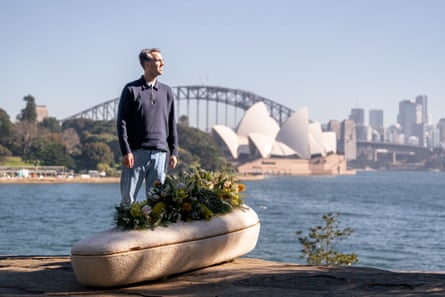 ‘It’s enriching the soil’: Loop Biotech founder Bob Hendrikx in Sydney. Photograph: Loop Biotech
Dr Hannah Gould, a cultural anthropologist at the University of Melbourne, believes people are becoming increasingly interested in environmentally friendly farewells.
skip past newsletter promotionafter newsletter promotion
“As people perhaps become less religious, other kinds of values or community groupings become more important, and one of those that we’ve seen is eco-death.
Gone to a wetter place: the Queenslanders disrupting the death industry with water cremations Read more“This idea that perhaps that you don’t go up to heaven after you die, you return to the earth, has been an increasingly popular narrative around death and dying.”
While about 70% of Australians choose to be cremated, it has a substantial environmental impact: the emissions from a typical cremation are estimated to be equivalent to 125kg of carbon dioxide.
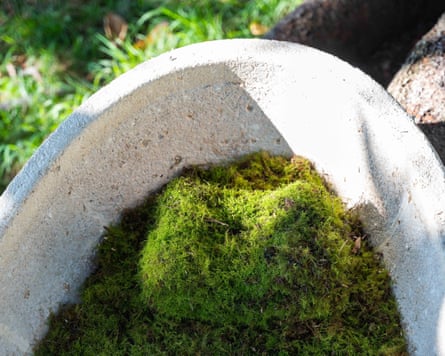 Loop Biotech’s mushroom coffin can be lined with moss. Photograph: Loop Biotech
In recent years options such as alkaline hydrolysis (a cremation-like process that uses water instead of fire), natural burials without embalming, and even shallow burials have become available. A natural burial uses a cardboard coffin with rope handles and will emit less than 10kg of carbon dioxide equivalent, according to PlanetMark analysis.
Gould believes that as Australians are living longer and more people are dying from prolonged illnesses, more time is being spent thinking about how to depart and farewell loved ones.
“They’ve maybe seen or organised a funeral for their parents and it hasn’t gone so well,” she said. “And they’re now deciding that they want to do things differently. So we’re seeing a huge rise in funeral planning.”
Explore more on these topicsShareReuse this content