 Image source, Getty ImagesImage caption,
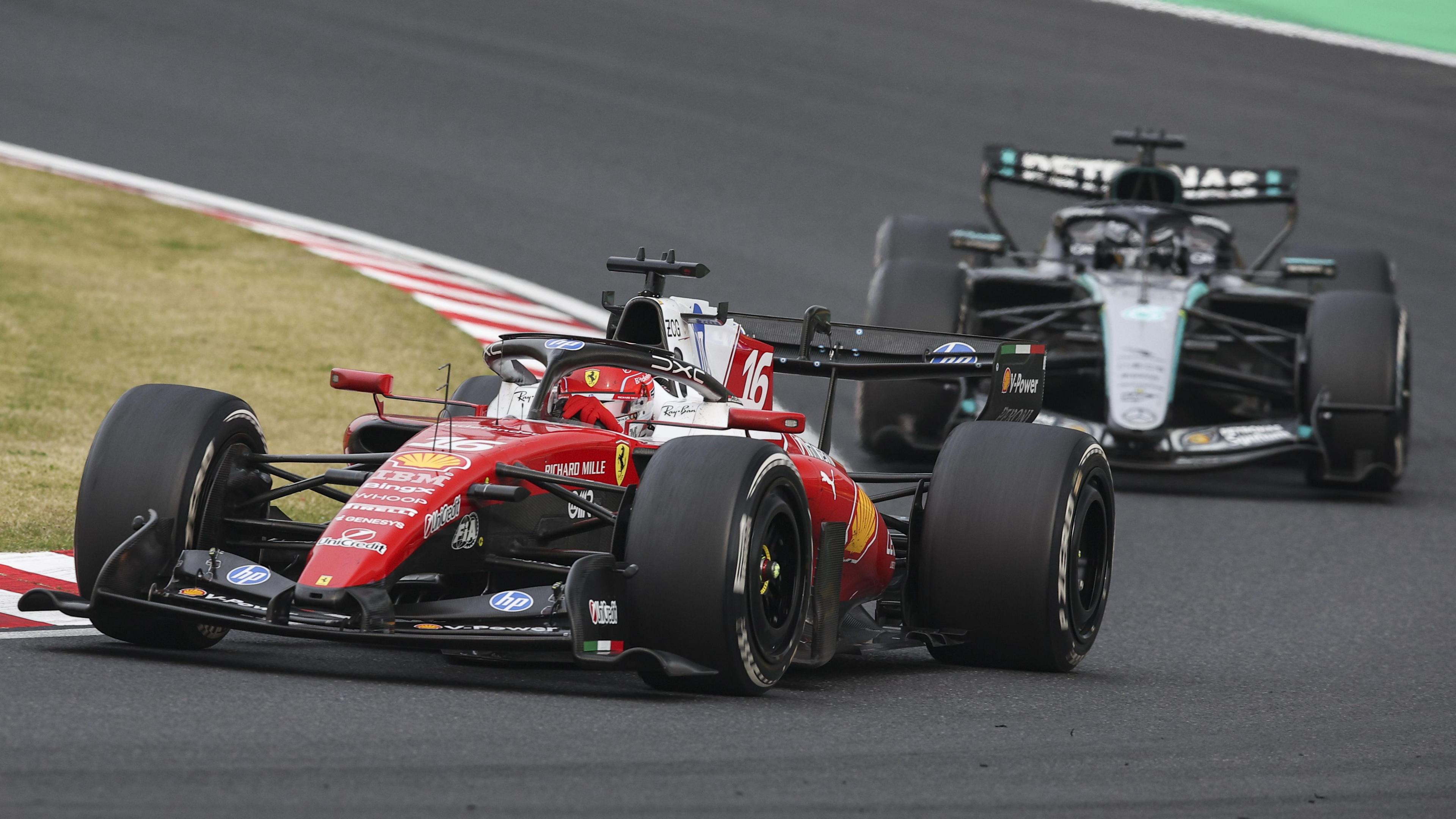
 Ferrari's Charles Leclerc finished third in Japan, with Mercedes' George Russell fourth
- Published53 minutes ago
- 27 Comments
The Formula 1 season finally resumes this weekend with the Miami Grand Prix - the first race in five weeks.
Going into the fourth grand prix of the year, Mercedes' 19-year-old Italian Kimi Antonelli leads the drivers' championship from team-mate George Russell.
Miami will be the first event since a series of rule changes to address concerns about the new engine regulations.
BBC F1 correspondent Andrew Benson answers your latest questions.
Do you think the tweaks to this year's regulations are really going to make a noticeable difference in Miami? - Sam
Formula 1 has made a series of changes to the regulations governing power-units for this weekend's race in Miami. These are aimed at heading off some of the criticisms of the new rules that have emerged in the first three races.
The changes focus on returning the feel of driving in qualifying to a more conventional/natural "on the limit" one, and alleviating concerns about the dangers of excessive closing speeds when one car is deploying full energy and another is charging its battery.
The detail of these changes is complex, but Red Bull team principal Laurent Mekies spoke for most F1 figures last week when he said: "It's a good step forward. It's going in the right direction."
The idea is to reduce the need for so-called 'lift and coast' in qualifying, as well as the time spent when the engine is charging the electrical motor at full-throttle, which in F1 jargon is known as 'super-clipping'.
There are some other - rather esoteric - features of the new rules, about which drivers have complained, that should also be reduced.
However, this is a long way from returning F1 driving to what it has traditionally been. One senior figure said these changes go about 20% of the way there.
Mekies and his opposite number at McLaren, Andrea Stella, both agree that a hardware change is needed to go the full distance.
By that they mean a change in the fuel-flow rate of the internal combustion engine. This would change the current more or less 50-50 split to more like 60-40 or so.
Will it be a "noticeable change" in Miami? For the drivers, it looks like it.
McLaren's Oscar Piastri said: "The changes to the boost button especially and then some of the way the power comes in should make things a bit more in our control and also a bit more sensible."
For the audience, less so perhaps. There will be reduced instances of that tell-tale speed drop-off towards the end of straights - but it will still be there.
The idea was to keep the new style of racing, where overtaking happens more often and cars can swap position for several laps. So that is unlikely to be affected dramatically.
To play this video you need to enable JavaScript in your browser.
This video can not be played
Figure caption,'I love the competition'
Driver styles and car design are talked of often. Using Red Bull as an example, do many teams design a car to suit a driver? Was it a pathway used by Ferrari with Michael Schumacher? To add to my questions, could a driver like George Russell be fast in another car like a Ferrari or an Alpine? - Joseph
First of all, a shout out to Joseph, who delivered his question in an unconventional way. He was struggling to get the BBC Sport website form to work - apologies for that. So he resorted to posting it - from Newfoundland in Canada. Thanks to Joseph - and everyone else who sends in questions - for the support, effort and interest.
The question stems from a common misconception, based on drivers such as Max Verstappen and their specific tastes in an F1 car, in combination with their supernatural ability.
Teams do not design cars for a specific driver. They set about designing the fastest car they can based on objective data.
However, an F1 car is constantly developed throughout a season, and once it hits the track, one of the key metrics that defines how that happens is driver feedback.
And that's where this idea comes from. If the fastest driver in the team feels he can be quicker if the car behaves differently, he will say so, and the engineers are likely to put more weight on his feedback than that of his team-mate.
Verstappen - like Schumacher before him - is renowned for liking a "pointy" car, ie one with a sharp front end and responsive turn-in. Then he relies on his talent to deal with the loose rear in the corner-entry phase.
But other drivers have found they cannot cope with such a car - they prefer a more stable rear end. And that can lead to large gaps between team-mates.
Alex Albon described it well. He said of his experiences alongside Verstappen at Red Bull in 2019-20: "The car is what it is. He is very quick. He has quite a unique driving style, it's not that easy to get along with.
"I like a car that has a good front end, so quite sharp, quite direct. Max does, too, but his level of sharp and direct is a whole different level - it's eye-wateringly sharp.
"To give people an explanation of what that might feel like, if you bump up the sensitivity [on a computer game] completely to the max and you move that mouse and it's just darting across the screen everywhere, that's kind of how it feels. It becomes so sharp that it makes you a little bit tense.
"As it goes sharper and sharper, he goes quicker and quicker, and for you to catch up you have to start taking a little bit more risk. You might be a couple of tenths behind one session, just try a little bit more, 'OK, I've gone off, I've had a crash', and you've got to restart.
"Then you've lost a little bit of confidence, it takes a little bit more time, that gap is growing a little bit, and the next time you try and go out and do another job, another spin or another whatever - it just starts to snowball."
As for the final part of the question, a genuinely fast driver - such as Russell - will be fast in any car, yes. But car traits can often have an effect on whether any driver can achieve their maximum potential.
How Russell is surprising himself in title race - and the positives of F1's new rules
- Published4 days ago
Turkey to return to F1 calendar in 2027
- Published3 days ago
In the past, we heard of drivers using the simulator. Now it's "the simulator in the loop". What does this mean? - Mick
The correct terminology here is "driver-in-the-loop simulators", which are now used by all teams to prepare for races and test developments.
These simulators are essentially a highly sophisticated version of a computer game. There is a room in the factory with a mock-up of an F1 chassis and a large screen in front of it - the team programme particular settings and the driver assesses how they feel.
This could be a new aerodynamic package, a new suspension design, even early in the year the entirely new car, etc.
The chassis is mounted on hydraulic pillars, so that it gives a sensation of movement in terms of pitch and roll and bumps and so on. However, it cannot simulate G-forces.
The driver feeds back their impressions and the team responds accordingly, just as they would with a real car on track.
These devices have become extremely sophisticated, but drivers will tell you that there is no substitute for the real thing when it comes to fully assessing a car.
And of course a computer programme can sometimes make mistakes. Usually, the feel translates quite well, but there can be occasions when the car feels quite different out on track than it did in the simulator.
Miami Grand Prix
1-3 May with race at 21:00 BST on Sunday
Listen on SoundsLive commentary on BBC Radio 5 Live and BBC Radio 5 Sports Extra; live text updates on BBC Sport website and app
Full coverage guideI was wondering what a standard race day would look like for journalists in the paddock. Do you sit in the hospitality of certain teams to watch the race? Do you have to arrive at certain times to do the media sessions post-race? - Ruairidh
Every journalist has their own schedule, although of course all are based around the events at the track.
Our base is the media centre, where we all have desks allocated. This is usually - and traditionally - situated within the paddock, in or near the race control building, ideally - although increasingly rarely - with a view of the race track.
But there is a trend to move media centres away from the paddock.
In Miami this weekend, for example, the media centre is spread over a number of rooms several stories above the paddock, which is on the NFL pitch in the Hard Rock Stadium. This involves taking a lift down to ground level, or a buggy up and down a circular car-park ramp.
In Las Vegas, although F1 is the promoter and built the location from scratch, it was decided to devote the entire structure above the pits to the Paddock Club for corporate guests, to maximise income.
The media is housed in a casino hotel, about a 10-minute walk away, through a tunnel and across a car park, although there is a small workspace in the paddock as well.
Team hospitalities are for employees and guests. Some media events, whether they be team press conferences, or individual interviews, do take place in these areas, either in the general space or in a senior team member's office.
For more informal matters, the media is usually allowed in, up to a point. Some teams are more welcoming than others. But many a conversation, often off the record, has been had over coffee in the hospitality areas.
I will typically arrive at the track about six hours before the start of a race. Some leave it later.
If it's a late race start, such as this weekend, it will be significantly earlier than that. There is always plenty of work to do, people to talk to, information to gather. Plus, the earlier you are, usually the less traffic there is.
Written media watch the race in the media centre. Television and radio broadcasters usually have commentary booths.
In terms of post-race media sessions, these happen on top of each other after the race, which can make it tricky.
The drivers go to the "pen", where they do the rounds of the broadcasters before spending a few minutes with the written media, who all crowd around trying to get their voice recorders as close as possible.
That's with the exception of the top three finishers, who go to an official news conference after their broadcast interviews.
At the same time as this happening, the teams are starting to do their media sessions with their bosses - typically, Mercedes are first, followed by McLaren, Ferrari and Red Bull.
Sometimes even these overlap, however, especially if teams are rushing away to catch flights.
Any interviews we miss - and it's inevitable you will miss some - we have to source elsewhere.
Then it's a question of turning all that material into content for the audience.
We leave the track when we're finished for the day. Sometimes, depending on logistics, you have to leave before you're done, and work on the go. Typically, that will have meant at least a 13-hour day, sometimes longer.
Do you have to be a millionaire to become an F1 driver?
- Published16 April
What it's really like to try to make it to F1
- Published17 April
Lotus 79 voted most beautiful F1 car by BBC Sport users
- Published16 April
What do you know about teenagers in F1?
- Published15 April
Get in touch
Send us your question for F1 correspondent Andrew Benson
Contact formContact form