

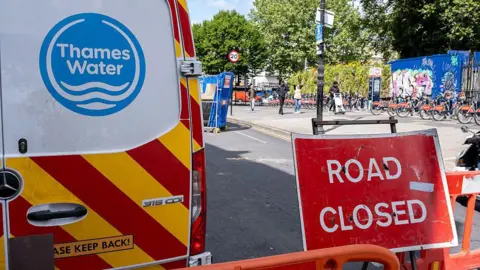
 Getty Images
Ministers have objected to Thames Water's proposed rescue deal, moving the UK's largest water company closer to public ownership.
Environment Secretary Emma Reynolds has written to regulator Ofwat raising concerns about a £10bn deal put forward by the company's lenders.
Thames Water has been trying to stave off financial collapse for the last three years as it struggles under billions of pounds of debts.
The company, which serves about 16 million people across London and southern England, is also struggling to fix leaks, stop sewage spills and modernise outdated infrastructure.
Could Thames fall under government control?
Thames Water's main group of lenders - known as London & Valley Water - has put forward a rescue plan that would involve injecting billions in fresh investment.
Without it, Thames Water is set to run out of cash within a matter of months and could face financial collapse.
The deal would also involve writing down about half of the company's £20bn debt pile, but in return the lenders want leniency from future pollution fines.
But on Tuesday, Reynolds said she was concerned that the offer "does not do enough to protect consumers or the environment".
It raises the chances of Thames Water falling into a form of temporary nationalisation known as a special administration regime (SAR), where it would be kept running by government-appointed managers.
If the firm does go bust, households will still have drinking water and sewerage services.
Why do some people want it to happen?
Proponents of public ownership say it would give Thames Water a fresh start, allowing it to write off some of its debts and get a new long-term owner.
In April, an investor that wants to buy Thames Water said it would prefer temporary nationalisation because it would make it easier to buy.
Thames Water has pushed back strongly against that prospect, instead favouring a "market-led solution".
The lenders have previously said a SAR would not solve its problems and will only "restart the process of fixing Thames Water".
If the company did collapse, they would be likely to lose out on much of the value of what they are owed.
The government has previously favoured a commercial deal, but on Tuesday Reynolds said it "stands ready for all eventualities".
What does all this mean for customers?
No matter who eventually owns or runs Thames Water, customers will see no impact on their services. Taps will still run and toilets will still flush.
However, Thames has said it needs to increase its bills to fix its ageing infrastructure, with the average annual bill set to rise sharply until 2030.
London & Valley Water has said the proposed rescue deal would hold bills at that level rather than pushing them higher still.
A spokesperson for the group claimed its proposal was "the fastest route to improve outcomes for customers and the environment".
But Reynolds said on Tuesday that she did not want a scenario where Thames Water customers had to "pick up the bill for the company's failures".
Thames Water has said a commercial deal remains the "best way to secure the long-term stability needed to continue improving performance and advancing our turnaround plan".
How did Thames end up looking for a rescuer?
Many UK water companies have large debts, but Thames Water's problems are the worst.
When Thames was privatised in 1989, it had no debt. But over the years it borrowed heavily and its total debt has spiralled beyond £20bn.
Its debt pile increased sharply when Macquarie, an Australian infrastructure bank, owned Thames Water, with debts reaching more than £10bn by the time the company was sold in 2017.
Macquarie said it invested billions of pounds in upgrading Thames's water and sewage infrastructure while it owned the company.
But critics argue that it took billions of pounds out of the company in loans and dividends.
In May last year, Thames was handed the biggest ever fine issued by Ofwat after it was deemed to have "let down its customers and failed to protect the environment".
How can I save money on my water bill?
Who actually controls Thames Water now?
Until 2024, Thames Water was controlled by a group of pension funds and investment firms, but many wrote down their stakes to zero that year.
The move indicated that they believed their shares were worth nothing.
It has left Thames effectively in the control of its lenders, a group of finance firms that it collectively owes billions of pounds.
They include the US hedge funds Elliott Management and Silver Point Capital, as well as financial institutions in the UK such as Aberdeen Investments and M&G.
The group failed to sell the company in 2025 after KKR, a US private equity giant, pulled out of plans to buy it, forcing them to draw up the latest rescue deal.
Why was Thames Water privatised?
The entire water and waste sector was privatised under Margaret Thatcher's Conservative government. At the time, Thatcher wrote off the industry's £5bn debt, leaving companies with a clean slate, and gave them £1.5bn in public money.
At the time, the UK was under pressure to meet European water quality standard standards. Thatcher wanted the billions of pounds of investment need to do this to come from the private sector and, by extension, companies' customers.
"If we want environmental improvement, it will cost money," said Mrs Thatcher in 1988. "It will be the people who want those improvements in water who will have to pay."
However, critics say that privatisation has not worked, arguing water firms have taken on too much debt while failing to invest in infrastructure.
Thames WaterWater pollutionCompanies


