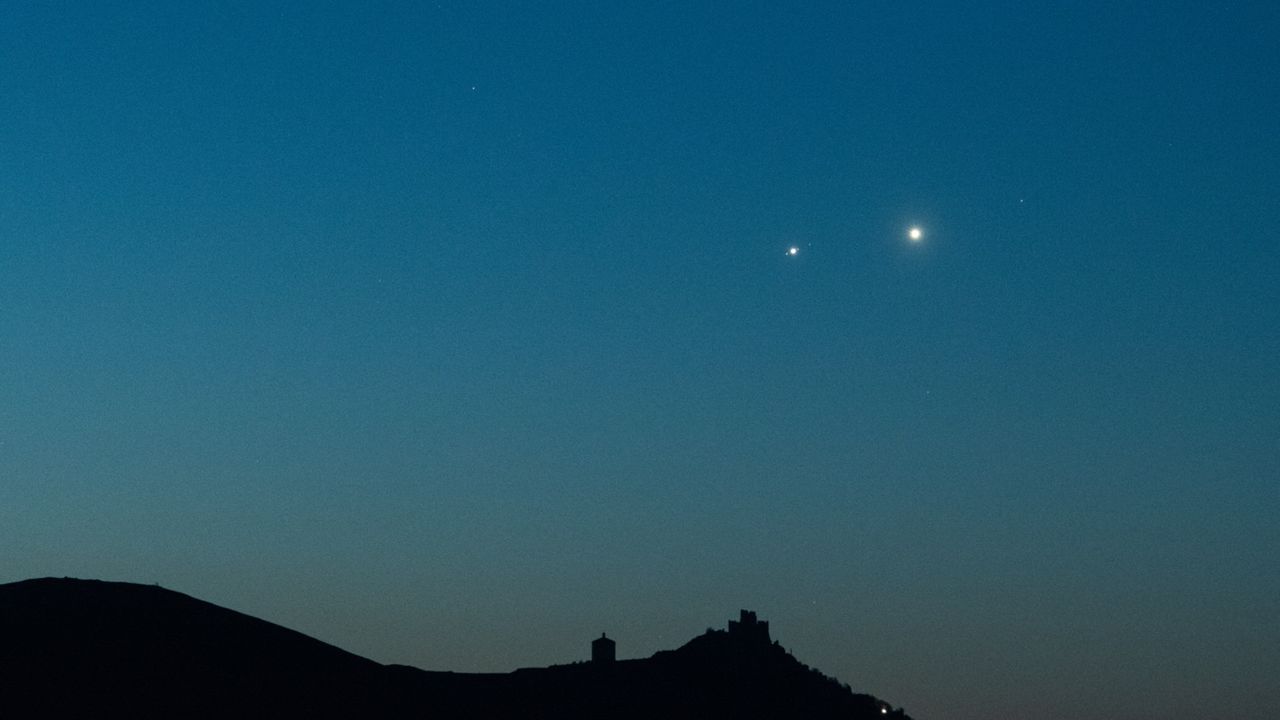
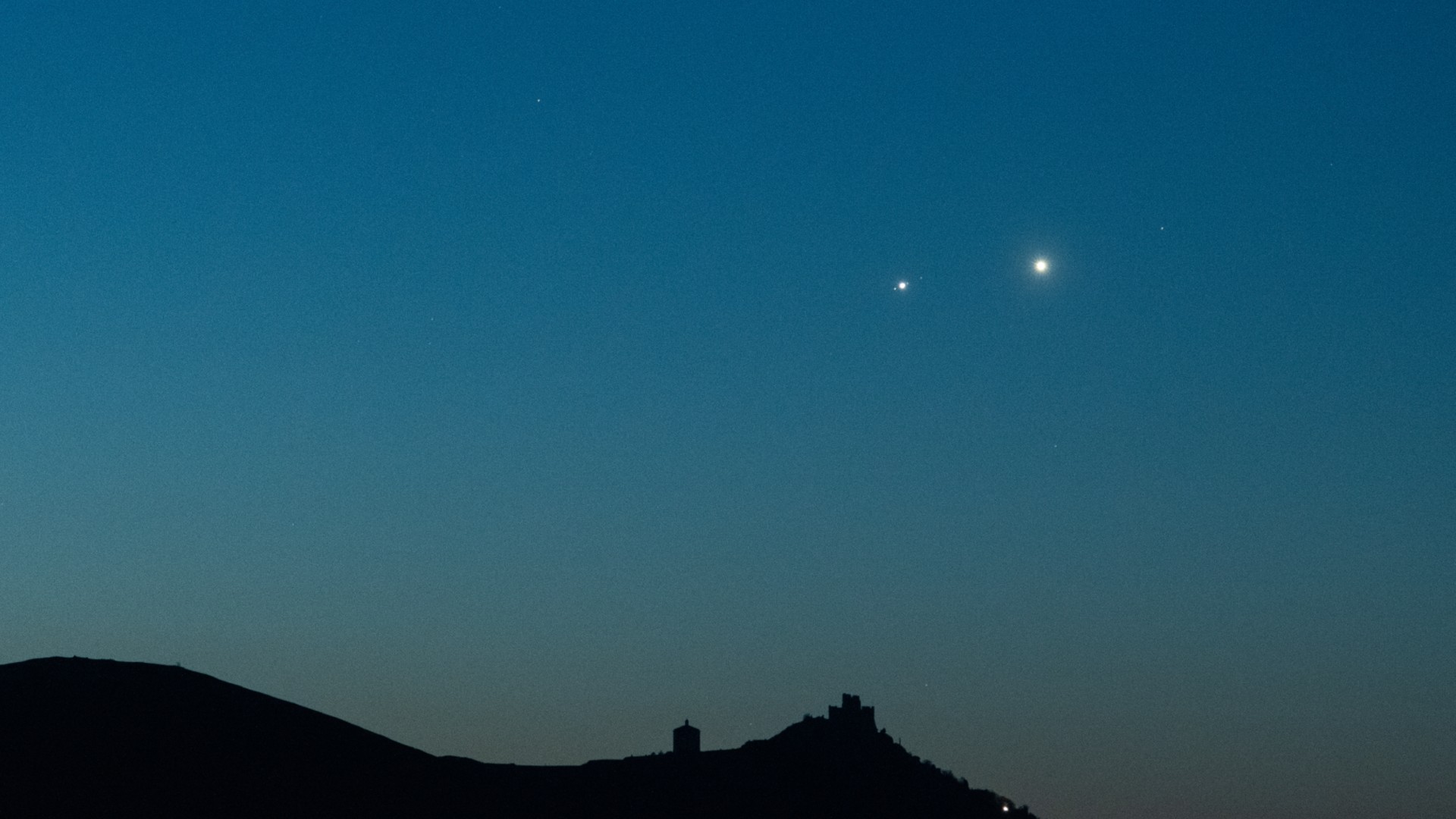
 Jupiter and Venus approach conjunction behind Rocca Calascio castle in Italy on April 30, 2022. (Image credit: Lorenzo Di Cola/NurPhoto via Getty Images) Share this article 0 Join the conversation Add us as a preferred source on Google Newsletter Subscribe to our newsletter
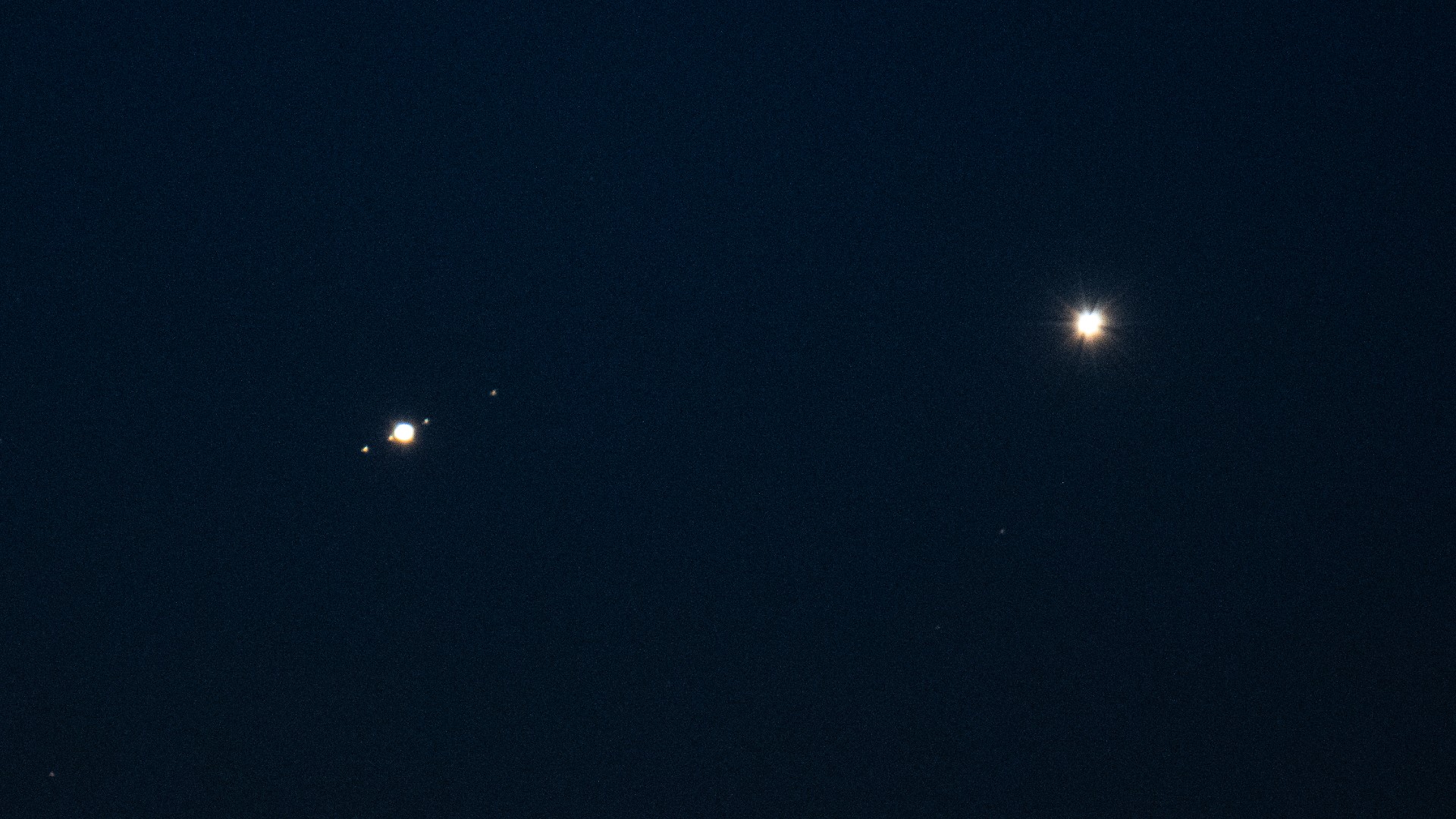
 Shortly after sunset on June 9, Venus and Jupiter will look very close together, in what is known as a planetary conjunction.
Sunlight will reflect off the cloudy tops of Venus and Jupiter before journeying millions of miles to enter Earth's sky in almost the same place, making the planets appear very close to one another on Tuesday (June 9). But in reality, the two planets will be separated by at least four Earth-sun distances in space.
A conjunction between Jupiter and Venus also happened just ten months ago, in August 2025. Before that, in May 2024, preceded by March 2023. Its occurrence roughly once every year is a sign of a wonderful arrangement of planets that may be absent around other stars. And as it turns out, the conditions that set Venus and Jupiter up for their conjunction are the same that are critical for life to survive on Earth.
'Pie' in the sky
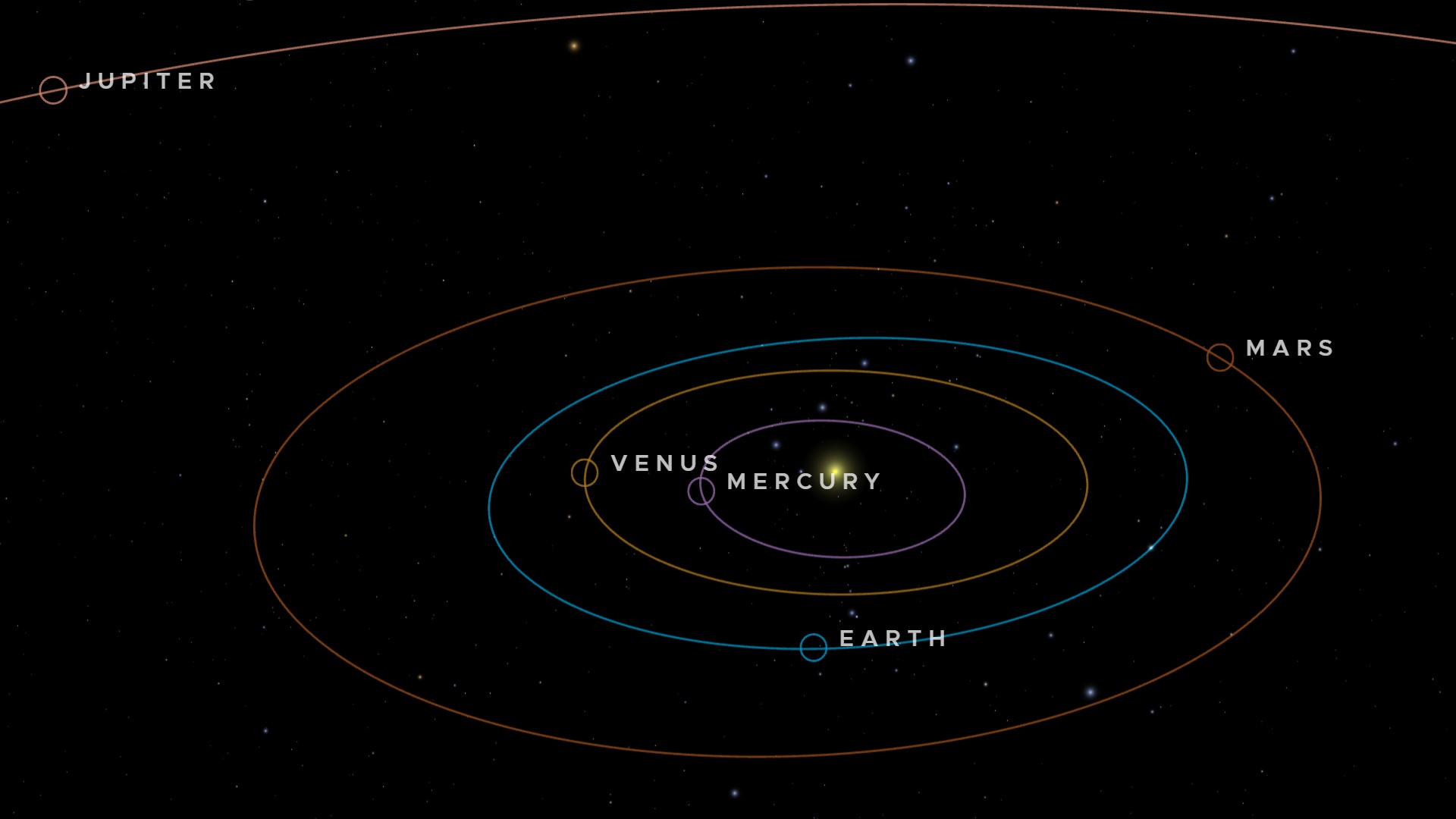
Thanks to the explosion of exoplanet discoveries over the past decade, planetary scientists like Kat Volk, who works at the Planetary Science Institute in Tucson, Arizona, know there are many distant worlds taking wonky and puffed-up loops around their parent stars. But the solar system is more like a pie of pizza.
The flat-disk shape means that, although the sky is a huge dome above our heads, the planets can only appear in part of it.
Venus, Jupiter, and their planetary siblings travel in almost concentric circles around the sun. That means that the planets appear just a handful of degrees above or below the sun's apparent path through the sky, called the ecliptic. (The ecliptic is really the Earth's orbital plane, but from our perspective it appears as though the sun is in motion.)
The Earth's orbital plane is only tilted a little relative to the average plane of the solar system, called the invariable plane, Volk tells Space.com.
"That's why, as we're watching them in the sky, they're all kind of following a path along the ecliptic plane."
It's all reflective of how the sun and the planets formed, said Volk.
"When the sun was being born out of some cloud of gas and dust, it was collapsing down to form the star. Then, angular momentum caused the material surrounding that [star], that didn't make it into the sun, to form a disk that is rotating and orbiting around the star. The really massive bodies in the solar system — the planets — tended to form within that disk," said Volk.
But no two stars are the same. Some systems deviate significantly from this proto-structure. "If there's another Earth out there, there's no guarantee that the observers on that 'Earth' would see the same kind of nice ecliptic plane that we see in our solar system."
Our cosmic neighborhood is flat and relatively circular, but that is not universal. "The sun isn't by itself in the galaxy," said Volk. "A lot of stars form in clusters. Sometimes stars actually interrupt and interact with each other," which could boot baby planets into a "wider range of inclinations."
Larger planetary tilts may have happened in the ancient past to our solar system. But after the gas giants migrated from nearer to the sun to the cold reaches they inhabit today, the inner planets and the remaining mass of small bodies like comets and asteroids likely helped to balance out their orbits.
As a result, Earth gets to inhabit what's known as a "dynamically cold" configuration. The planets coast past one another on the ecliptic, and appear to us to nuzzle one another every so often.
The planetary dance and life on Earth
These celestial musings are a symptom of a solar system that supports life on Earth. Orbital dynamics control the distance a planet is from the star, and how stable the planet will be throughout its trip.
Exoplanets with orbits tilted with respect to their invariable plane could disrupt the rest of their system. They could perturb the circular and flat configuration that supports worlds like Earth that have water — an essential ingredient for life as we know it — and the 'Goldilocks' distance year round from a star.
"If our planet's orbit was really elongated, you'd have different intensities with sunlight throughout the year. That would be an additional complication on the climate," said Volk.
"Orbital dynamics allows you to start to think about all those fun, different aspects of what makes our planet habitable, and ask how normal it is to have a habitable planet."
View MoreYou must confirm your public display name before commenting
Please logout and then login again, you will then be prompted to enter your display name.
Logout Doris Elin UrrutiaContributing Writer
Doris is a science journalist and Space.com contributor. She received a B.A. in Sociology and Communications at Fordham University in New York City. Her first work was published in collaboration with London Mining Network, where her love of science writing was born. Her passion for astronomy started as a kid when she helped her sister build a model solar system in the Bronx. She got her first shot at astronomy writing as a Space.com editorial intern and continues to write about all things cosmic for the website. Doris has also written about microscopic plant life for Scientific American’s website and about whale calls for their print magazine. She has also written about ancient humans for Inverse, with stories ranging from how to recreate Pompeii’s cuisine to how to map the Polynesian expansion through genomics. She currently shares her home with two rabbits. Follow her on twitter at @salazar_elin.