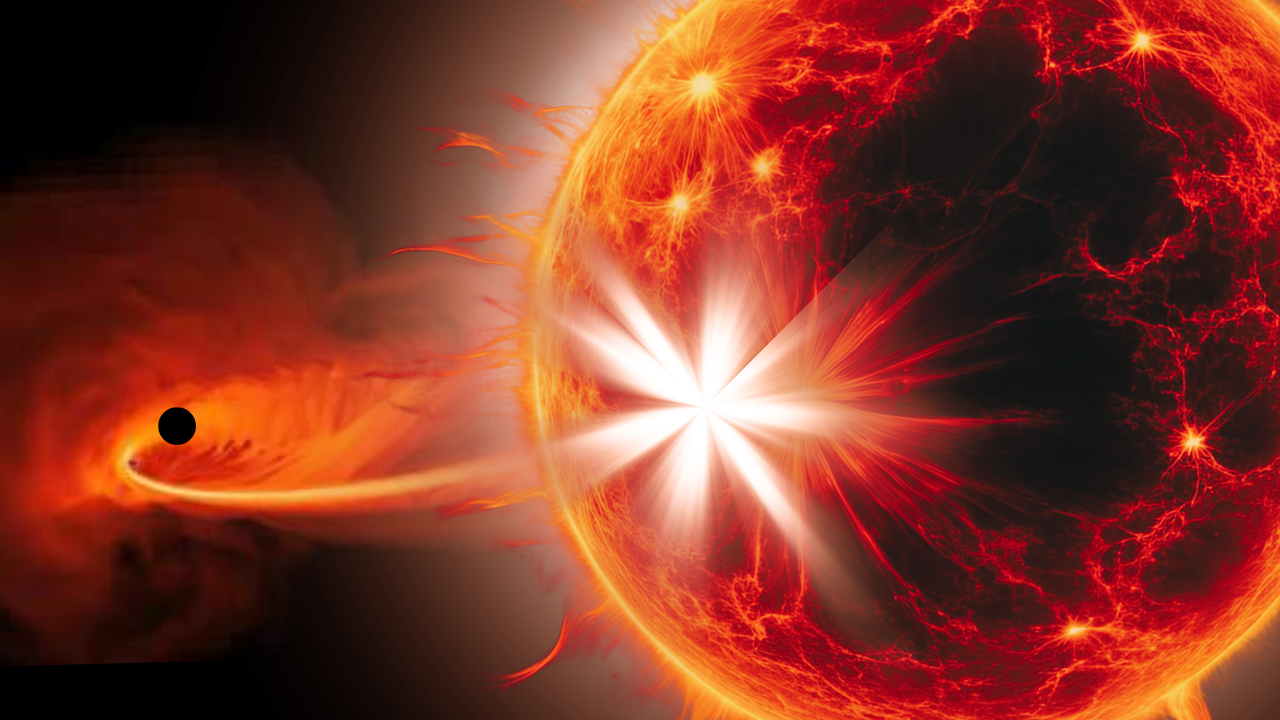
Some stars encounter supermassive black holes and live to tell the tale. New research shows why the flares these encounters cause dim over repeated episodes, and it may be down to the way these stars spin and an escaping binary partner that leaves them to be a stellar snack for a black hole.
Some stars are unfortunate enough to encounter the supermassive black holes that sit at the heart of every galaxy, being subjected to immense tidal forces that turn them into a strand of stellar spaghetti, a process called "spaghettification." This plasma pasta wraps around the black hole and is gradually fed to it, with some former star stuff being ejected as near-light-speed jets. These occurrences are called tidal disruption events (TDEs).
However, other stars get a reprieve, passing close enough to a supermassive black hole for the cosmic titan to take a bite and strip off material, but not close enough to be fully destroyed. As the star orbits the supermassive black hole, it takes repeated "bites," with this stellar snacking called a repeating partial tidal disruption event (rpTDE).
Each incident causes a flare of light from the vicinity of the black hole, as would be expected from the brightening seen during a standard TDE. But a strange pattern has emerged in rpTDES; each successive flare can become dimmer. Scientists have struggled to explain this dimming for some time, but finally a team of researchers from Syracuse University may have solved this puzzle.
To reach an answer to black hole flare dimming, the team considered a factor that hadn't been thought of before: the spin of the star itself. This element explained the dimming of black hole flaring and also helped to explain why not all rpTDEs play out the same. "We were puzzled by this for two years," team leader Ananya Bandopadhyay of Syracuse University said in a statement.
A new spin on stellar snacking
Bandopadhyay and colleagues previously determined that how much material a star loses during repeated rpTDE episodes depends partially on its internal structure, which in turn depends on its mass.
Bandopadhyay compares a low-mass star to a fluffy meringue, which makes it more susceptible to the tidal forces generated by the black hole, allowing more material to be stripped from deeper within the star.
In contrast, a high-mass star has a structure more like an onion. That means that when such a stellar body buzzes a black hole in a rpTDE, its outer layers are stripped, but its core resists the influence of the black hole. Thus, as that outer layer is whittled away, there is less and less material to be stripped away in subsequent episodes. However, that alone can't fully account for the dimming of flares from four of the ten currently discovered rpTDEs, because of the influence the black hole has on the star as it passes.
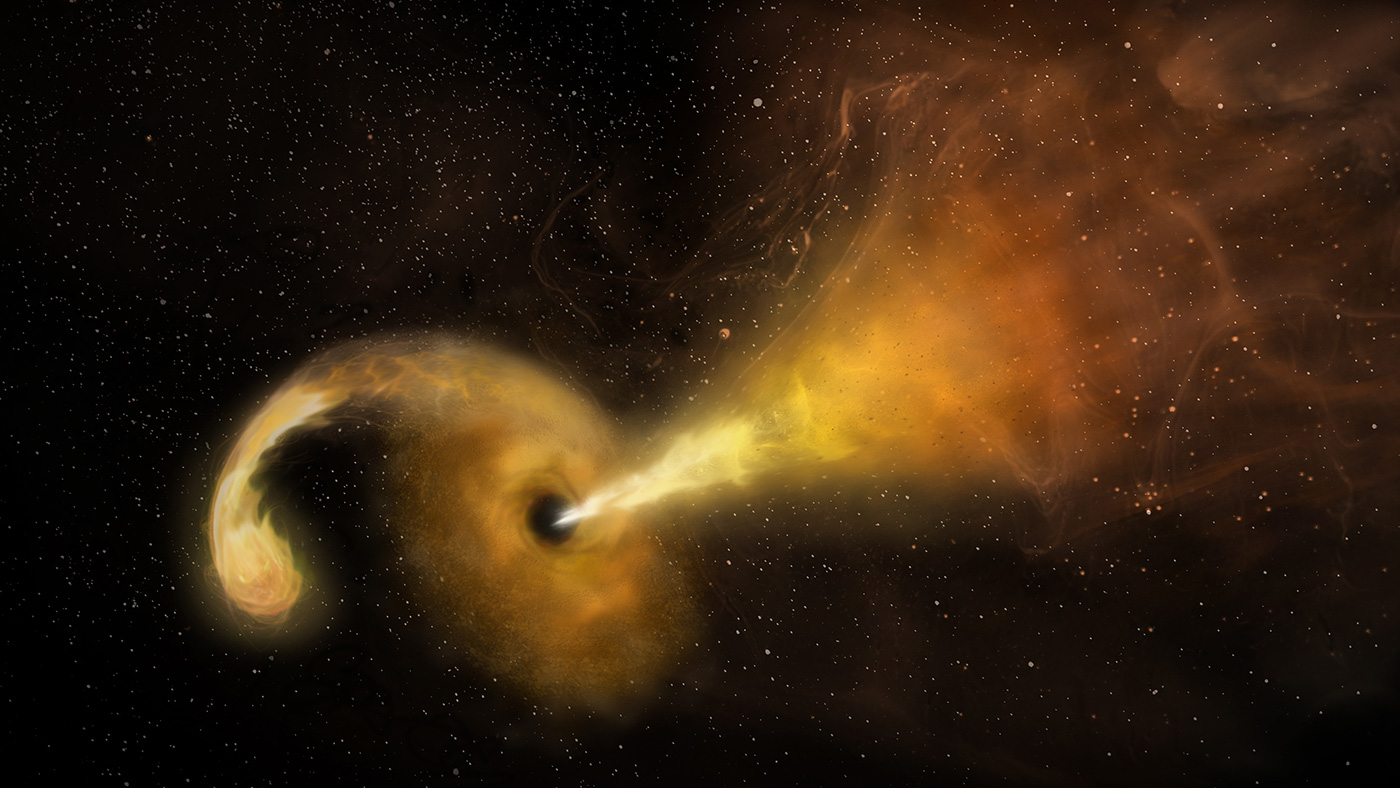
The team's prior work had identified that during rpTDEs, supermassive black holes exert a torque on the passing star that causes the star to spin faster during each passage.
That means even though less material falls to the black hole during each passage, the star returns over shorter and shorter periods of time. That helps keep flaring consistently bright. Thus, a recipe for dimming requires a new ingredient. Bandopadhyay determined that this element could be a star that was already spinning rapidly before its first encounter with a supermassive black hole.
If a star is already rapidly spinning when it first encounters a black hole, the torque experienced doesn't increase that spin much. And without that increase in spin, there is no shortening of periods between episodes, meaning less and less material being stripped would result in dimming. Of course, that leaves another question: why would a star be spinning so rapidly in the first place?
Rogue stars could be the answer
The key to this mystery could lie in the fact that most stars don't orbit the centers of their galaxies where supermassive black holes dwell alone, instead existing in binary partnerships. "It is also extremely difficult to 'bind' a star to a supermassive black hole so tightly that it orbits the black hole in a matter of months, and yet they seem to do so in rpTDEs," team member Eric Coughlin of Syracuse University said. The loss of a partner star, could cause a stellar body to be tightly bound to a supermassive black hole, completing an orbit once every few months.
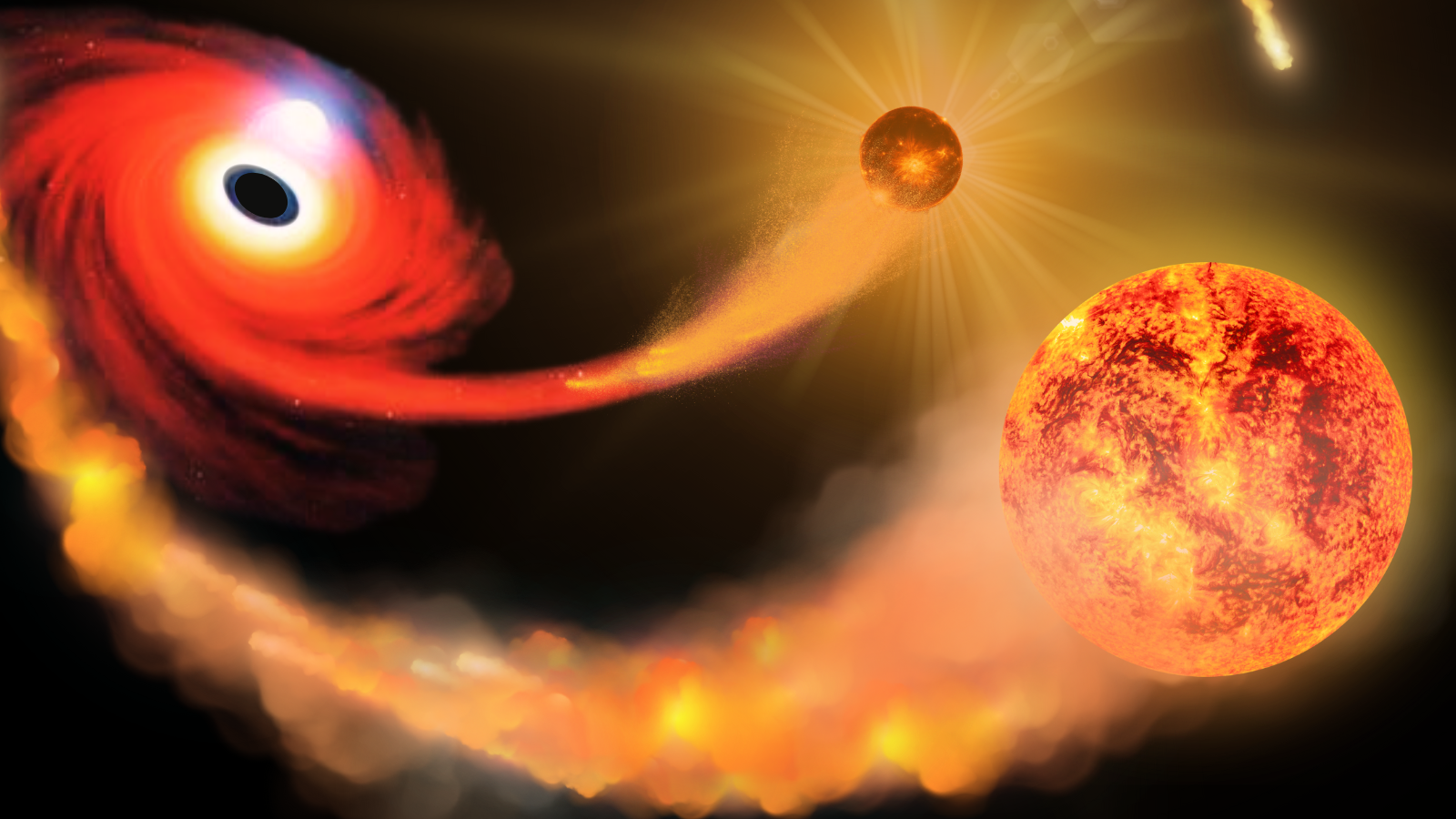
During a process called Hills capture, as a stellar binary orbits a supermassive black hole and the gravitational influence of the black hole rips the binary apart, ejecting one star while capturing the other.
If this stellar binary was particularly tight, with the stars closely orbiting each other, this ejection and capture process could leave the trapped star rapidly spinning on a tight orbit. "This work demonstrates that each of these peculiarities can be explained by the same underlying phenomenon: the tidal destruction of a binary system and the capture of one of the stars," Coughlin said. "From a theoretical standpoint, this is a major step forward in our understanding of the physics at play in these systems." The discovery may have implications closer to home too. Though the supermassive black hole of the Milky Way, Sagittarius A* (Sgr A*), isn't currently involved in a rpTDE, it is orbited by many rapid stars. These findings may explain how they came to be there. The team's research was published on August 18 in The Astrophysical Journal.


