
 Reuters
For decades, Canada was seen as a global laggard in defence funding, and just two years ago, recruitment was so dire that a former defence minister warned the armed forces were in a "death spiral".
Now, the Canadian army is growing at a pace not seen in decades, reaching its highest number of recruits in 30 years and potentially reversing the chronic personnel shortage that has plagued the country's military.
The boost over the last two years comes as the world grapples with major armed conflicts and geopolitical uncertainty, and as Canada commits billions in new military funding after years of falling short of its Nato obligations.
It also coincides with an uncharacteristic rise in nationalism that has emerged since US President Donald Trump referred to Canada as the "51st state" - remarks that many viewed as a threat to the country's sovereignty from its closest neighbour.
Charlotte Duval-Lantoine, a fellow at the Canadian Global Affairs Institute who researches Canada's military culture, said that while there may be a "Trump effect" behind the recent rise in enlistment, military applications had already begun spiking in 2022, around the time of Russia's invasion of Ukraine.
"When people see that the world is not as safe, that their country might be at risk… we tend to see people join the military," she said.
Global conflicts are not the only factor driving the increase. Canada's high youth unemployment rate - which hovered at nearly 14% in March - as well as the promise of job security and higher wages after Prime Minister Mark Carney announced the largest pay increase for military personnel in a generation, are also a factor, Duval-Lantoine added.
On patrol with Canadian forces securing the Arctic as global threats grow
Stuck between the US and Russia, Canada must prove it can defend its Arctic territory
Since taking office last year, Carney has made the military a focus of his government, with a self-described "ambitious" plan to rapidly modernise and expand the Canadian Armed Forces.
In March, he announced that Canada had officially achieved the Nato target of spending 2% of its GDP on defence for the first time since the late 1980s, amounting to over C$63bn ($46bn; £34bn) in a single year. Carney also joined the Nato pledge to spending up to 5% of GDP on defence by 2035.
Canada reached that 2% milestone by increasing salaries, as well as pledging to buy new equipment, upgrade existing bases and build new infrastructure in the Arctic.
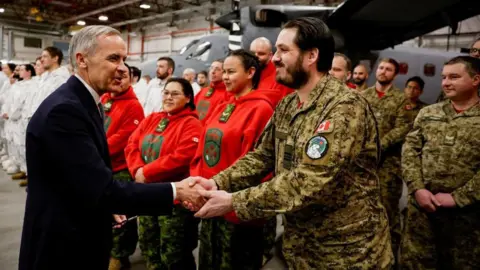 ReutersCanada reached its Nato defence spending target this year for the first time since the 1980s, thanks to a boost in military funding by the Carney government
But even with the new recruits, analysts say Canada's military still lags significantly behind its allies, and caution that it may take some time before funding translates into improvements.
Richard Shimooka, a senior fellow at the Macdonald-Laurier Institute, a public policy think tank, said the Canadian Armed Forces currently have the capacity to deploy only a few thousand soldiers at a time, along with a limited number of fighter jets. By comparison, the UK military can deploy 10,000 troops if necessary, he said.
"The state of the Canadian Armed Forces is currently at a very low point, and it will take five or 10 years before you start to see a real upswing," Shimooka said.
A big reason for this, Shimooka argued, is Canada's historic overreliance on the US - its neighbour and the world's largest military power - for its defence.
Successive US presidents and officials have repeatedly pressured Canada to increase defence spending, and critics have referred to Canada as a military "freeloader". US House of Representatives Speaker Mike Johnson accused Canada in 2024 of "riding on America's coattails".
Last year, Trump singled out Canada as one of Nato's "low-payers", telling reporters in June: "Canada says, 'Why should we pay when the United States will protect us for free?'"
Canada is still among the lowest paying Nato members even after reaching the 2% target, according to report from the defence alliance released last year - behind the US, UK and France.
Less red tape and welcoming foreign nationals
Canada's ability to bring in more recruits is a sign that things may be slowly improving. David McGuinty, Canada's defence minister, said that he believes the country could reach its recruitment goals earlier than projected.
The rate of attrition, or the number of service members leaving the military, has also declined slightly, after being described as causing "a death spiral" by former Defence Minister Bill Blair in 2024.
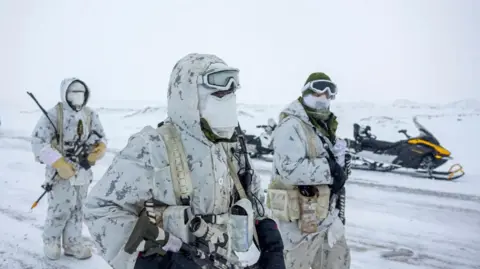
Active service members told the BBC during a recent Arctic sovereignty and security operation in Canada's northern territory of Nunavut that the new funding is welcome and - in some cases - long overdue.
"We're a couple of decades behind, but at least we're trying to do things now," said Alden Campbell, a first officer with the Royal Canadian Air Force. He said the recent pay structure changes have led to a boost in morale, as has the promise of upgraded equipment.
"Hopefully I can be at an age and a time in my career where I can be a beneficiary of these updates," he said.
What does it take to survive in the Arctic? These rangers have an ideaIn late April, the Canadian military announced it had enrolled more than 7,000 new members in the last fiscal year - its highest number of new recruits in three decades.
That figure is a fraction of the total number of people who have expressed interest in joining the military. As of February, confirmed applications to the Canadian Armed Forces had nearly doubled year over year, rising from 21,700 to 40,116, according to figures shared with the BBC by Canada's Department of National Defence.
Those numbers reflect applicants who submitted the required documents to confirm their eligibility. The total number of applications was far higher, reaching nearly 100,000 over the past year.
It is a big jump from 2019-20, when around 36,000 people had applied.
Travis Haines, a lieutenant colonel in the Canadian Armed Forces, told the BBC he believes the boost in recruitment is in large part tied to the military reducing bureaucratic hurdles.
Canada's military has long been criticised for its inability to review and bring applicants on board quickly, and it has recently digitised some application elements - including allowing the submission of documents electronically - to speed up the process.
"There was always interest," Haines said. "It was just hard to get through the system."
Another significant recruitment change in recent years is the opening up of applications to permanent residents of Canada, rather than just citizens - a change that came into effect in 2022. Foreign nationals made up around 20% of last year's new recruits.
Canada is now eyeing a major expansion of its military, with plans for a total of 85,500 regular service members and a mobilisation force of up to 300,000 reservists.
Duval-Lantoine said Canada has not pursued a mobilisation plan on this scale since 2004 - a sign the country is reckoning with the ongoing war in Ukraine, which she noted has endured in large part because of Ukraine's military manpower.
Canada, like its European allies, is trying to prepare "for future wars by analysing the current one", she said.
War in UkraineMilitaryMark CarneyCanada