 Image source, Getty ImagesImage caption,
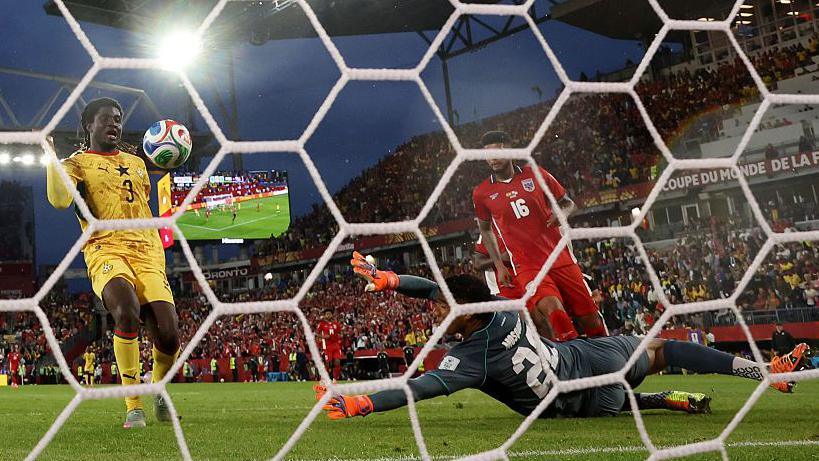
 Caleb Yirenkyi scores Ghana's 95th-minute winner against Panama in Toronto
ByMohamed MoallimBBC Sport Journalist- Published21 minutes ago
As the clock ticked towards the final quarter hour of Switzerland's match against Bosnia and Herzegovina, the two teams were locked in a stalemate.
Then everything changed. Substitute Johan Manzambi came off the bench and needed only three minutes to score.
By the final whistle he had two goals, Switzerland had scored four times after the 70th minute, and Bosnia became only the third team in World Cup history to concede four or more goals from the 70th minute onwards.
It was an extreme example of a trend that has emerged across World Cup 2026.
Of the tournament's 96 goals so far, 28 have arrived between the 76th minute and full-time. That represents 29.2% of all goals scored, making the final 15 minutes - including stoppage time - comfortably the most productive period of matches.
The next-highest scoring window has been the period immediately before half-time, with 19 goals scored between the 31st minute and the interval.
Nor is the phenomenon confined to a handful of teams. Twenty nations have already found the net during the final quarter hour and second-half stoppage time, with Switzerland's three goals the highest tally recorded by any side in that period so far.
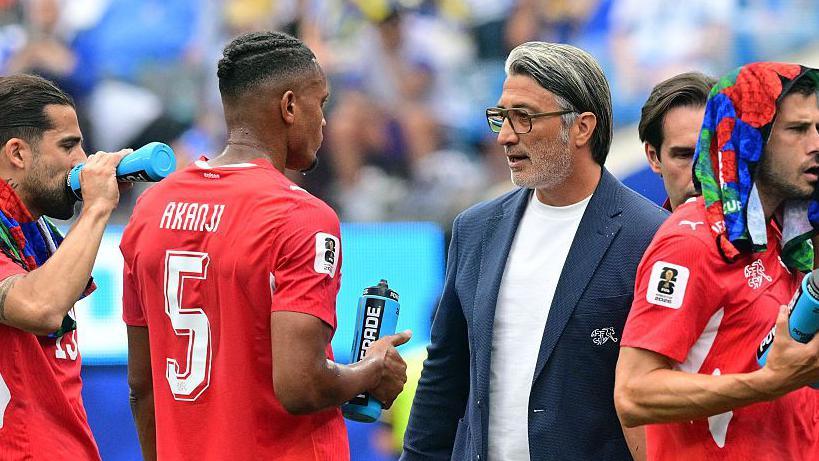 Image source, Getty ImagesImage caption,
 Switzerland manager Murat Yakin made decisive changes during a cooling break
An intriguing subplot is the timing of those goals. Fifa introduced mandatory hydration breaks at approximately the 22nd minute of the first half and the 67th minute of the second to help players cope with summer conditions across the United States, Canada and Mexico.
Coincidence or not, the tournament's two most productive scoring periods have both come in the aftermath of those stoppages. Establishing a direct causal link is difficult, but the pattern raises an interesting question: are Fifa's hydration breaks helping create the conditions for goals as well as preventing the effects of heat?
The policy has attracted some criticism given that the breaks remain mandatory even at climate-controlled venues. However, regardless of temperature, they provide coaches with additional opportunities to reorganise their teams, adjust their shape and deliver what amount to mini team talks from the touchline. While it would be difficult to establish a direct causal relationship, those tactical resets may be one factor behind the concentration of goals immediately afterwards.
Not a new trend, but an amplified one
Late goals have always been a defining feature of football's biggest tournament.
Across World Cup history, the period from the 76th minute onwards has consistently produced more goals than any other phase of a match. Analysis of previous tournaments shows approximately a quarter of all World Cup goals are typically scored during this window.
Yet the numbers in North America are eye-catching even by modern standards.
At Qatar 2022, 24.4% of goals arrived in the final 15 minutes. The figure was 23.0% in Russia 2018 and 23.9% in Brazil 2014.
The current tournament's figure of 29.2%, after just under one-third of the 104 overall games, is significantly higher.
Only Germany 2006, when 30.6% of all goals arrived in the closing stages, offers a comparable precedent among recent editions.
Fatigue creates opportunities
The most obvious explanation is physical exhaustion.
Defensive organisation requires concentration, communication and constant movement. As players tire, small errors become more frequent. A mistimed tackle, a missed runner or a momentary lapse in judgement can be enough to decide a game at elite level.
Modern football places enormous physical demands on players, particularly during tournaments where recovery time is limited and matches arrive in rapid succession.
By the final 15 minutes, defensive lines are often stretched and spaces begin to appear that simply did not exist earlier in the contest.
For creative attackers, those spaces can be decisive.
The impact of substitutes
Fresh legs have become one of the most powerful weapons in international football.
With teams now able to make five substitutions, coaches regularly introduce pace and attacking energy during the closing stages. Fresh forwards entering the game against defenders who have already spent more than an hour covering large distances creates a significant structural advantage.
Manzambi's performance against Bosnia offered a perfect illustration. His speed, movement and sharpness immediately altered the rhythm of the game. Similar scenarios have unfolded repeatedly throughout the tournament as substitutes have exploited increasingly tired opponents.
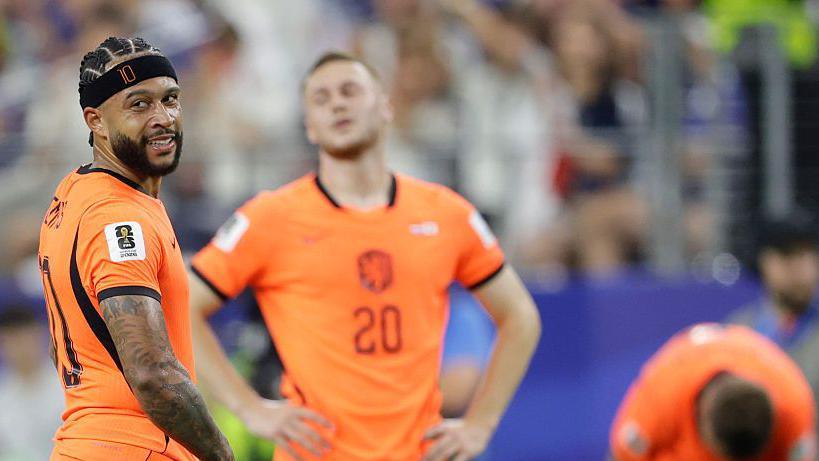 Image source, Getty ImagesImage caption,
 Memphis Depay and Teun Koopmeiners react after Japan's late equaliser in Dallas
Substitutions can also have unintended consequences. The Netherlands appeared in complete control against Japan while leading 2-1 and enjoying 70% possession, only for Ronald Koeman's triple substitution to alter the balance of the contest.
The withdrawal of wide threats Crysencio Summerville and Donyell Malen reduced the Dutch ability to stretch Japan's back line, allowing Hajime Moriyasu's side to push higher up the pitch. Dutch possession dropped sharply after the changes and Japan's late pressure was eventually rewarded when substitute Koki Ogawa's header went in off Daichi Kamada for an 88th-minute equaliser.
The contrasting examples underline the growing importance of the bench. At World Cup 2026, substitutions are not merely changing personnel; they are increasingly changing matches.
Chasing games changes everything
Tactics also play a major role.
A team leading by a single goal often attempts to protect its advantage. A team trailing by a goal frequently abandons caution altogether.
Full-backs push forward. Midfielders take greater risks. Centre-backs venture forward for set-pieces. Defensive balance is sacrificed in pursuit of an equaliser.
Those decisions increase the likelihood of goals at both ends.
The attacking team creates more chances, but also leaves larger spaces behind for counter-attacks.
Many of the tournament's late goals have emerged from precisely these situations, with matches becoming progressively more open as the final whistle approaches.
More added time than ever
Another factor may be the changing nature of stoppage time itself.
In previous decades, referees often added only one or two minutes at the end of each half. Modern tournaments are different.
Fifa has instructed officials to account more accurately for interruptions, substitutions, injuries and goal celebrations. Additional measures designed to reduce time-wasting have also increased active playing time.
As a result, the period commonly grouped as the "final 15 minutes" now often contains substantially more football than it once did.
Ghana's 1-0 victory over Panama offered a striking example. Although six minutes were initially added, Caleb Yirenkyi's winning goal in the 95th minute and the subsequent stoppages meant the match ultimately extended beyond the 101-minute mark. The 20-year-old's strike remains the latest winning goal of World Cup 2026.
In practical terms, a modern World Cup match can now feature 10 or even 12 additional minutes beyond the 90-minute mark, extending the window in which decisive moments can occur and giving substitutes more time than ever to influence the outcome.
Why fans should keep watching
For supporters, the trend reinforces a familiar lesson: no lead is entirely safe.
Some of the most iconic moments in World Cup history have arrived when the clock appeared to be running out.
Roberto Baggio's rescue act for Italy against Nigeria in 1994, Dennis Bergkamp's unforgettable winner for the Netherlands against Argentina in 1998 and Toni Kroos' stoppage time free-kick to give 10-man Germany three points against Sweden in 2018 are among the most memorable moments to have emerged from football's most chaotic phase.
This YouTube post cannot be displayed in your browser. Please enable Javascript or try a different browser.View original content on YouTubeThe BBC is not responsible for the content of external sites. YouTube content may contain adverts.Skip youtube video by BBC SportAllow YouTube content?
This article contains content provided by Google YouTube. We ask for your permission before anything is loaded, as they may be using cookies and other technologies. You may want to read Google’s cookie policy, external and privacy policy, external before accepting. To view this content choose ‘accept and continue’.
Accept and continueThe BBC is not responsible for the content of external sites. YouTube content may contain adverts.End of youtube video by BBC SportWorld Cup 2026 is proving no different.
If anything, the tournament's opening stages suggest the final whistle has never felt further away.
With nearly one-third of all goals arriving after the 75th minute, the most dangerous period of a World Cup match is increasingly its last.
Related topics
Play BBC Sport's new World Cup predictor game
- Published9 June

World Cup fixtures and group standings

How to watch the World Cup on the BBC
- Published6 June
Everything you need to know about the World Cup
- Published1 April