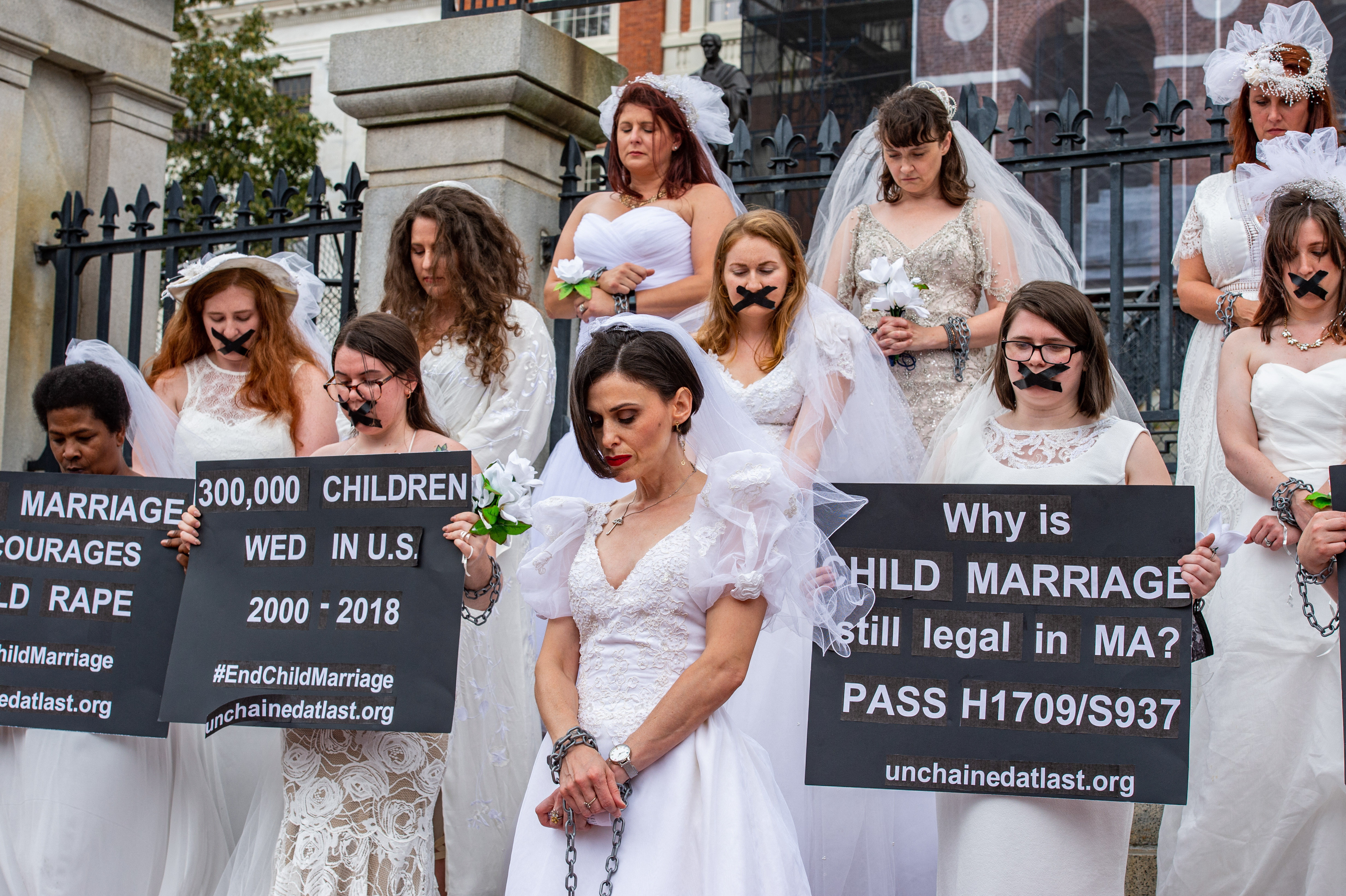
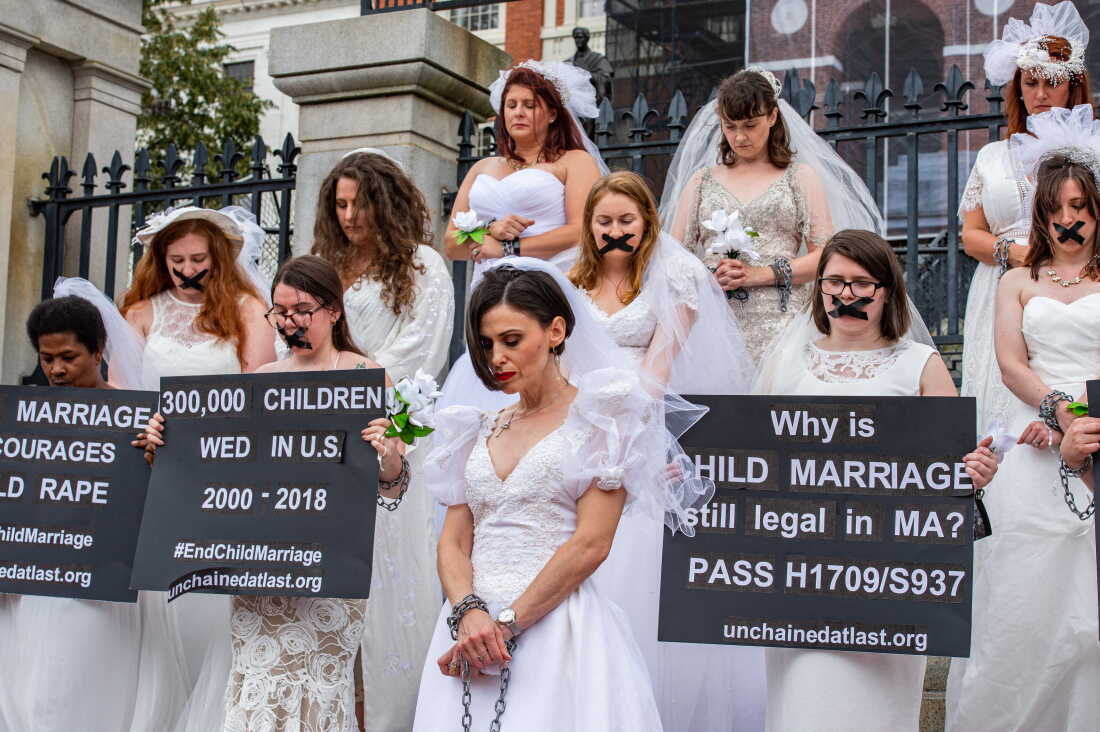
Advocates and child marriage survivors in Boston gather to call for an end to child marriage. Currently more than two dozen U.S. states allow for marriage under the age of 18 under certain circumstances. A new bill up for debate in Congress calls for a national ban. Joseph Prezioso/AFP/via Getty Images hide caption
toggle caption Joseph Prezioso/AFP/via Getty ImagesOur team of global health reporters has covered child marriage –- when one partner is under age 18. The United Nations calls it a "human rights violation," citing a litany of concerns for child brides: "early pregnancy and social isolation, interrupting her schooling, limiting her opportunities for career and vocational advancement and placing her at risk of domestic violence." Yet every year, the U.N. estimates that 12 million girls become child brides.
Child grooms, the U.N. further notes, may be forced into "an adult role for which they are unprepared," with pressure to drop out of school and support a family.
The U.N. has set the goal of ending child marriage by the year 2030.
This year there are new efforts to make child marriage illegal — a bill introduced by U.S. legislators in July and a resolution adopted by the U.N. General Assembly on September 4 establishes November 27 as the International Day to End Child, Early and Forced Marriage. As part of our "Whatever happened to …" series, we asked contributor Kamala Thiagarajan to examine the ongoing effort to end this practice.
Over the next week, we'll be looking back at some of our past global health and development stories to see "whatever happened to ..."
Nations around the world are seeking to meet the U.N. goal of ending child marriage by 2030.
Since 2021, countries as diverse as Sierra Leone, England, the Philippines and the Dominican Republic have been passing legislation to set the marriage age at 18, with no exceptions.
In the United States, the current push for a national law is controversial — some have criticized provisions in the proposed legislation, and others oppose it altogether.
And legislation is not necessarily the solution. In India, marriage under age 18 is illegal, yet the latest National Family Health Survey conducted in country found that one in five women ages 20 to 24 married before turning 18. UNICEF estimates that at least 1.5 million girls under the age of 18 are married in India each year.
The U.S. effort
On July 16, U.S. Rep. Gwen Moore of Wisconsin and Sens. Dick Durbin, Brian Schatz and Kirsten Gillibrand introduced the Child Marriage Prevention Act, a federal bill aimed at combating child marriage.

Goats and Soda
Children Get Married In The U.S., Too: #15Girls
This legislation would push states toward a nationwide minimum marriage age of 18. "In 34 states, including Wisconsin, child marriage is legal. Many of these marriages are between young girls and adult men. It's time we end this predatory practice," Moore said in a statement emailed to NPR. "I know that advocates have pushed for reform at the state level, which has led some states to change their laws. This federal legislation would help bolster and support those efforts, including helping states get the data to understand its prevalence in their jurisdictions and then take action to address it."
In announcing the bill, its four congressional cosponsors cited data showing that more than 314,000 minors were legally married in the United States between 2000 and 2021, including girls as young as 10. The figures, compiled by child-marriage advocacy groups from state marriage records, indicate that most of the underage girls were married to adult men.
Unchained At Last, a nonprofit worked to end forced and child marriage in the U.S., estimates that at least 66,415 of these marriages — about one in five — occurred when the bride was at an age when sexual relations would be considered a crime (the age varies from 14 to 18 depending on the state). In roughly 90% of that subset, according to the organization's founder, Fraidy Reiss, marital exemptions in state statutory-rape laws shielded the adult spouse from prosecution. Married minors may also face legal barriers to hiring an attorney, filing for divorce or obtaining protection from abuse.
The Tahirih Justice Center, an organization with a long history of advocating for survivors of forced and child marriage, has been a key partner in developing and supporting this legislation.
"The one thing we hear all the time from places — Cameroon, Guatemala, you name it — is: 'It makes my work harder when a politician can say to my face, the United States allows child marriage, so why should I do anything?' The best thing that we can do to help the global movement is to get our house in order," says Casey Carter Swegman, director of public policy at Tahirih.
Swegman says that a child's apparent consent does not necessarily mean that the decision to marry was made freely. "A 15-, 16- or 17-year-old who has been pressured and coached by family members may tell a judge that she consents because refusing could expose her to punishment or violence at home," she says. This is especially troubling, Swegman says, when pregnancy, potential evidence of sexual abuse, is treated as justification for allowing the marriage to proceed.
"A child is coming before your court pregnant by an adult person — that should be a red flag for statutory rape, not a green light for marriage," she says.
Although the proposed bill has won support from many child-marriage advocates, others have questioned whether its provisions go far enough and warn of possible unintended consequences that it has overlooked.
"If I could heart a provision of this bill, it would be [the proposal] to provide financial incentive to states that have banned child marriage — that I can get behind," says Reiss. "While I applaud Congress for introducing and considering legislation to combat child marriage at the federal level, I am appalled that two sections of the Child Marriage Prevention Act would make a mockery of the bill's title."
Section 6, she says, would provide federal grants to states to "study" child marriage instead of banning it. "If states are given money to examine something that's a human rights violation instead of banning it outright, it would be devastating," says Reiss, who says she was forced to marry at age 19.
Section 10 would allow some minors as young as 16, whether in the United States or abroad, to qualify for a U.S. spousal visa under certain circumstances. This would actually encourage a particularly heinous form of child marriage, says Reiss: the trafficking of minors to the U.S. under the guise of marriage, and it would discourage U.S. states from setting their marriage age at 18, no exceptions. "If the bill were amended to set the spousal visa age at 18, it would be a 'game-changer' by sending a clear message to states and halting legal trafficking," she says.
And there is opposition to the very idea of the bill. In some states, Oklahoma and Missouri, for instance, Republican lawmakers have opposed state bans on child marriage, arguing that such restrictions constitute government overreach and interfere with parental authority.
In 2024, in an interview with the Missouri Independent, Republican state Rep. Dean Van Schoiack called a proposed ban "government intrusion in people's lives." Asked what would be lost if 16- and 17-year-olds could no longer marry, he replied, "Liberties that people currently have."
How the U.S. bill compares to other global efforts
As Congress prepares to debate the U.S. bill this fall, other countries have already adopted more sweeping national restrictions. The Prohibition of Child Marriage Act 2024 in Sierra Leone sets 18 as the minimum age of marriage without any exceptions for parental consent, religious marriage or pregnancy. Section 15 declares that any child marriage contracted after the Act took effect to be void. The legislation even penalizes people who facilitate or attend a child marriage.
In November 2024, Columbia, where 23% of girls are married before they're 18, passed a law banning such marriages outright. In a similar move, on Sept. 25, 2025, Bolivia banned child marriage without exceptions, removing provisions allowing 16- and 17-year-olds to marry with parental consent or judicial approval.
But laws are not always a solution. In many countries in sub-Saharan Africa and in India, there are national laws banning child marriage but weak enforcement often limits their effectiveness.
"In countries like India, child marriage persists despite strong laws due to deeply ingrained cultural factors, making solutions very complex," says Renu Singh, executive director of Young Lives India, a research program that studies how poverty and inequality shape children's lives as they grow into adulthood.
The Young Lives study began in 2002, in India, Ethiopia, Peru and Vietnam.
In India, Young Lives has followed 3,000 children in the southern Indian states of Andhra Pradesh and Telangana — from childhood into their late 20s. Researchers have repeatedly interviewed them and their families about education, health, employment, marriage, fertility, household circumstances and personal aspirations. They found that many of the children they'd followed married early.
Working with India's National Commission for Protection of Child Rights, they analyzed 2011 Census data to map child marriage at the state and district levels. That research reported 12.1 million marriages involving people below India's respective legal marriage ages (21 for boys and 18 for girls) and identified hotspots that could help the government target interventions.
"We found that there were so many varied and complex reasons driving these marriages," says Singh. "It wasn't just low-income groups who got their children married off." Some parents, she says, who were deeply concerned about the safety of an unmarried daughter, saw marriage as a security net. Young Lives found that girls with older brothers were more at risk of being married early because of the social custom of giving dowries — when the bride's family gifts the bridegroom's family money at the time of marriage. In a household with a boy and a girl, the girl was married especially early, so that her older brother could get married too.
"Boys were often married off early as well, especially if the family wanted to get dowries for their sons to offset the financial losses they faced when they gave their own daughters away in marriage. And this was the case across all income groups," says Singh.
India's national law has helped establish that child marriage is unacceptable and punishable, Singh says — but lasting change also requires communities to stop accepting and supporting the widespread practice.
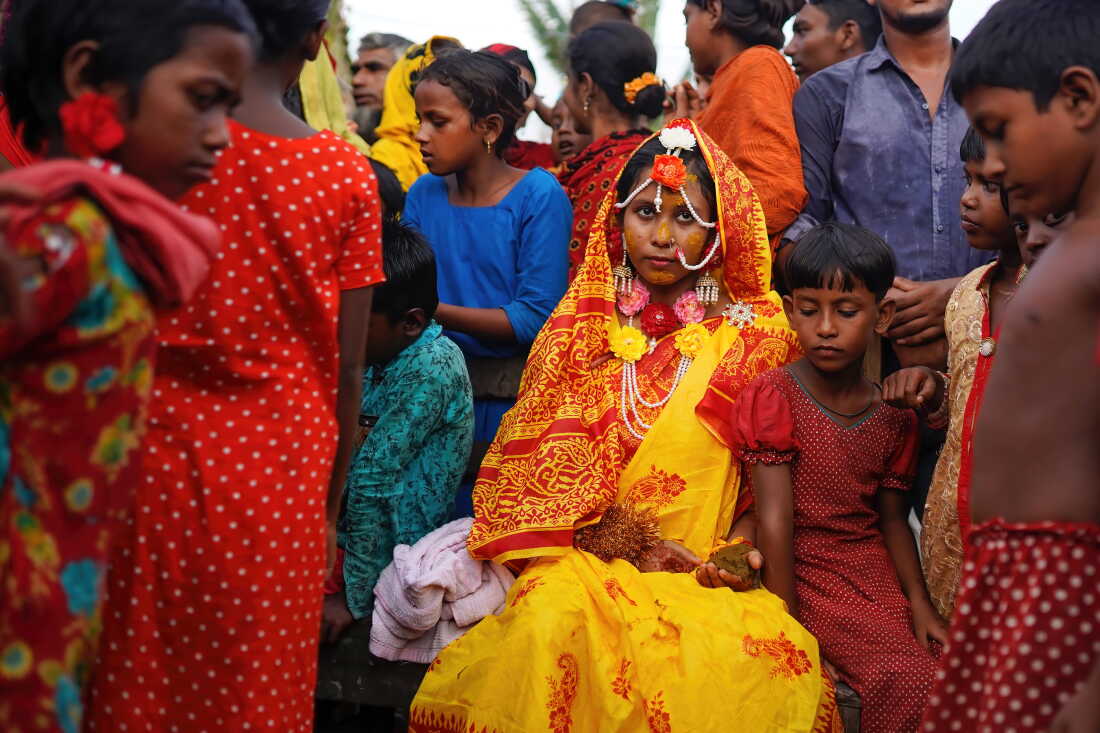
Although India has laws forbidding child marriage, there are many thousands of child marriages each year. Pictured: A 14-year-old on her wedding day. Sultan Mahmud Mukut/SOPA Images/LightRocket/via Getty Images hide caption
toggle caption Sultan Mahmud Mukut/SOPA Images/LightRocket/via Getty ImagesNPR has reported on how this practice unfolds in India: "Our parents just hold the weddings in secret," a 16-year-old told our correspondent. "At night - very rushed." Our story continues: "She was married when she was 9 years old. A bunch of other girls nod. They were all married around that age, too. A shy girl in a pink T-shirt says she didn't even understand what was happening at the time."
For legislation to be effective, Singh says, parents, relatives, religious leaders and others must no longer regard an early marriage as normal, protective or beneficial for a girl.
"The U.S. also has major issues with deeply entrenched gender roles, with patriarchy, with extreme — I would say almost obsession over the control of female sexuality. These are the [reasons] the social pressure for this practice continue," says Swegman. In addition to a national law, it's clear that attitudes must change too. "This requires belief and behavior change, services, support, thoughtful conversations on the community level," says Swegman.
The campaign for stronger laws in the United States is a part of a growing international effort to move child marriage higher up the global political agenda.
One of the key figures behind the U.N. resolution declaring a day "to end child, early and forced marriage" is Bhuwan Ribhu, a lawyer and the founder of Just Rights for Children, a child rights network. Just Rights for Children has filed 60 Public Interest Litigations in India that would reframe child marriage as child rape, securing legal protections for the young women.
"Establishing an official International Day to End Child, Early and Forced Marriage gives us an annual platform to hold governments accountable and enforce laws that protect children. Now is the time to build on this commitment and end child marriage by 2030. Today, the world has spoken in one voice: the crime of child marriage must end," Rhibu says.
Kamala Thiagarajan is a freelance journalist based in Madurai, South India. She reports on global health, science and development and has been published in The New York Times, The British Medical Journal, the BBC, The Guardian and other outlets. You can find her on X: @Kamal_t.
For stories about life in our changing world, subscribe to NPR's Global Health newsletter.
NPR does not offer or accept money for coverage or interviews. Anyone who makes such an offer or request is not an NPR employee and does not represent NPR.