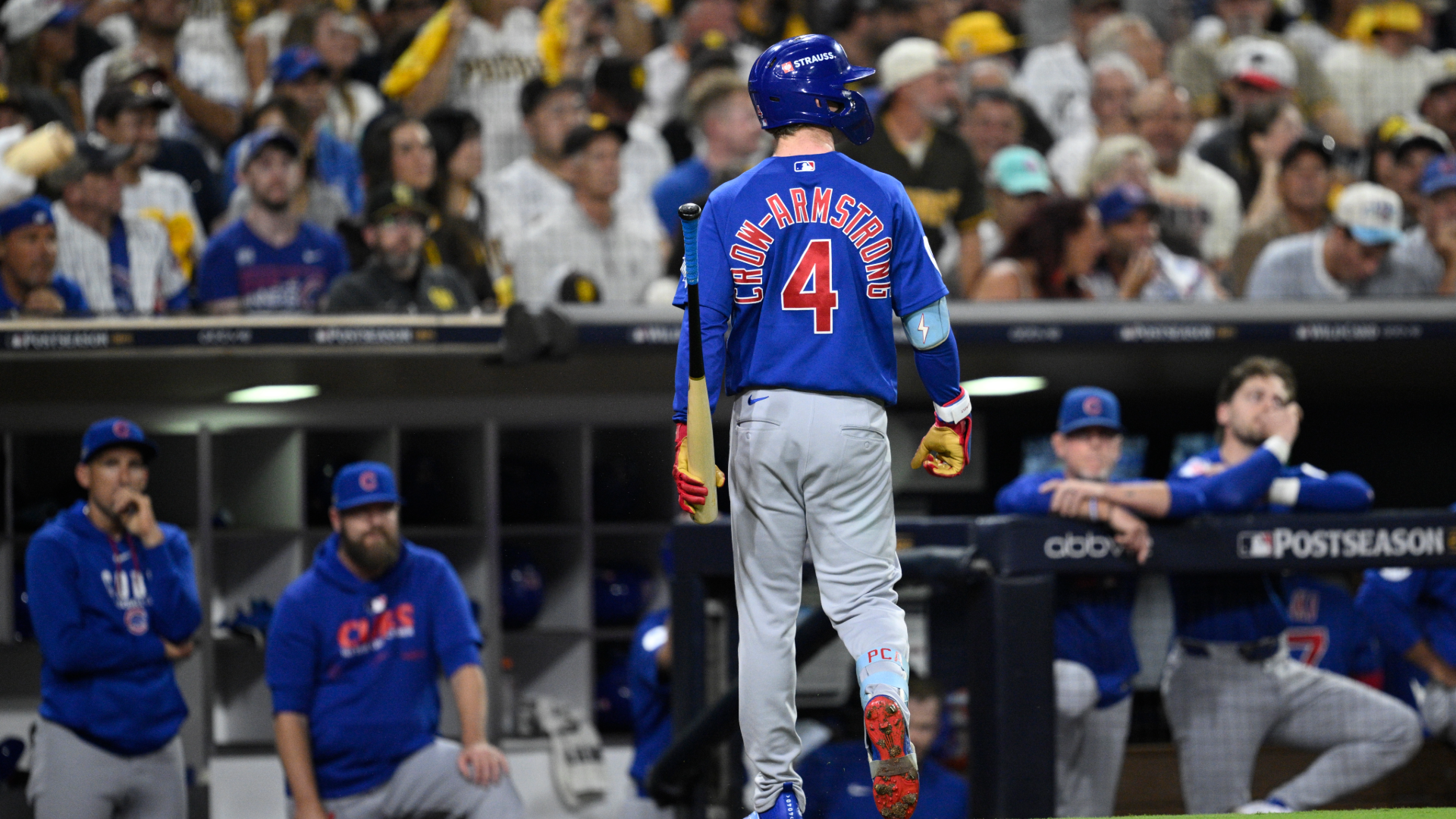
For the second consecutive year, the Chicago Cubs earned one of the National League wild-card spots and for the second straight year, they were unable to parlay the spot into a deep postseason run. Last year, they defeated the Padres in the Wild Card Series in three games before being eliminated by the Brewers in the NLDS. This time around, they were swept in two games by the Padres in the first round.
In some ways, the Cubs had an incredibly fun season. There were two separate 10-game winning streaks from mid-April through early May, pushing the Cubs to an MLB-best 27-12 record. They later went on a 35-16 run from June 11 to Aug. 12 and looked, again, like a World Series contender. They had the best defense in baseball while also scoring the most runs and leading the majors in OPS and position-player WAR. Pete Crow-Armstrong went 40-40 and is likely going to win NL MVP with one of the greatest Cubs seasons ever -- and one of the best for any team this century.
In other ways, this was an incredibly frustrating bunch. While topping the majors in several position-player stats, the Cubs had the worst pitcher WAR in baseball. Yes, even worse than teams like the Rockies and A's. There were plenty of injuries, but also a ton of underperformance that just shouldn't be acceptable for a team with the aspirations of the Cubs. Those two 10-game winning streaks? They were followed by 14 losses in the next 16 games, a stretch that included a 10-game losing streak. The pitching really started to melt down in mid-August, in part causing the Cubs to finish 17-22 after Aug. 12. The tumble meant losing home field advantage for the WCS and having to travel to San Diego.
Perhaps summing it all up, the Cubs led the majors with 13 walk-off wins in 2026, but also blew 34 leads among their losses and took seven walk-off losses.
As they look toward next year, here are three questions facing the ballclub.
1. How will the corner outfield spots shake out?
Right fielder Seiya Suzuki and left fielder Ian Happ are both headed to free agency, leaving massive holes in the lineup.
Happ, 32, is coming off his worst season since 2021 after a string of four years between 3.5 and 4.3 WAR (he recorded 2.9 this year). His offense took a bit of a tumble and the culprit was -- as a switch-hitter -- his work as a right-handed hitter. He was still productive as a lefty, but from the right side, he hit .145/.217/.267 with 52 strikeouts in 131 at-bats.
Suzuki, 32, has long been a productive, albeit inconsistent, hitter and improved his defense this season to get him up to a career-best 5.1 WAR. In his last four seasons at the plate, he's hit .270/.353/.480 (131 OPS+) and this season, his slash line was .270/.368/.473 (131 OPS+), so you can see the season-to-season consistency. He just gets to a similar point with a series of hot-and-cold streaks within each season.
It's unlikely that the Cubs just run it back and keep both, but it's possible they'll pick one to re-sign while letting the other walk. It's pretty clear Suzuki is the better player, but that also means the Cubs will have to deal with tougher competition in bidding to retain his services.
If the Cubs lose both, internal options could be Pedro Ramirez (a rookie utility man who has shown good promise) and Matt Shaw, who transitioned from the everyday third baseman to a utility guy this season. Of course, if both players get everyday corner outfield jobs, that really thins out the infield depth. Bringing back Michael Conforto to platoon in a corner outfield spot could help matters. Maybe they'll try to bring Tyrone Taylor back, too.
Otherwise, the Cubs are looking at giving Kevin Alcántara an extended look or fishing outside the organization for help.
It says here a wise path would be to bring Suzuki back, plant Shaw in left field and use Ramirez as a utility backup. Conforto and/or Taylor would be a bonus. Happy trails to Happ, unless his market completely bottoms out to where he takes an awfully cheap one-year deal to re-establish value.
2. Can the pitching be fixed?
As noted, the Cubs' position player group was amazing in 2026. The run prevention numbers were not as bad as the pitching was, thanks to a defense that covered up a lot of the pitching problems. Not all, though. There was plenty of bad on the pitching staff.
Yes, there were injuries. Promising youngster Cade Horton was lost for the season after just two starts. Ben Brown emerged as a breakout beast and wasn't able to pitch after June 19. Matthew Boyd spent time on the IL. Justin Steele has now missed nearly two seasons following his early 2025 Tommy John surgery.
There were also misses. Edward Cabrera thus far has been a debacle. Jameson Taillon had to be designated for assignment. Boyd and Shota Imanaga were inconsistent, even if mostly good. The bullpen had a bunch of injuries and underperformance as well.
The Cubs don't seem to have the pitching system in place, organizationally, to be able to churn out many of their own wins, which means shopping for bargains each offseason.
One thing this front office seems to like to do is take risks on volatile (Cabrera, Phil Maton, Jacob Webb, Ryan Zeferjahn) or injury-prone pitchers (Hunter Harvey), hoping to hit the lottery. Sometimes it works. Baked in with the possible reward on high-risk-high-reward moves is the downside of injury concerns or older players (Hoby Milner) on the cheap.
So, sure, there's a built-in excuse for the front office when there are tons of injuries up and down the pitching staff. Some of this comes with the territory, though, given the approach. This meant a scramble in the middle of the season to grab David Peterson and then both Kevin Gausman and Clay Holmes in front of the trade deadline. It is not a model many organizations would want to follow.
How do things shape up for next year?
Gausman, Imanaga and Peterson are free agents. Boyd has a $15 million mutual option, which he can probably beat on the open market. The same goes for Holmes and his $12 million player option. This means a very realistic scenario is that the entire rotation from late in the season is gone. Fill-in starter Colin Rea is also a free agent, as is long reliever Aaron Civale.
This means the rotation heading into the offseason probably has Cabrera, Steele and Javier Assad, with the hope of Horton returning midseason and relying on Brown's neck injury to heal properly.
The bullpen will need an awful lot of work, too, even if Daniel Palencia is fixed and Zeferjahn hones his stuff next year. There's a $2.5 million club option for Webb, which the Cubs might as well pick up in hopes that his midseason streak this year could be what he looks like all season in 2027.
It sure looks like the Cubs will have a lot to accomplish on the pitching side this offseason.
Something else of note: Catcher Carson Kelly really seems to work well with the pitching staff and he's also hitting free agency.
3. Is this really good enough?
This is the overarching question for Cubs ownership. The post-2021 rebuild is complete and the Cubs went from 83 wins in 2024 to 92 wins and an NLDS loss in 2025, then fell back again in 2026 with 89 wins and a Wild Card Series loss.
This was Jed Hoyer's sixth full year in charge of baseball operations and the Cubs have neither won the division nor advanced to the NLCS. When Hoyer was second in command to Theo Epstein, the Cubs went through a more thorough rebuild and were still in the NLCS in the fourth year of that administration before winning 103 games and the World Series in the fifth year. Through year six, they had a pair of division titles and three straight NLCS trips along with that ring.
The Cubs at present are being embarrassed by the Brewers. They finished five games back of the Brewers in 2025 and lost to them in the NLDS, and this year finished a whopping 14 games behind them. The Brewers won the season series nine games to four, including five of six in September.
The player development has left a lot to be desired. There have obviously been some wins, but not enough to form the backbone of the future of the ballclub without having to heavily dip into free agency or trades.
It sure appears that this is "good enough" for the Ricketts family because there are no signs of meaningful front office changes at this juncture.
Should it be good enough, though? Playing second fiddle to the Brewers while winning 90 or so games and getting bounced in the early rounds of the playoffs?
It sure doesn't feel like it should be. I'm not suggesting that Hoyer or general manager Carter Hawkins should definitely be fired, but I'm not sure either move should be off the table. I'm not necessarily saying the front office needs to spend more, either.
What I am saying is that the status quo is taking a back seat to the Brewers and that can't be good enough. Something needs to get better.
Add CBS Sports on Google Join the Conversation comments


