
 Reuters
President Donald Trump has announced a pause to the just-launched US initiative that aimed to help guide ships stranded by Iran's closure of the Strait of Hormuz.
Trump had said the initiative - Project Freedom - was a humanitarian gesture "meant to free up people, companies, and Countries that have done absolutely nothing wrong". Iran has said vessels can only cross the pivotal waterway with its authorisation.
Trump announced the new initiative on Sunday. Since then, Iran's military said it has fired at US warships to deter them from navigating the waterway and the US says it has sunk small boats - threatening a ceasefire meant to end the war.
Then on Tuesday - two days after first being announced - Trump said the initiative would pause "for a short period of time" to see whether the US and Iran can come to an agreement.
Here is what we know about "Project Freedom" and the concerns over whether it could lead to a wider resumption of hostilities.
Follow live updates
How was the US military implementing it?
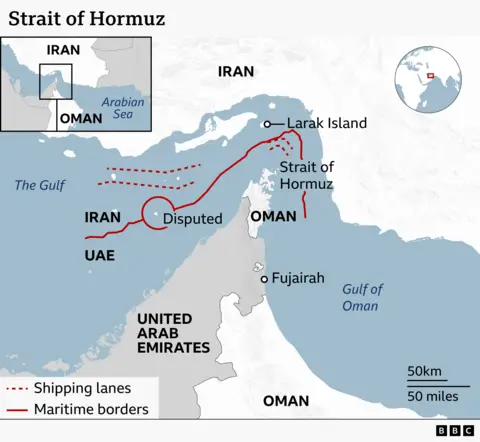
The Hormuz Strait has remained largely blocked since the US and Israel launched air strikes on Iran on 28 February - and Tehran responded by blocking the crucial waterway through which 20% of the world's oil and liquefied natural gas is meant to pass freely.
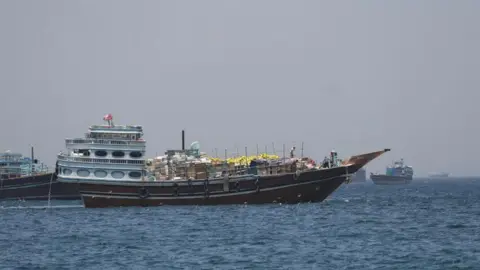
The US says there are 22,500 mariners on 1,550 commercial vessels trapped in the Gulf.
There has been growing concern over dwindling supplies and the effects on sailors' physical and mental health.
US Central Command (Centcom) says that "guided-missile destroyers, over 100 land and sea-based aircraft, multi-domain unmanned platforms, and 15,000 service members" were being used to support the operation.
In a briefing on the first day of the operation, Centcom commander Adm Brad Cooper said vessels from 87 countries were stranded in the Gulf - and the US had contacted "dozens of ships and shipping companies to encourage traffic flow through".
It wasn't clear when the operation was announced whether the US would attempt to provide stranded ships with a military escort.
Mick Mulroy, former US deputy assistant secretary of defence and a Marine veteran, told the BBC he believed the US military would likely be more focused on air cover, and defence from drone or missile attacks, rather than physically escorting ships.
"The question is whether ships will trust their ability to get through without being attacked, and more importantly, the insurance company," he said, before the operation was paused.
Tim Wilkins, managing director at Intertanko, a trade body representing independent tanker owners and operators, told the BBC the Trump administration did not establish any co-ordination for the operation, leaving members worried about their safety transiting the Strait.
Are vessels passing through the Strait of Hormuz?
On Monday afternoon, Centcom said US Navy guided-missile destroyers were operating in the Gulf "after transiting the Strait of Hormuz in support of Project Freedom".
It added American forces were "actively assisting efforts to restore transit for commercial shipping" but gave no details.
"As a first step, 2 U.S.-flagged merchant vessels have successfully transited through the Strait of Hormuz and are safely headed on their journey," Centcom also said. Again, no details were released about the identity of the commercial vessels.
Shipping company Maersk confirmed that one of its vessels was able to exit the Gulf, accompanied by the US military.
But Iran's powerful Islamic Revolutionary Guard Corps denied any vessels had passed through the Strait.
For now, though, with the operation to help guide vessels paused, it's unclear whether more ships will be able to navigate through.
Is Iran firing at US warships and other vessels?
Hours after the US operation was set to start on Monday, the Iranian military said it had fired against "American and Zionist enemy destroyers", which it said the Americans had "disregarded".
Centcom quickly denied the Iranian claims that a warship had been hit by two missiles. It confirmed that Iran did fire cruise missiles at both US warships and US-flagged commercial ships, while drones and small boats were used against commercial ships.
The United Arab Emirates (UAE) - a Gulf ally of the US, which has often been attacked by Iran during the war - said a tanker affiliated with Adnoc, its state-owned oil company, was targeted by two drones as it transited the Strait of Hormuz.
No-one was injured, the country's foreign ministry said in a statement. At least three missile interceptions also were reported.
A suspected strike hit a South Korean cargo vessel anchored in the strait, near the UAE.
Centcom commander Cooper said that some of the US attack helicopters supporting the mission were used to sink six small Iranian boats that were targeting civilian vessels. Iran has denied this.
Iran insisted that it will take "decisive action" against ships that do not use the regime-approved route through the strait.
The country's top negotiator has accused the US of jeopardising shipping security with its own blockade of Iranian ports, saying the "continuation of the status quo is intolerable for America".
Trump, on Tuesday, said the US was pausing the new operation at the request of Pakistan - the intermediary in negotiations between the US and Iran, along with other countries.
Is the Iran war resuming?
When Trump announced the initiative's pause on social media on Tuesday, he said "great progress" had been made toward "a complete and final agreement" with Iran.
He said the Strait would remain blockaded during the pause.
The White House told the BBC that it had nothing to add regarding the president's post.
Iranian state media said the pause demonstrated that Trump had "retreated" after "continued failures" in his efforts to reopen the vital waterway for global shipping.
Grant Rumley, a Middle East expert who served as an adviser to the Biden and Trump administrations between 2018 and 2021, said that the plan to secure passage for ships in the Gulf would be "very, very hard".
Before it was paused, he noted such an operation would likely require a stronger, more "kinetic" military option.
"I think that the general consensus is that a resumption of hostilities is a question of when," he said. "Not if."
Nitya Labh, a fellow on the International Security Programme at London's Chatham House, said the US operation was "extremely risky" and"quite escalatory".
She added that, if Trump's "Project Freedom" succeeded in getting some vessels out of the strait, "it will be a temporary relief at best" - a more sustained effort would be required to open up the critical waterway.
At a briefing on Tuesday, US defence secretary Pete Hegseth was asked if US operations in the strait meant that the ceasefire was over.
"No, the ceasefire is not over," he said. "This is a separate and distinct project."
Chairman of the Joint Chiefs of Staff Gen. Dan Caine said that even though Iran had fired at commercial vessels nine times, seized two container ships and attacked US forces 10 times since the ceasefire agreement on 8 April, those actions were below the threshold of restarting major combat operations "at this point".