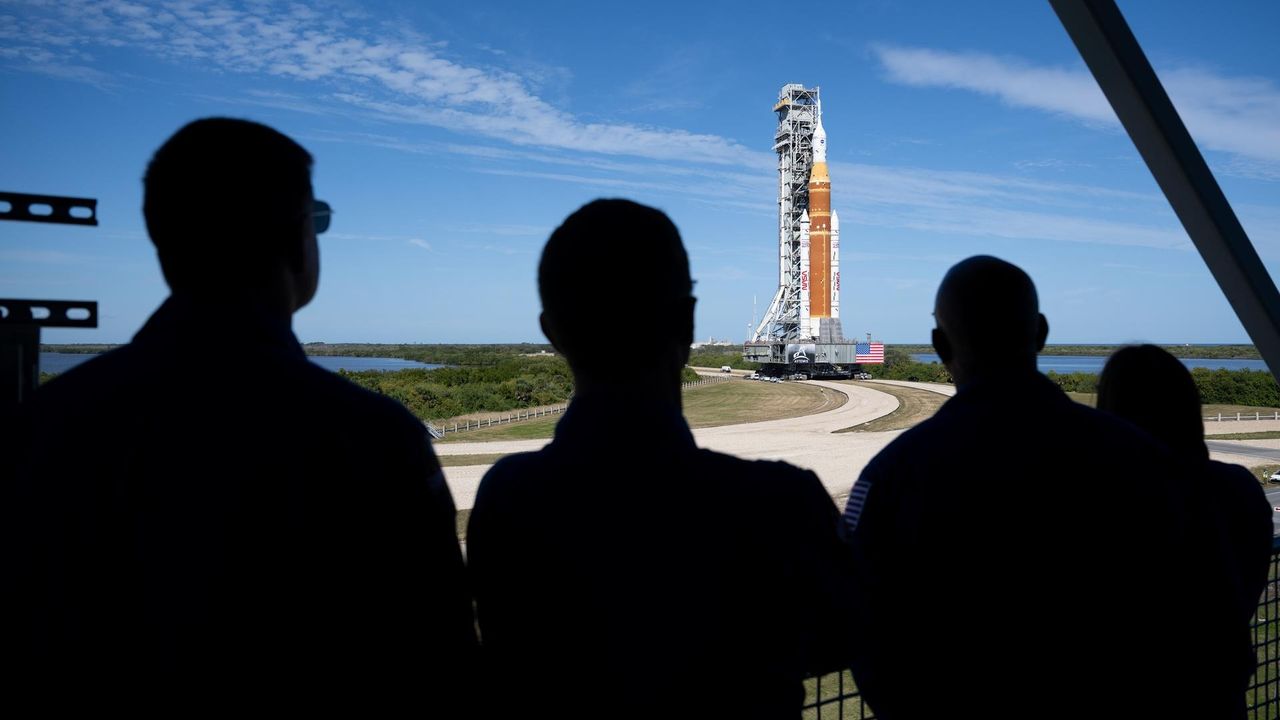
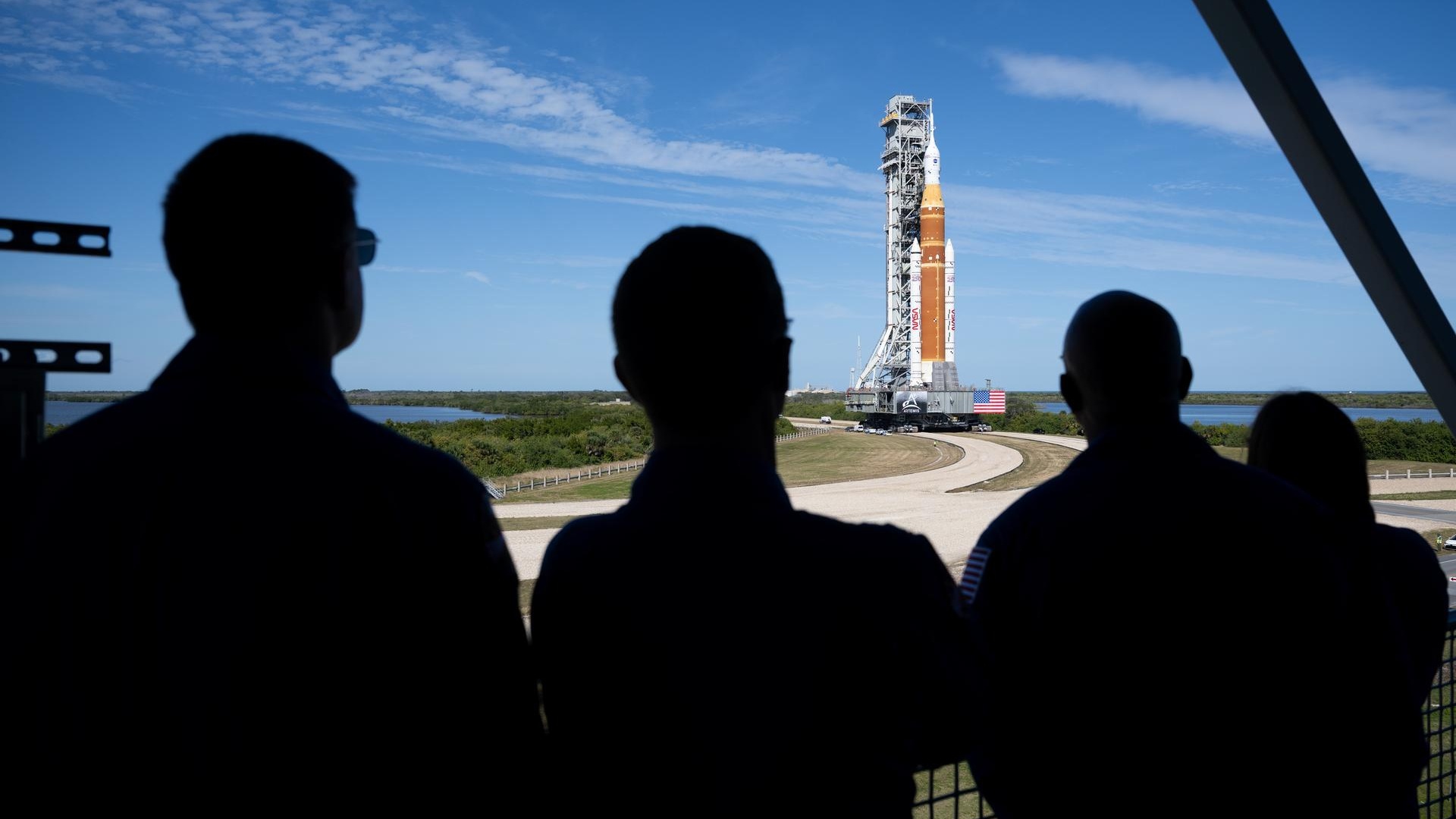
 CSA (Canadian Space Agency) astronaut Jeremy Hansen, Artemis II mission specialist, left, and NASA astronauts Reid Wiseman, Artemis II commander, Victor Glover, Artemis II pilot, and Christina Koch, Artemis II mission specialist, watch NASA's Space Launch System (SLS) rocket and Orion spacecraft secured to the mobile launcher as the duo made a trip to the launchpad in January. (Image credit: NASA/Joel Kowsky) Share this article 0 Join the conversation Follow us Add us as a preferred source on Google Newsletter Get the Space.com Newsletter
 Breaking space news, the latest updates on rocket launches, skywatching events and more!
Contact me with news and offers from other Future brands Receive email from us on behalf of our trusted partners or sponsors By submitting your information you agree to the Terms & Conditions and Privacy Policy and are aged 16 or over.You are now subscribed
Your newsletter sign-up was successful
Want to add more newsletters?
An account already exists for this email address, please log in. Subscribe to our newsletterNASA is just hours away from launching Artemis 2, the first mission to ferry humans into the moon's vicinity in more than half a century.
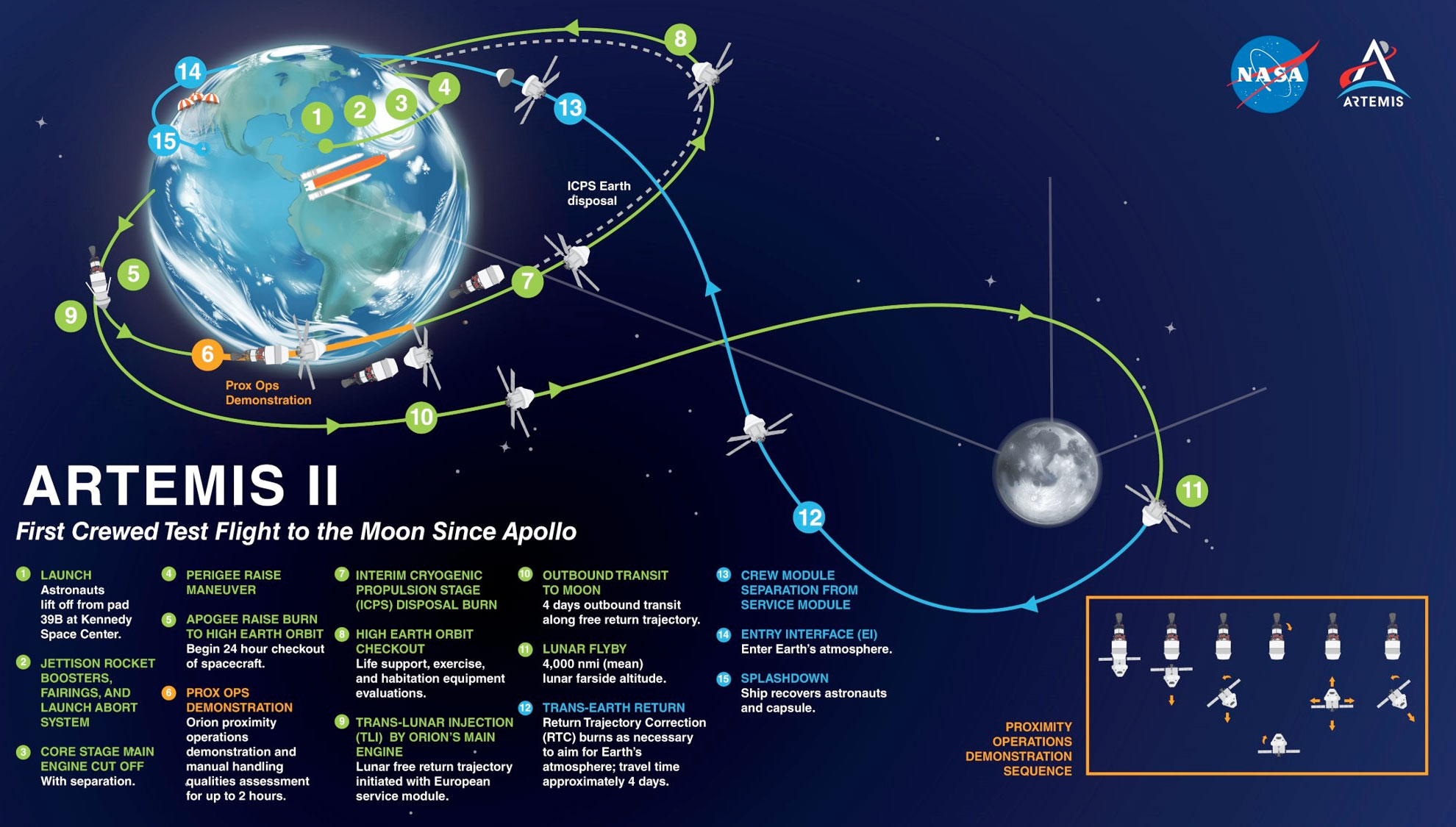
The roughly 10-day flight — expected to lift off today (April 1) from Kennedy Space Center (KSC) in Florida at 6:24 p.m. EDT (2224 GMT) — will carry NASA astronauts Reid Wiseman, Victor Glover and Christina Koch, along with Canadian Space Agency astronaut Jeremy Hansen aboard the Orion spacecraft toward the moon. If all goes to plan, the crew will loop around the moon and return to Earth on a free-return trajectory, reaching roughly 4,700 miles (7,560 kilometers) beyond the moon's far side — farther than Apollo 8's historic lunar flyby and the most distant journey ever attempted by humans.
Here's a closer look at the science flying with Artemis 2, and how it could shape future lunar landings and, ultimately, crewed missions to Mars.
Bone marrow study targets astronaut health risks
Among the experiments aboard Artemis 2 is a small but sophisticated project known as AVATAR, short for "A Virtual Astronaut Tissue Analog Response." The experiment uses lab-grown tissue models — each about the size of a flash drive — that contain living human cells engineered to behave like real organs.
AVATAR is designed to focus on bone marrow tissue grown from cells obtained through preflight blood donations from the astronauts, according to NASA. Bone marrow produces blood and immune cells and is particularly sensitive to radiation, making it a key target for evaluating health risks during missions beyond Earth.
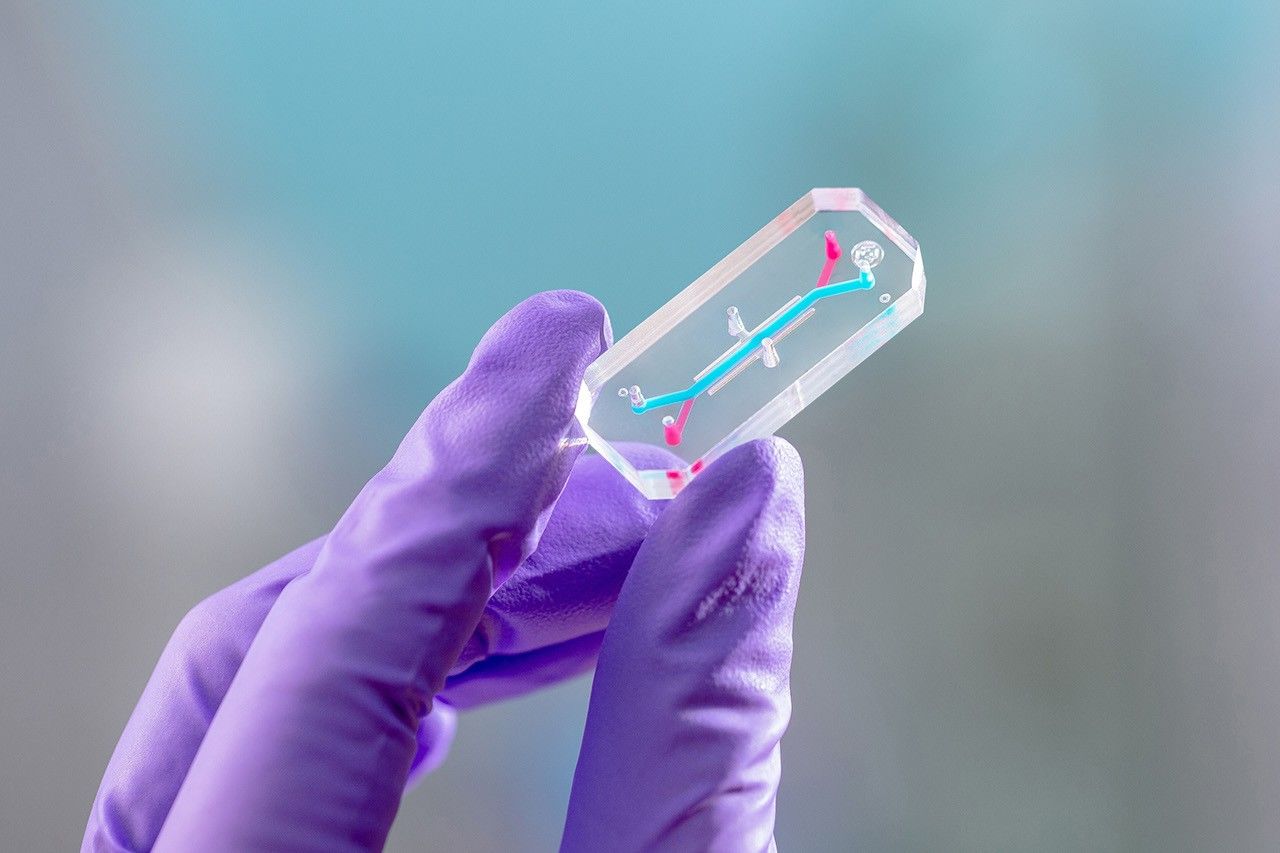
Once the mission concludes, researchers plan to analyze the tissue samples at the molecular level to assess how thousands of genes responded to spaceflight. To determine whether the organ chips can reliably predict human responses to space-related stress, scientists will compare the results with data from the International Space Station (ISS), as well as with biological samples collected from the crew before and after flight, according to NASA.
Get the Space.com NewsletterContact me with news and offers from other Future brandsReceive email from us on behalf of our trusted partners or sponsorsPrevious research aboard the space station, which is partially shielded by Earth's magnetic field, has shown that astronauts experience bone loss even during shorter space stints, underscoring the greater risks anticipated during future deep-space travel. The findings could help guide more personalized healthcare strategies for astronauts on future long-duration missions, NASA said.
A deep-space stress test
Another key experiment is the Artemis Research for Crew Health and Readiness, or ARCHeR, that will examine how astronauts cope with life inside Orion's tight, studio-apartment-sized quarters.
Crew members will wear wrist-mounted devices that monitor stress levels, movement, sleep and cognitive performance. Researchers hope the real-time data will help them analyze how daily activity, rest and confinement affect health and teamwork in deep space, according to NASA.
Another investigation will focus on the immune system. During the mission, astronauts will collect saliva samples by blotting them onto special paper stored in small booklets, a simple method required because Orion lacks refrigeration, NASA said.
When compared with samples collected before and after the flight, the saliva and blood data will allow researchers to track immune changes linked to stressors such as radiation and isolation. Scientists also plan to monitor dormant viruses that can reactivate during spaceflight, including those related to chickenpox and shingles, a reaction that has been previously observed aboard the ISS.
Crew health monitoring is planned for months before launch and after landing, NASA said. Astronauts will undergo balance and movement tests, including simulated spacewalking tasks in a pressurized suit, to measure how the body adapts to long-duration spaceflight and how quickly it readjusts to Earth's gravity.
Measuring radiation
Unlike astronauts aboard the ISS, the Artemis 2 crew will travel beyond Earth's protective magnetosphere, where exposure to space radiation is significantly higher.
To monitor that risk, astronauts will carry personal radiation sensors, known as dosimeters, in their pockets to track exposure in real time. Together with six radiation sensors installed throughout the Orion crew module, these instruments can detect sudden increases in radiation, such as during a solar storm, and alert the crew to take protective action.
Data from these devices, along with measurements from several shoebox-sized cubesats provided by international partners, could help scientists better understand how radiation behaves inside Orion and how it affects human health experiments.
A rare view of the moon
No overview of Artemis 2 would be complete without the moon itself.
As Orion arcs around the moon's far side, the crew is expected to turn their attention outward, using a three-hour window behind the moon to study terrain no human has closely examined in more than 50 years. From Orion's vantage point, the moon will appear roughly the size of a basketball held at arm's length.
During a planned observation period over the far side, the hemisphere permanently turned away from Earth, astronauts will rely on their geology training to photograph and describe surface features shaped by ancient impacts and long-ago lava flows, NASA explains .
What the crew sees will depend on Orion's flight path and the angle of sunlight, but scientists say the astronauts could catch views of regions never before seen directly by human eyes.
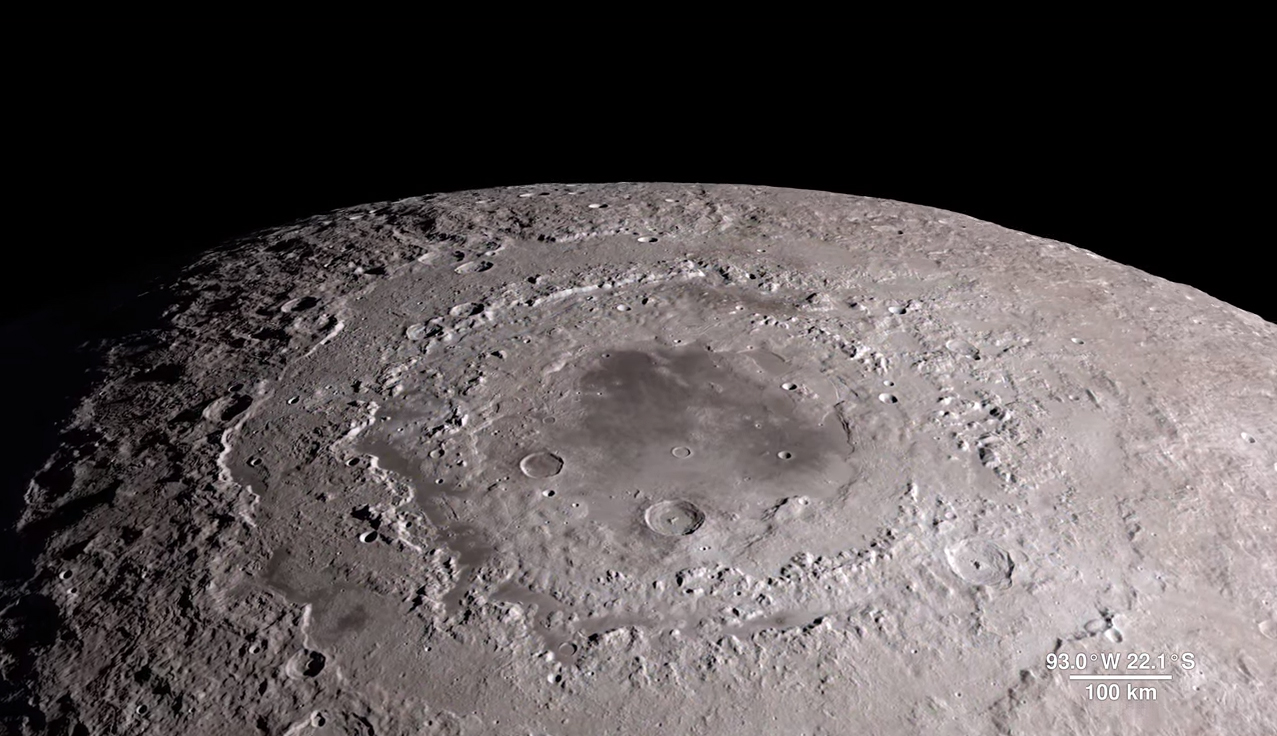
Among the most compelling targets is the Orientale Basin, a massive, 3.8-billion-year-old impact scar roughly 600 miles (960 kilometers) wide that marks the boundary between the moon's near and far sides and remained hidden during the Apollo era.
Astronauts may also witness brief flashes from meteoroids striking the surface or faint clouds of dust hovering above the lunar horizon that are not very well understood, NASA says.
Those observations are expected to help guide upcoming Artemis missions, including plans to land astronauts near the moon's south pole. Data gathered from orbit could influence where future crews explore, what samples they collect and which regions hold the greatest scientific promise.
 Sharmila KuthunurContributing Writer
Sharmila Kuthunur is an independent space journalist based in Bengaluru, India. Her work has also appeared in Scientific American, Science, Astronomy and Live Science, among other publications. She holds a master's degree in journalism from Northeastern University in Boston.
View MoreYou must confirm your public display name before commenting
Please logout and then login again, you will then be prompted to enter your display name.
Logout MORE FROM SPACE... 1NASA's Artemis 2 moon launch may be visible from Florida and southern Georgia today. Here's when to look
- 2Watch Artemis 2 fly through space in real time with this telescope livestream
- 3April's full 'Pink Moon' rises tonight — just as NASA readies its Artemis 2 moon mission
- 4Satellite spies SpaceX Starlink before it breaks apart | Space photo of the day for April 1, 2026
- 5Saturn's magnetic field is curiously warped, and one of its moons may be to blame