 Dan WetzelApr 1, 2026, 08:00 AM ETClose
- Dan Wetzel is a senior writer focused on investigative reporting, news analysis and feature storytelling.

Last week, after Michigan became one of four Big Ten teams to reach the men's Elite Eight, coach Dusty May was asked how recent rule changes around compensation in college athletics had helped league teams have such success.
"You'd have to catch me off the record to answer that question," May said with a smile.
The implication was clear: Now that every school can pay players -- either through direct revenue share or name, image and likeness dollars -- Big Ten schools are no longer disadvantaged in recruiting by everything from booster bag men to shoe company AAU connections.
This narrative, of course, ignores many past scandals in the league, let alone that the Big Ten has produced plenty of contenders through the years. It just hasn't won it all since Michigan State in 2000.
The overall sentiment is somewhat fair, however. While violations certainly occurred in the Big Ten, they generally weren't as extreme as in other places.
Now though, it's an open game and open checkbook. That means game on.
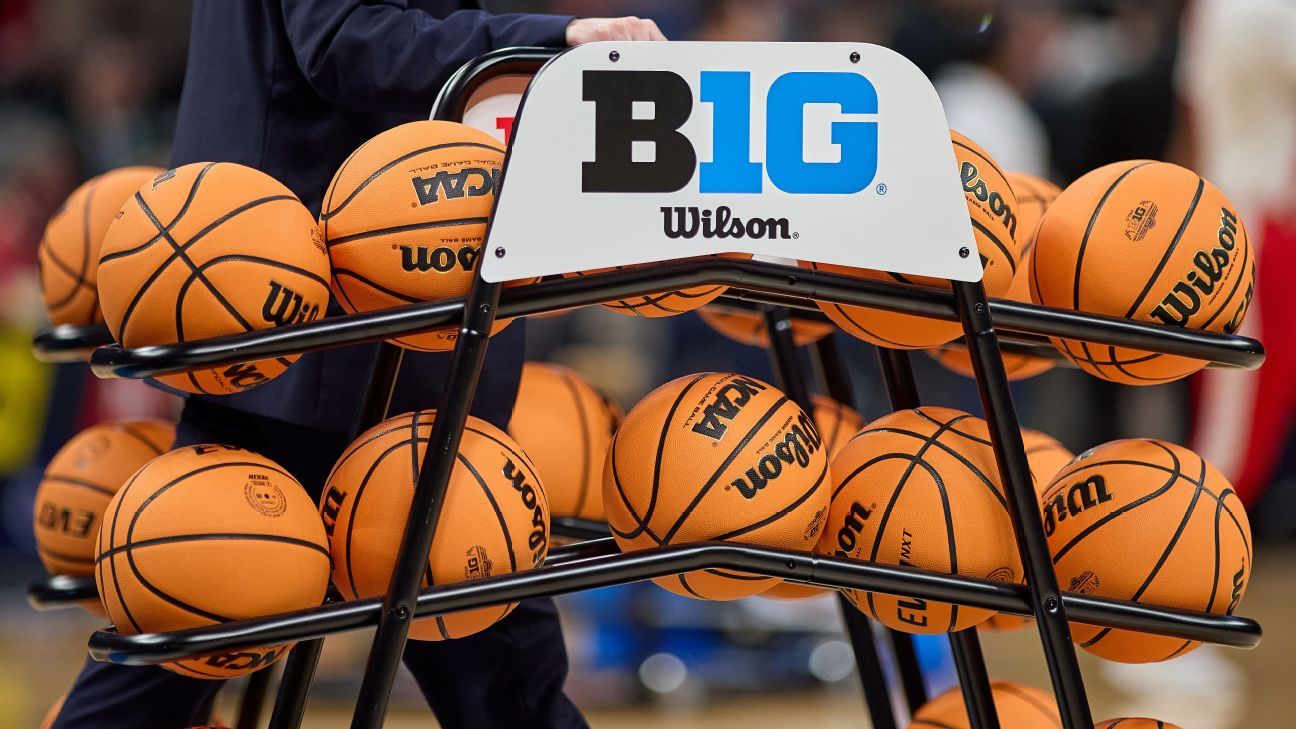
Big Ten schools have already won the past three national titles in football (Michigan, Ohio State and Indiana), and with two teams in the men's Final Four -- Illinois joins Michigan -- it has a chance to break that 26-year hoops title drought.
"I think now that the playing field has been leveled out as far as finances and things like that, the environments in the Big Ten are second to none," May said.
The money allows Big Ten programs to take different strategies to construct rosters.
For decades, league schools seemed to battle each other over many of the same Midwestern recruits -- effectively kneecapping each other over a point guard from Flint or a swingman from Indiana. In the end, many of the very best went to other conferences, anyway: Anthony Davis, Derrick Rose, Shane Battier, Antoine Walker, Jalen Brunson, Dwyane Wade and so on.
Last year, the two best high school recruits with Midwestern hometowns were Darryn Peterson (Canton, Ohio) and Darius Acuff Jr. (Detroit). They chose Kansas and Arkansas, respectively.
No matter. May, for example, has constructed arguably the best team in Michigan history without a roster full of area high school stars.
Instead, armed with exceptional scouting and plenty of money, he hit the transfer portal and brought in Yaxel Lendeborg (UAB), Aday Mara (UCLA), Morez Johnson Jr. (Illinois) and Elliot Cadeau (North Carolina).
Those four alone make up 65% of the Wolverines' scoring, 66.2% of their rebounding and 74.2% of their assists. U of M is 35-3 and won each of its tournament games by double digits.
Then there is Illinois coach Brad Underwood, whose program, based on proximity to Chicago, St. Louis and Indianapolis, should be a historic powerhouse. Yet the Illini have only occasionally gotten the best local recruits.
That's one reason Underwood has put an emphasis on targeting European talent by using newly legal money to sign players who would have otherwise chosen to play professionally over there.
Illinois is powered by David Mirkovic of Montenegro, twin brothers Tomislav and Zvonimir Ivisic of Croatia and Andrej Stojakovic, who spent part of his childhood in Thessaloniki, Greece, before moving to California where his father, Peja, played in the NBA.
Add in some Americans, including unheralded-recruit-turned-superstar Keaton Wagler, and the Illini are making their first Final Four appearance since 2005.
"NIL has opened it up so we can actually get the really, really good [European players]," Underwood said. "Dribble, pass, shoot guys. They've been extremely well coached. They are fundamentally very sound.
"We've had ones before, but maybe not the top-quality guys," Underwood continued.
Maybe under the old rules, May is two years into building a program and still trying to make recruiting connections while Illinois is stuck in its good but rarely great history.
Not anymore. The entire league is awash with talent, with six teams reaching the Sweet 16. And while Nebraska basketball couldn't do the impossible that Indiana football pulled off, the Cornhuskers' first ever NCAA tournament victory (and then a second) is proof enough that a new day is here.
Even a title this weekend wouldn't give the Big Ten basketball dominance to go with football, but here in the new era of college sports, it would suggest another step in its revival, if not arrival, as a true behemoth.