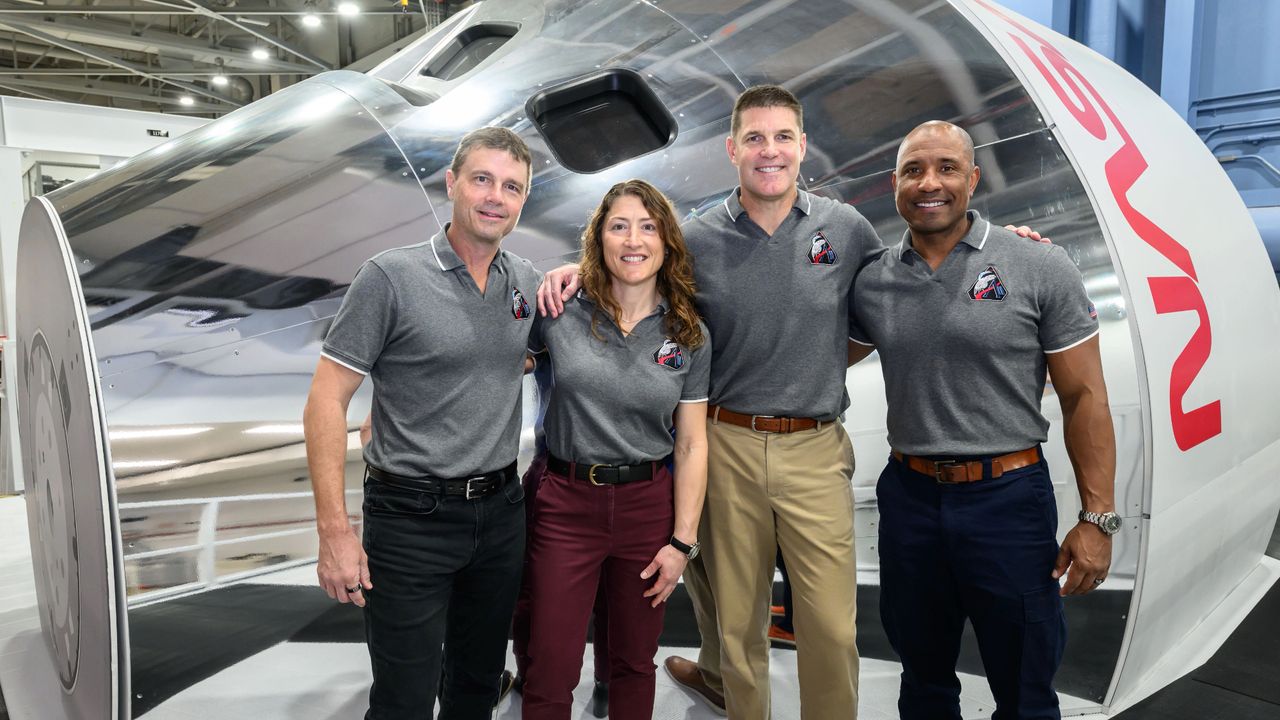
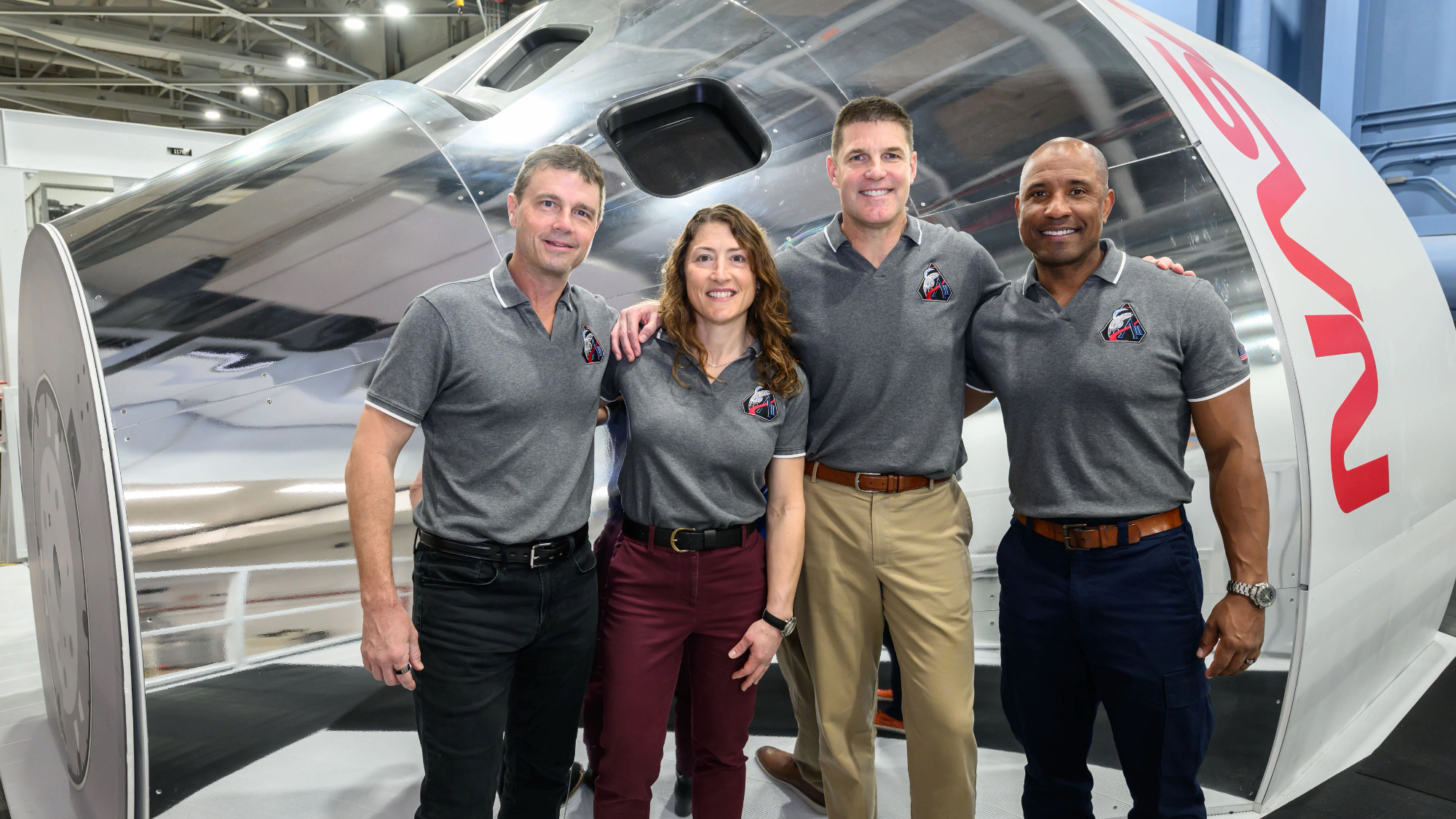
 The Artemis 2 crew poses in front of an Orion simulator Jan. 23, 2026 at NASA's Johnson Space Center in Houston. From left: Reid Wiseman, Christina Koch, Jeremy Hansen and Victor Glover. (Image credit: NASA/Robert Markowitz) Share this article 0 Join the conversation Follow us Add us as a preferred source on Google Newsletter Get the Space.com Newsletter
 Breaking space news, the latest updates on rocket launches, skywatching events and more!
Contact me with news and offers from other Future brands Receive email from us on behalf of our trusted partners or sponsors By submitting your information you agree to the Terms & Conditions and Privacy Policy and are aged 16 or over.You are now subscribed
Your newsletter sign-up was successful
Want to add more newsletters?
An account already exists for this email address, please log in. Subscribe to our newsletterWhat does it mean to be the first humans in decades to fly to the moon?
The Artemis 2 astronauts will do just that on their historic mission around the moon, which could launch as soon as April 1. They are NASA's Reid Wiseman (the Artemis 2 commander), Victor Glover (pilot) and Christina Koch (mission specialist), as well as Canadian Space Agency astronaut Jeremy Hansen (mission specialist).
Article continues belowIt will be a busy 10-day mission, in which the quartet will be the first humans to fly Orion — and the first people since 1972 to leave Earth's orbit for a trip around the moon. They and their ground-support teams also are aiming to set up for future Artemis missions — especially Artemis 4, which is scheduled to land astronauts on the moon in 2028. In a few words, this makes the astronauts busy indeed.
But the crew has also talked about the importance of the mission to them, not only as individuals with different life experiences but also as representatives of humanity. The crew has pointed to both history and humility: none of them were alive when the Apollo missions flew to the moon between 1968 and 1972. NASA's first Black and women astronauts were selected in 1978, and Canadian astronauts were first selected in 1983, meaning some of the Artemis 2 crew were well into their childhoods before they could conceivably imagine applying as astronauts.
And three of the four Artemis 2 crewmates will be making history of their own: Glover and Koch will become the first Black person and the first woman, respectively, to leave low Earth orbit, and Hansen will be the first non-American to do so.
Below are some thoughts from each of the astronauts explaining what Artemis 2 means to them. Space.com spoke with Wiseman, Glover and Reid during interviews in September 2025 at NASA's Johnson Space Center in Houston. Hansen's remarks came from a Q&A in late November 2025 with entrepreneur Fred Bastien, on the CSA's YouTube channel.
Get the Space.com NewsletterContact me with news and offers from other Future brandsReceive email from us on behalf of our trusted partners or sponsorsReid Wiseman
Artemis 2 commander Reid Wiseman. (Image credit: NASA)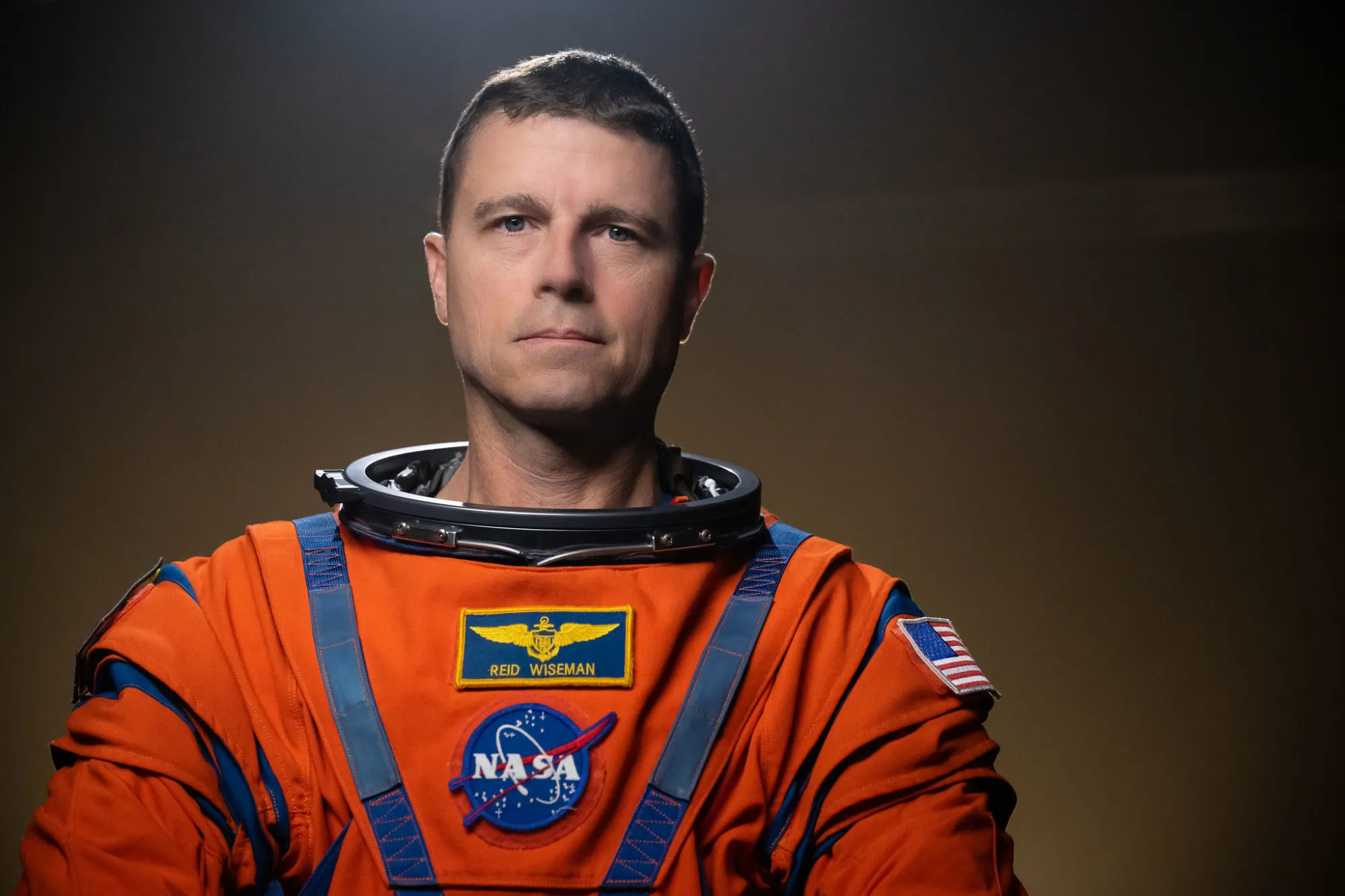
There's some Easter eggs in our patches. Some of the folks online have already discovered the Earth is in the Apollo 8 Earthrise formation. So some astute folks have picked up on that on the internet, which I really love. I love that people actually recognize that it was very intentional that we put that on there.
When I stand on the surface of Earth now, and I look at the moon at night — and I might see a waxing gibbous, but I know now on the far side that's a waning crescent — I'm flipping my brain around to all of those things, and just understanding that. Like, I've never spent time in my entire life thinking about that. But now it's all I think about.
And then when I think about that, and I think about what is the illum[ination] on the far side right now? Is it in shadow? Is it in illumination? What are the shadows doing, coming off the ridges of those canyons? And then I think about all these places [on the moon] that we've learned. And I'm just imagining. And every time I look up at the moon, I'm imagining, What do they look like on the far side?
Victor Glover
Artemis 2 pilot Victor Glover (Image credit: NASA)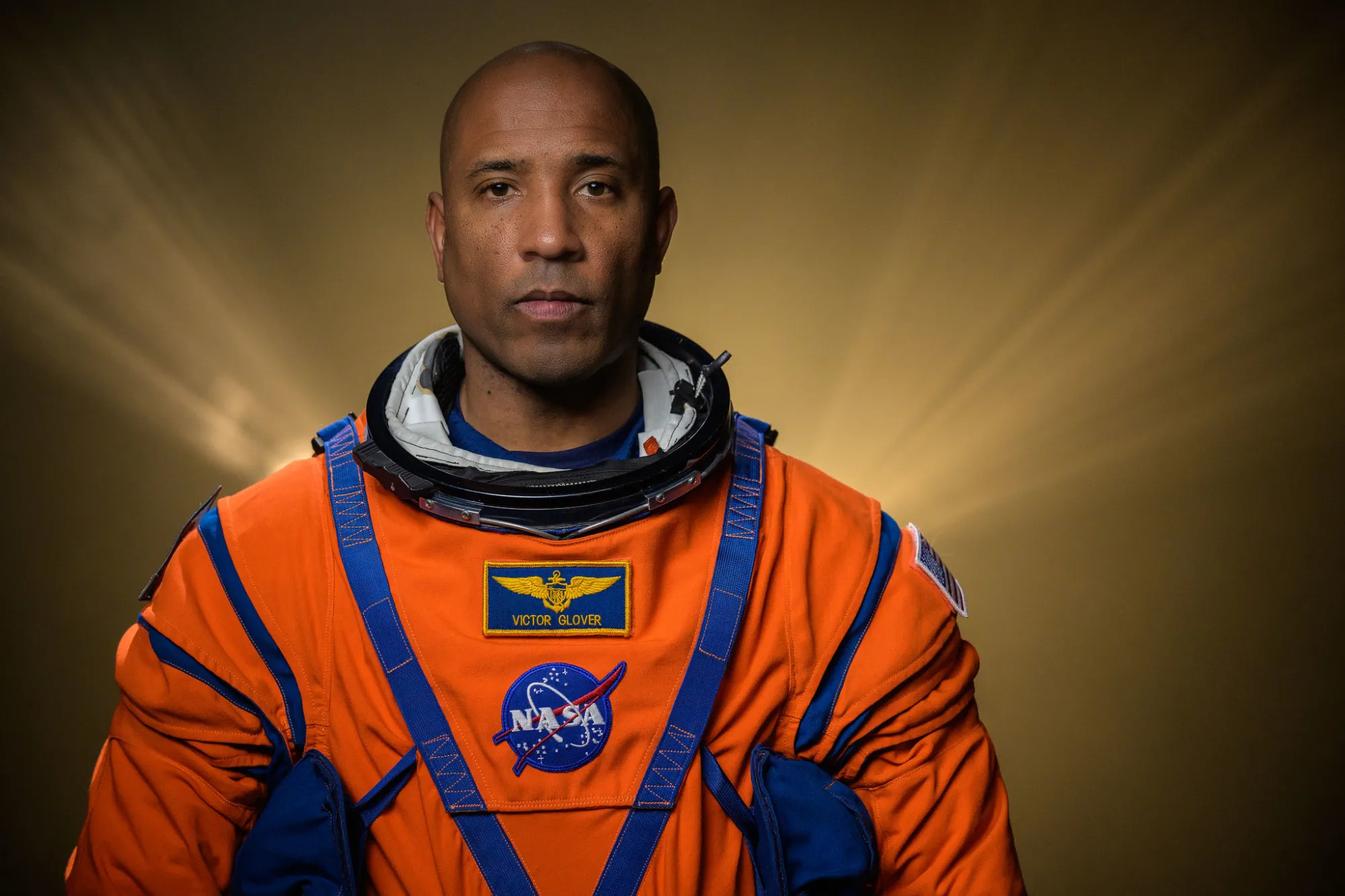
I gave a speech recently, and somebody came up to me after that. They sat through the whole thing and were like, "So, wait a minute: You're telling me we're going to the moon next year. Like, next year."
I don't know what the world is ready for, but when you do big things like [that], hopefully people will just know that moment will bring us together in a way that, whether we're ready for it or not, I hope we just respond to it in kind. We all let ourselves be moved by it and take a minute to be one thing, to be humans. Whether you're sitting at home in your sweats or working in Mission Control or riding the vehicle around the moon, we're all on this journey together, and so I hope that — ready or no — people embrace it, because it's for all of us.
[Trans-lunar injection] is a big milestone, but splashdown? When we land back on the Earth, the destination is Earth. You know, when we burn the engines for TLI … that's also our deorbit burn. And when we hit the Pacific Ocean under those three big old beautiful parachutes, my wife is going to breathe a sigh of relief, and that means the world to me. So, all of the other amazing things that'll happen on the way are irrelevant, if that doesn't go well. So splashdown is everything to me.
Christina Koch
Artemis 2 mission specialist Christina Koch. (Image credit: NASA)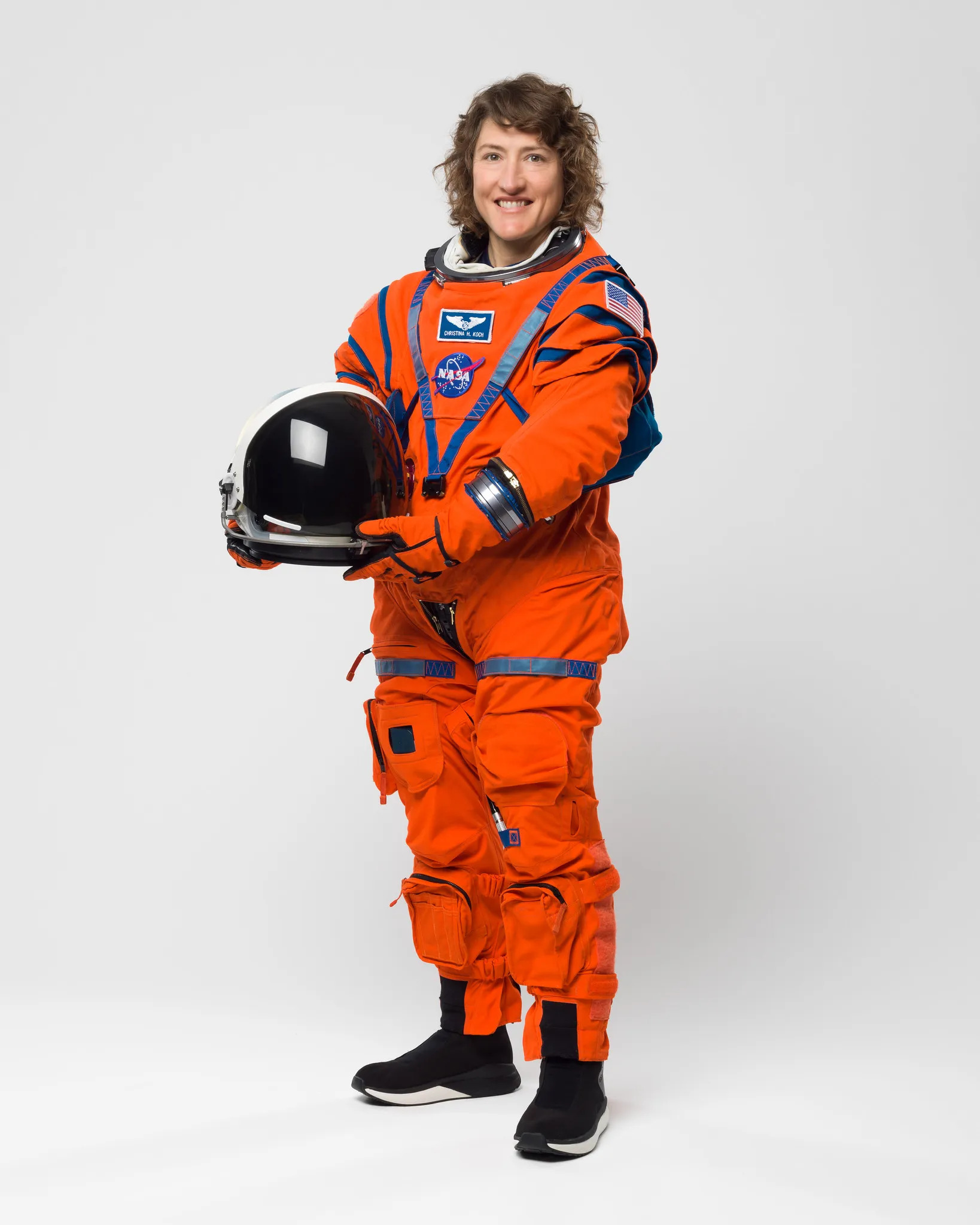
For me, it's bigger than [our crew]. There's levels. Obviously, our crew cohesion and the respect we have from each other — for each other — is so important to get the job done, to get the mission done as successfully as possible, and safely as possible. And building that out to a wider team, to me, is just as important, if not more important. I think we stand on their shoulders. We wouldn't be here if it weren't for our wider teams.
I think for me, [Artemis 2] comes down to not being any single individual's accomplishments. The accomplishment that we can celebrate together is that we got here. Decades ago, we made the right decisions so that our astronaut corps brings diverse backgrounds together to solve the hardest problems. And that, to me, is what's truly worth celebrating and what I'm honored to be a part of.
Jeremy Hansen
(Image credit: CSA, NASA)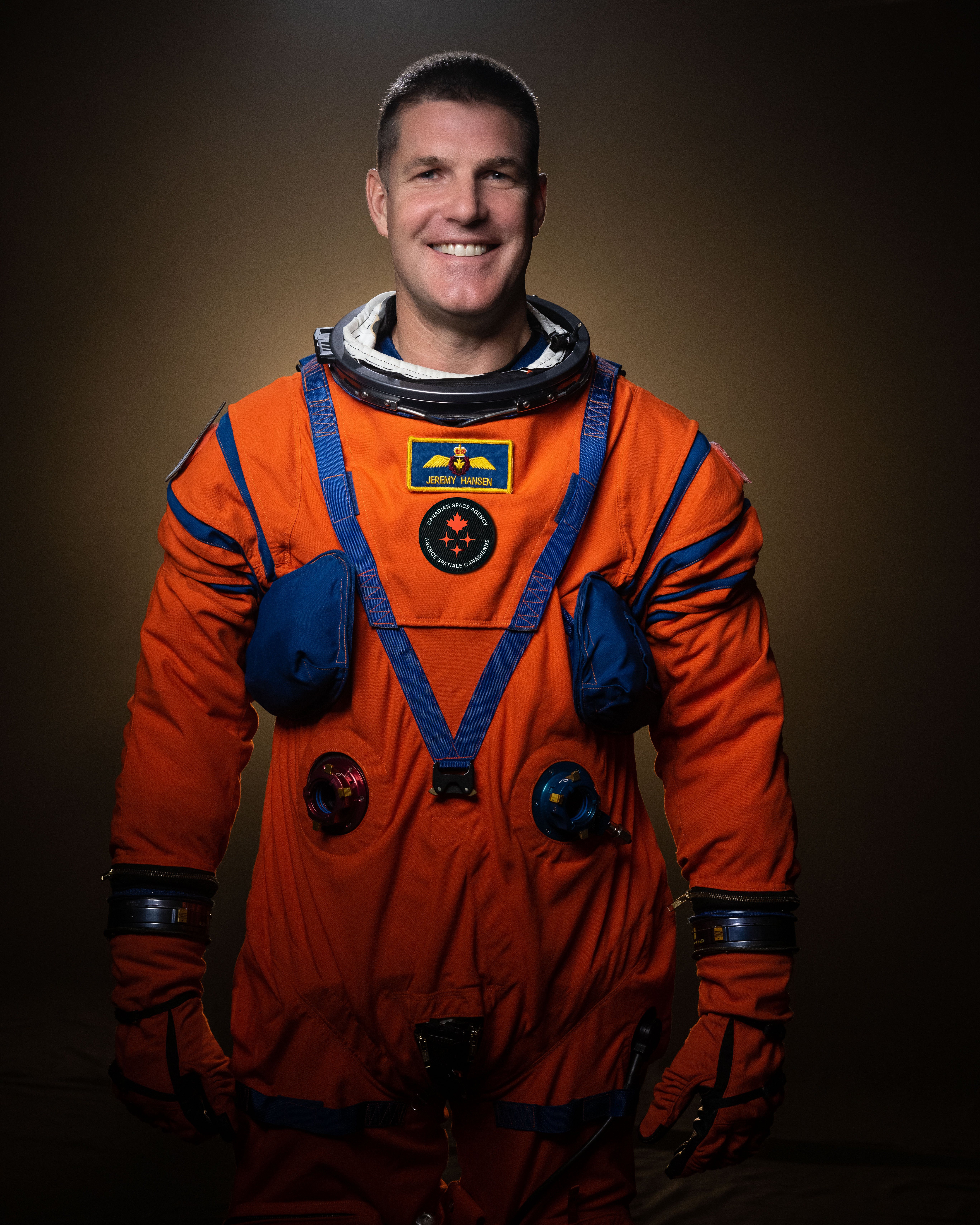
It's a pretty exciting time for me and the entire crew right now. As we enter these final days of preparations, we never know when the launch will actually be.
It's this weird sense of, like, in some moments, I'm super-excited. And I'm thinking, "Wow, this is coming." I'm starting to feel that. And then the next moment, I'm like, "Wow, I gotta really get to work. Like, time is running out, and we still have work to do." But it's an extraordinary opportunity,
We're going to have extraordinary things that we will see. [Seeing] Earth from the moon: It's something amazing. And I think that's important for humanity to take a break during the mission and look at the image, and realize that we can do better here. That we can do extraordinary things when we collaborate. And it is possible to have international collaboration. It's possible to create together instead of destroying things. I hope that will be the case. I hope it [the mission] was something that tells the world we can do things better.
Space.com Staff Writer Josh Dinner and Editor in Chief Tariq Malik contributed to this story.
 Elizabeth HowellContributing Writer
Elizabeth Howell (she/her), Ph.D., was a staff writer in the spaceflight channel between 2022 and 2024 specializing in Canadian space news. She was contributing writer for Space.com for 10 years from 2012 to 2024. Elizabeth's reporting includes multiple exclusives with the White House, leading world coverage about a lost-and-found space tomato on the International Space Station, witnessing five human spaceflight launches on two continents, flying parabolic, working inside a spacesuit, and participating in a simulated Mars mission. Her latest book, "Why Am I Taller?" (ECW Press, 2022) is co-written with astronaut Dave Williams.
View MoreYou must confirm your public display name before commenting
Please logout and then login again, you will then be prompted to enter your display name.
Logout MORE FROM SPACE... 1Where should we send a real 'Hail Mary' spacecraft? A new study has the answers
- 2Astrophotographer captures spectacular photo of Antennae Galaxies dueling in deep space
- 3This Week In Space podcast: Episode 203 — China Rising
- 4'Project Hail Mary' author Andy Weir reveals his favorite scenes in the movie, praises Ryan Gosling's amazing performance, & more (interview)
- 5This Celestron Firstscope is my go-to for moonwatching and it's 15% off in Amazon's Spring Sale