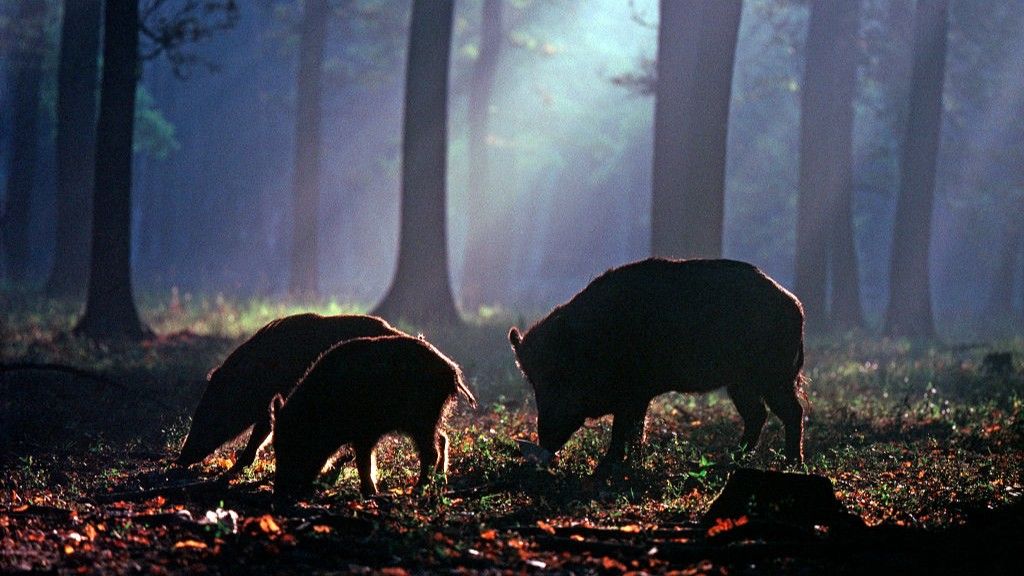
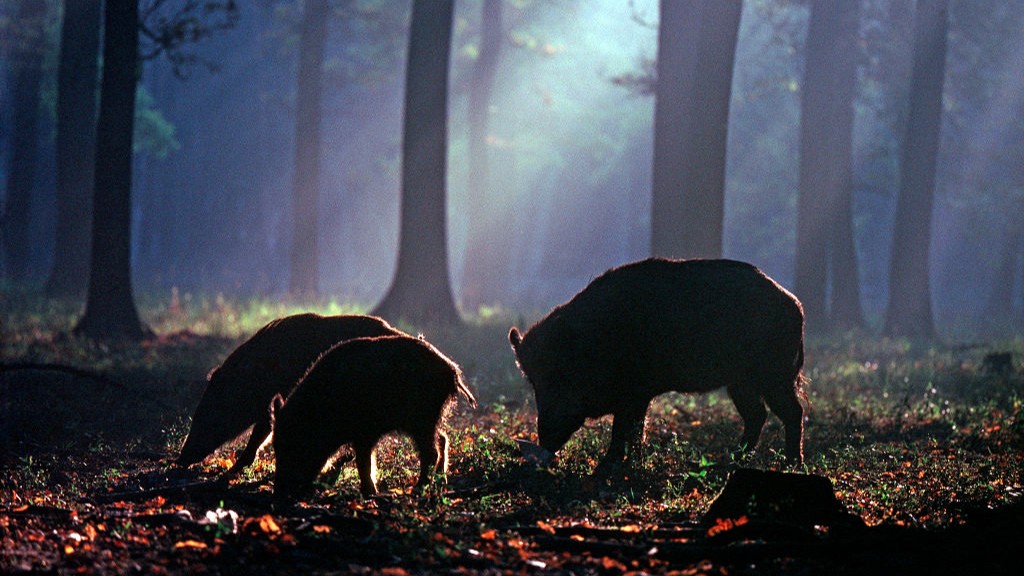
 Doggerland, which now sits beneath the North Sea, once had temperate forests with animals such as boars and deer, a new study suggests. (Image credit: Harald Lange/ullstein bild via Getty Images) Share this article 0 Join the conversation Follow us Add us as a preferred source on Google Newsletter Get the Live Science Newsletter
 Get the world’s most fascinating discoveries delivered straight to your inbox.
Become a Member in Seconds
Unlock instant access to exclusive member features.
Contact me with news and offers from other Future brands Receive email from us on behalf of our trusted partners or sponsors By submitting your information you agree to the Terms & Conditions and Privacy Policy and are aged 16 or over.You are now subscribed
Your newsletter sign-up was successful
Want to add more newsletters?
Join the club
Get full access to premium articles, exclusive features and a growing list of member rewards.
Explore An account already exists for this email address, please log in. Subscribe to our newsletterA sunken landmass that connected Britain to mainland Europe until a few thousand years ago may have been an excellent refuge for plants and animals, including humans, during the last ice age, a new study finds.
Parts of Doggerland, which is now submerged under the North Sea, hosted temperate forests as early as 16,000 years ago — long before such forests recolonized Britain and northwestern Europe following the final retreat of glaciers about 11,700 years ago.
Article continues belowOaks (Quercus), elms (Ulmus) and hazel trees (Corylus) thrived for millennia in southern Doggerland, where the new study was conducted, before the landmass disappeared. Previous estimates suggest Doggerland was fully inundated by 7,000 years ago, but the new results indicate this may have happened closer to 6,000 years ago. Researchers reconstructed the region's long-lost terrestrial ecosystem using DNA that was preserved in dirt under the sea for thousands of years, known as ancient sedimentary DNA.
"We got evidence of boars, deer, bears, aurochs," study lead author Robin Allaby, an evolutionary geneticist and professor of genomics at the University of Warwick in the U.K., told Live Science. "To my knowledge, it's the largest sedimentary DNA study that's been done."
Allaby and his colleagues analyzed 252 samples from 41 cores that they drilled up from beneath the North Sea off the coast of England. Specifically, the researchers took the cores along the prehistoric, 20-mile-long (30 kilometers) Southern River, situated in what was once southern Doggerland.
Researchers have long known that Doggerland was forested before it was inundated by the North Sea. But the ages of those forests were unclear, so scientists assumed that they appeared around the same time as forests in Britain. The consensus prior to this new research was that 16,000 years ago, southern Doggerland was tundra (a dry, treeless plain), not forest, Allaby said. At that time, ice sheets reached down to what is now the border between Scotland and England, he added.
Sign up for the Live Science daily newsletter nowContact me with news and offers from other Future brandsReceive email from us on behalf of our trusted partners or sponsorsThe researchers analyzed sediments in the cores and separated them into two categories: secure and insecure. Secure sediments were fine silts and clays that contained ancient DNA from species that lived in the area where the core was taken. Insecure sediments were coarser sand and gravel that contained ancient DNA that was shed far from where the core was extracted, meaning this DNA was not useful to reconstruct the local ecosystem.
"That just makes perfect sense," Allaby said, as "DNA doesn't survive long in water." Sediments are usually transported and deposited in fluid, with slow-moving waters picking up only fine sediments and fast-moving, higher-energy waters shifting coarser sediments. Slow-moving waters can transport sediments carrying DNA only short distances before the DNA quickly degrades. Fast-moving waters, on the other hand, can transport sediments with DNA much farther before it disintegrates.
This means that when the researchers found fine sediments with ancient DNA in the cores, that DNA was likely to have been shed locally. DNA in coarse sediments was probably from upstream ecosystems. Therefore, "we could pick out the samples which we would not trust to be telling us about the local environment," Allaby said.
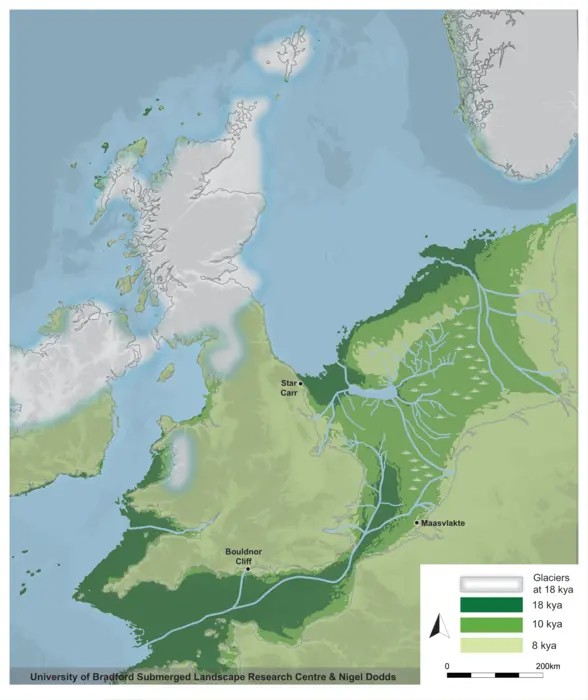
Ancient DNA in secure sediments showed that temperate trees and forest animals lived around the Southern River starting about 16,000 years ago, when much of Northwest Europe and Britain was still covered in tundra. Remarkably, the researchers identified DNA from a walnut relative (Pterocarya) that was thought to have gone extinct from the region 400,000 years ago. The team also found traces of warmth-loving lime trees (Tilia), suggesting that southern Doggerland was milder than the surrounding regions during the last ice age.
"Our knowledge is very imprecise, as it turns out," Allaby said. "This is not pure tundra — there is enough of an environment here to sustain something that looks like a forest."
The results, published March 10 in the journal PNAS, indicate that Stone Age people would have had "plenty to live on" in southern Doggerland after ice sheets retreated from the area about 21,000 years ago, Allaby said. "We can predict where good places for settlement would be, and typically at the mouths of rivers is the place to go, because you're close to resources."
RELATED STORIES—Ancient humans waited out last ice age in frigid Central Europe, surprising study finds
—18,000 years ago, ice age humans built dwellings out of mammoth bones in Ukraine
The findings could also help resolve Reid's paradox, which describes the mismatch between seed dispersal rates and how quickly trees like oaks recolonized northern regions from farther south after the last ice age, the researchers said. Southern Doggerland or another nearby region, such as northern France, may have been a glacial "microrefuge" for temperate trees, enabling species to spread north much faster than they could have done if they had survived only on the Iberian Peninsula, for example.
Finally, the study indicated that the North Sea fully submerged southern Doggerland around 6,000 years ago, which is at least 1,000 years earlier than previous estimates of when the landmass was inundated.
"It's another highlight of the imprecision of what our knowledge is of this landscape," Allaby said. "It really is a frontier."
Article SourcesAllaby, R. G., Ware, R., Cribdon, R., Hansford, T. A., Kinnaird, T., Hamilton, D., Kistler, L., Murgatroyd, P., Bates, R., Fitch, S., & Gaffney, V. (2026). Early colonization before inundation consistent with northern glacial refugia in Southern Doggerland revealed by sedimentary ancient DNA. Proceedings of the National Academy of Sciences, 123(11), e2508402123. https://doi.org/10.1073/pnas.2508402123
 Sascha PareStaff writer
 Sascha is a U.K.-based staff writer at Live Science. She holds a bachelor’s degree in biology from the University of Southampton in England and a master’s degree in science communication from Imperial College London. Her work has appeared in The Guardian and the health website Zoe. Besides writing, she enjoys playing tennis, bread-making and browsing second-hand shops for hidden gems.
View MoreYou must confirm your public display name before commenting
Please logout and then login again, you will then be prompted to enter your display name.
Logout LATEST ARTICLES 1A man went to the doctor for a bad UTI and learned he had an extra kidney
- 2Watch out-of-this-world space documentaries for less with this Paramount+ deal
- 3Top 16 health and fitness deals to snap up at Amazon ahead of the Big Spring Sale
- 4Understanding telescope magnification: A beginner’s guide to eyepieces, aperture and getting the best views
- 5Brazil's underprotected Cerrado savanna stores a staggering amount of carbon, study finds