
The most beautiful of all the zodiacal constellations is now visible, low toward the south-southeast as darkness falls. This is Scorpius the Scorpion. It really does look like a scorpion, one of the few star patterns that readily suggests the mythical form assigned to it by the ancients. Composed of several fairly bright stars, its body is formed by the upper stars of this star pattern; its tail slants toward the horizon, then curves to the left and upward, a fine stream of stars ending in a close pair of stars marking its stinger.
George Lovi (1939-1993), a well-known astronomy lecturer and author, used to say that it always bothered him that a striking star pattern such as Scorpius was made to represent "...a lowly, creepy-crawly thing that has few friends."
In his book, The Stars in Our Heaven, author Peter Lum (1911-1983) provides a perspective like Mr. Lovi's:
"The scorpion . . . is an odd-shaped, insignificant creature, but its sting is out of proportion to its size and, although seldom fatal, is extremely painful; hence it is usually disliked, feared and avoided by anyone who has ever come in contact with him."
Just as Orion is the most striking winter stellar pattern, such a distinction can be claimed for Scorpius for the summer season. Interestingly, one legend has Scorpius representing the creature that stung Orion to death. To honor Orion, the Scorpion was placed opposite him in the sky, so that these celestial antagonists will never meet again. Indeed, when Orion disappears below the western horizon during spring evenings, the Scorpion is poking his head up in the southeast. In addition, they were commonly thought of in opposition to each other: Orion was the constellation of life, Scorpius that of death.
And yet, the whole figure of the scorpion is a magnificent sight — sort of a "celestial fishhook" — and is best appreciated now in a dark sky without any interference from bright moonlight. It really looks like a huge scorpion, with its long stinging tail curled over its back. Two closely spaced stars known as Shaula and Lesath mark the Scorpion's stinger. Astronomy popularizer Hans A. Rey (1898-1977) christened these stars the "Cat's Eyes," noting, "You will find the name quite fitting."
Best seen from southern locales
Scorpius is a constellation that can be best appreciated by southerners. Those who live in the far-northern United States, southern Canada or the British Isles will have part or even all of its tail hidden below the southern horizon. Thus, it is well worth seeking out a good, clear horizon to appreciate this majestic figure. As one progresses farther south, the Scorpion slowly climbs the southern sky. Those who live in Australia, New Zealand, South Africa, northern Argentina, Uruguay, most of Brazil, northern Chile, and southern Peru see Scorpius high overhead. The Milky Way passes through the lower extremities of the Scorpion. Here, clouds of stars and dark interstellar dust combine in a bewildering array as seen in binoculars and telescopes.
The Milky Way captured by Alan Dyer from Warrumbungles Mountain Motel, near Coonabarabran, NSW, Australia. Antares and Scorpius shine to the upper right. (Image credit: Photo by: Alan Dyer/VWPics/Universal Images Group via Getty Images)
Ruddy contender to Mars
The Scorpion's brightest star is the first magnitude Antares, displaying a reddish hue. Antares appears due south at 10:30 p.m. local daylight time on Independence Day; a month later, you'll find it there two hours earlier as darkness falls. To the ancients, its distinctive red color suggested the planet Mars and the name Antares means literally "The Rival of Ares," Ares being the Greek name for the God of War. There was good reason for this, for unlike the fixed stars, the planets could wander against the starry background, and this ability to move had a magical, god-like quality.
Evidence of this lies in the very names of the planets, which represented ancient deities, and of the five bright planets, the one whose color appeared to come closest to that of blood was called Mars in honor of the god of war. But although often referred to as the "red planet," in the sky, it really appears more yellowish orange, fiery, or pumpkin-hued as opposed to red.
In contrast, Antares is one of the reddest stars in the sky. On those occasions when Mars passes just north of Antares, it is obvious which one is redder. So even when Mars is near opposition and appears to glow many times brighter, Antares still rivals it at least in color.
Scorpius and its surrounding constellations. (Image credit: lixu via Getty Images)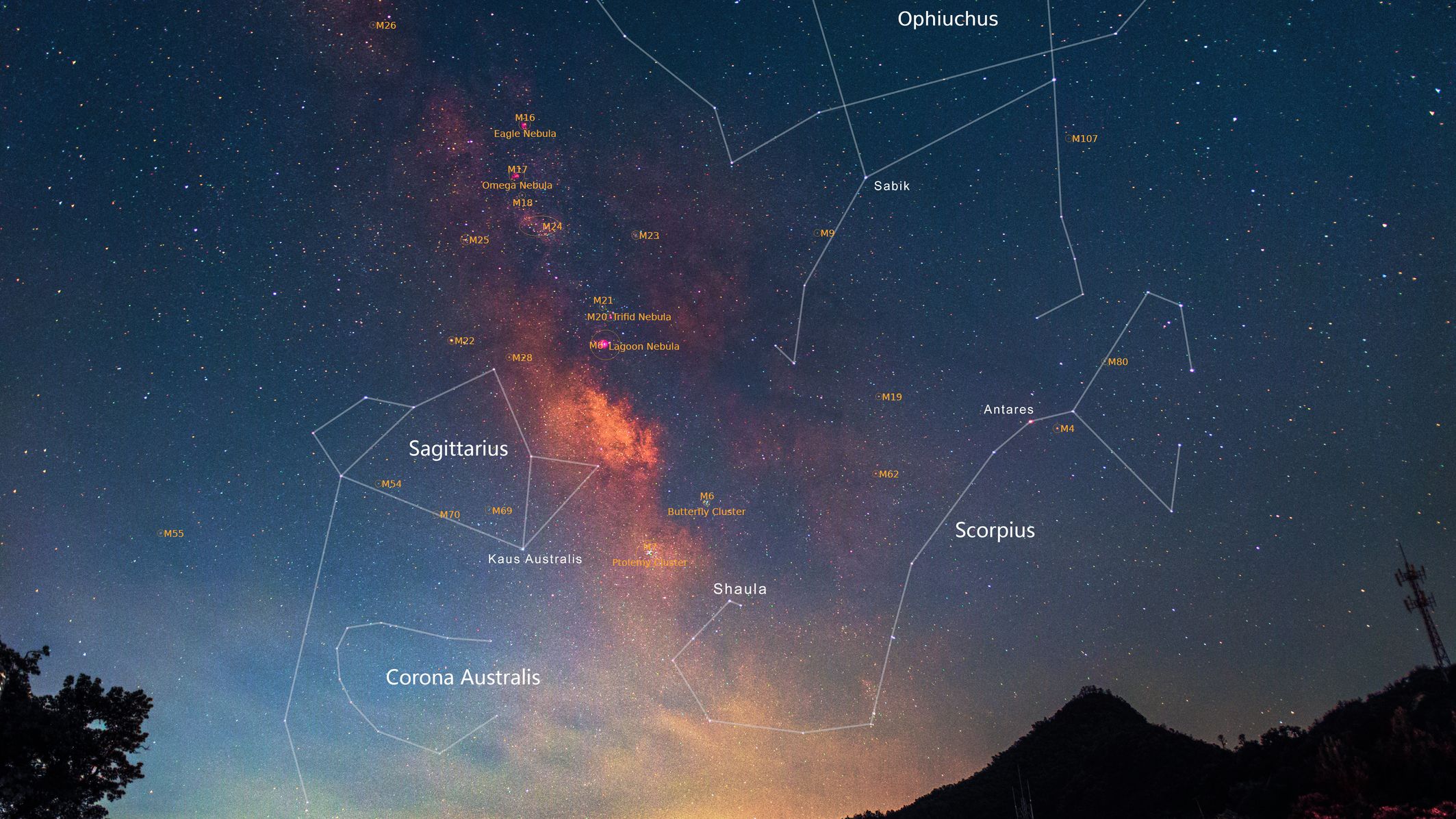
A star of many names
In the time of Confucius, the Chinese called this star Ta Who, "The Great Fire," at the heart of the Dragon of the East. Another Chinese legend refers to Antares and its two attendants — two fainter stars that flank it — as the Ming T'ang, the "Hall of Light" or the "Emperor's Council Hall." Those two stars are about equally bright — Sigma Scorpii (+2.8) and Tau Scorpii (+2.9). They are sometimes called the Praecordia — "the outworks of the heart," the heart of course being Antares.
The Romans called this mighty star Cor Scorpionis, meaning "heart of the scorpion," a title the French also use — Le Coeur de Scorpion. Some 5,000 years ago, the Persians thought of Antares as one of the four Royal Stars, a guardian of heaven.
Enormous celestial beacon
Antares is a cool, red supergiant star, about 550 light-years away. It is some 76,000 times more luminous and about 680 times the diameter of our sun. It's an irregular variable star, meaning that it expands and contracts in an unpredictable manner, causing its brightness to fluctuate. It has been observed to shine as brightly as magnitude +0.9, while at other times, its brightness has been down to +1.2. It usually ranks as the 15th on the list of the twenty-one brightest stars in the sky.
If our solar system were centered on Antares, the orbit of the Earth would easily fit within this star. Yet, despite these impressive statistics, it should be noted that the overall mass of Antares is only 13 to 16 times that of the sun, so it is not very dense. Its insides might be like a very hot vacuum.
Antares is also relatively cool as stars go, only about 6,100º F (3,400 ºC), compared to 11,000º F (6,000 ºC) for the sun. Its low temperature accounts for its ruddy color. It has a small, very hot companion, bluish white in color, yet has been described as appearing as ". . . a little spark of glittering emerald" because of its proximity and contrast to ruddy Antares. The pair orbit each other over a span of nearly 900 years, separated by a distance of about 500 times Earth's distance from the sun.
Caught in the claws
The constellations Scorpius and Libra overlap at the scorpion's claws (Image credit: "Celestial Atlas 1822" by Alexander Jamieson)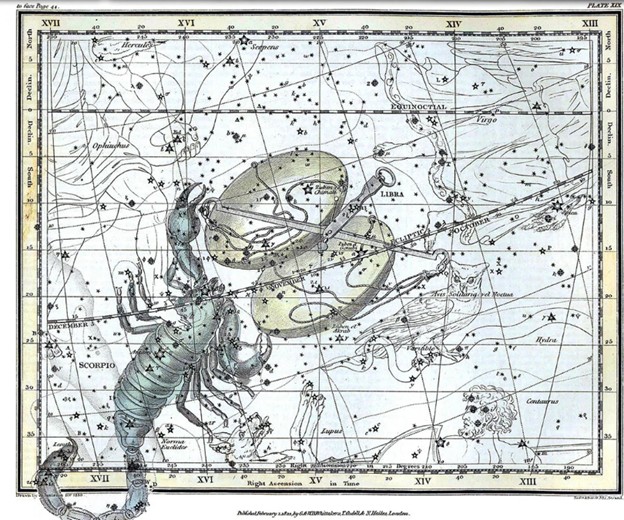
Scorpions have two large claws in front, but this one seems to have had its claws clipped; they were cut off to form the constellation of Libra the Scales, one of the constellations of the zodiac and associated with Themis, the Greek goddess of justice, whose attribute was a pair of scales. These stars still both carry Arabic names: Zubeneschamali ("northern claw") and Zubenelgenubi ("southern claw"), to help distinguish them as originally belonging to Scorpius.
Lastly, it must be emphasized to those newcomers to astronomy that the currently accepted name of this constellation is Scorpius, not Scorpio. Principally, astrologers (and some older astronomy books) use the latter for labeling the zodiacal sign of that name.
Just stingin' the nomenclature.
Joe Rao serves as an instructor and guest lecturer at New York's Hayden Planetarium. He writes about astronomy for Natural History magazine, Sky and Telescope, The Old Farmer's Almanac and other publications.