
 Blue Origin conducts a static fire test with its New Glenn rocket on April 16, 2026. (Image credit: Blue Origin) Share this article 0 Join the conversation Follow us Add us as a preferred source on Google Newsletter Get the Space.com Newsletter
 Breaking space news, the latest updates on rocket launches, skywatching events and more!
Contact me with news and offers from other Future brands Receive email from us on behalf of our trusted partners or sponsors By submitting your information you agree to the Terms & Conditions and Privacy Policy and are aged 16 or over.You are now subscribed
Your newsletter sign-up was successful
Want to add more newsletters?
An account already exists for this email address, please log in. Subscribe to our newsletterJeff Bezos' space company is about to take a giant leap toward reusable orbital rockets.
Blue Origin's New Glenn rocket is poised to lift off for the third time ever on Sunday (April 19) — but for the first time with previously flown hardware. The mission, called NG-3, will deliver BlueBird 7, a direct-to-cellphone internet satellite, to low Earth orbit (LEO), flying the same first-stage booster core that launched NG-2, but with new engines.
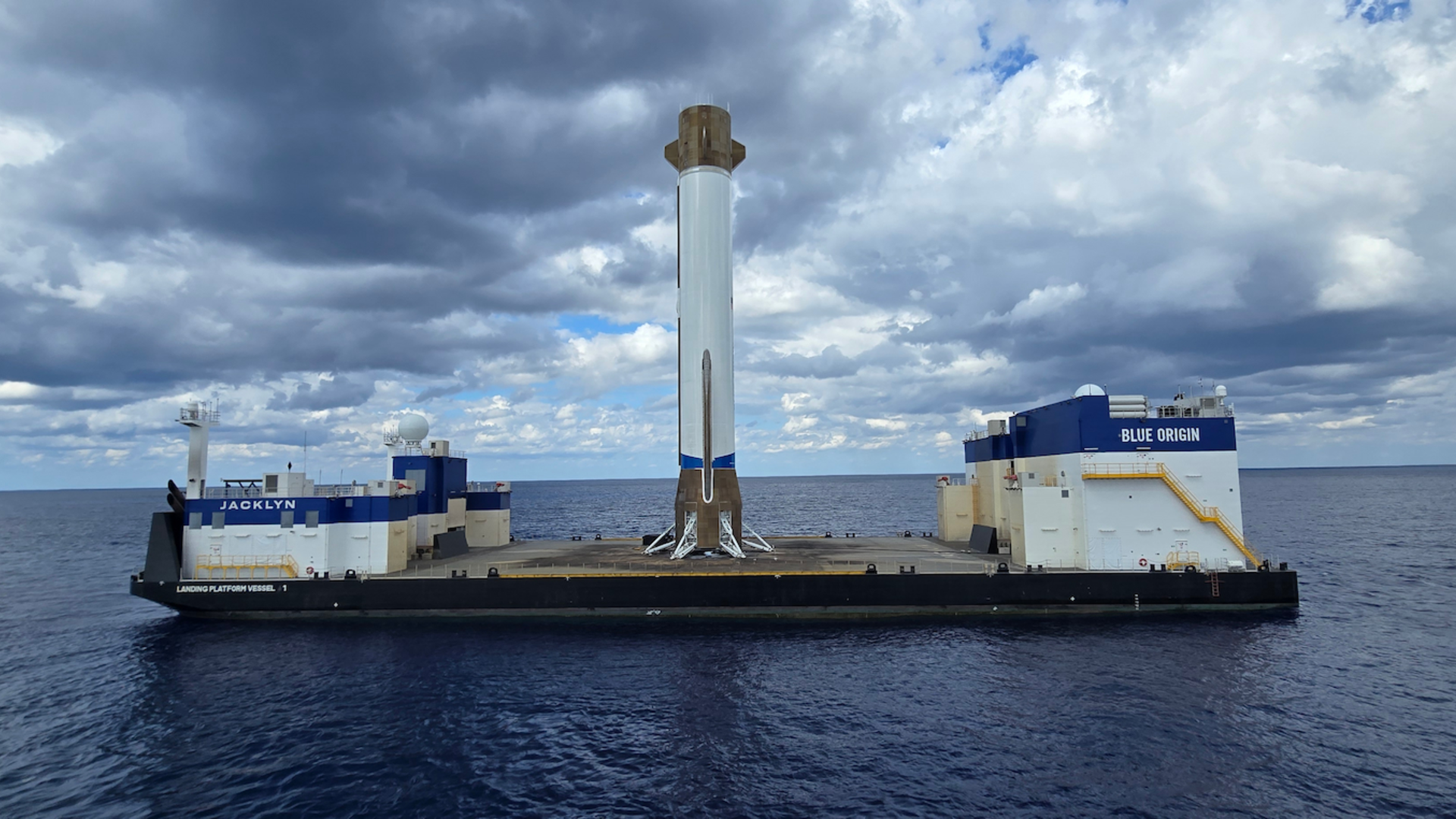
If all goes according to plan, New Glenn's first stage will shut off its engines and separate from the upper part of the rocket about 3.5 minutes into flight, landing, hopefully, on Blue Origin's droneship, "Jacklyn," in the Atlantic Ocean around six minutes later.
BlueBird 7 will be the second "Block 2" satellite in the internet constellation of Texas-based company AST SpaceMobile. Its predecessor, BlueBird 6, launched on an Indian LVM3 rocket last December. BlueBird 6 is one of the largest satellites in space, with an antenna that spans 2,400 square feet (223 square meters). BlueBird 7 has the same dimensions.
BlueBirds 1-5, the "Block 1" version, while sizable in their own right, pale in comparison; their antennas cover a more modest 693 square feet (64.4 m) apiece.
This third launch of New Glenn is a major milestone for Blue Origin, which has designed the rocket's first stage to be fully reusable. Such a capability would allow the company to compete with SpaceX's Falcon 9, Falcon Heavy and Starship rockets, the only orbital-capable boosters to date with proven reusability.
Get the Space.com NewsletterContact me with news and offers from other Future brandsReceive email from us on behalf of our trusted partners or sponsorsNew Glenn stands 322 feet (98 meters) tall — about the same size as the NASA Space Launch System (SLS) rocket that launched the Artemis 2 mission around the moon, and nearly 100 feet (30 m) taller than the 230-foot (70-m) Falcon 9.
New Glenn's first stage is powered by seven BE-4 engines, which burn a fuel mixture of liquid oxygen and liquid methane, known as methalox — the same fuel used by the 33 SpaceX-built Raptor engines that power Starship's Super Heavy booster. And right now, both launch vehicles need to prove themselves.
Blue Origin is relying on New Glenn to launch the company's Blue Moon lander, one of two commercial vehicles NASA selected to land astronauts on the moon as part of the agency's Artemis program.
SpaceX had been NASA's first choice for a crewed lunar lander, with Starship slated to put astronauts on the moon on the Artemis 3 mission. But delays in the development of both companies' spacecraft and a recent shakeup of Artemis architecture has put Blue Moon back in the spotlight.
Artemis 3 will no longer go to the moon. NASA now wants astronauts aboard its Orion spacecraft to practice rendezvous and docking maneuvers in Earth orbit with either or both of the lunar landers, and has indicated a willingness to fly with whichever is ready once it's time to launch — hopefully, in mid-2027.
Both landers have a list of qualifications and technology demonstrations to complete before NASA certifies either to support astronauts aboard, such as on-orbit cryogenic fuel transfer and uncrewed lunar landings, but each is making progress.
SpaceX is currently performing prelaunch tests on the Version 3 (V3) of its Super Heavy booster and Starship upper stage, which are expected to lift off on the vehicle's 12th test flight in the coming weeks. Meanwhile, the Mark 1 (Mk1) Blue Moon vehicle recently completed a stint inside the massive vacuum chamber at NASA's Johnson Space Center in Houston and will be shipped to the Kennedy Space Center, in Florida, for further testing.
New Glenn, too, has more ground to cover. Blue Origin has a lot riding on the NG-3 launch — more than just the massive BlueBird 7 payload. The first reuse of a New Glenn first stage, even if its engines are new, is a significant step toward the company's ultimate vision for the rocket, whose first stages are designed to fly at least 25 times apiece.
Of the two New Glenn missions to date, only NG-2 successfully landed its first stage aboard the Jacklyn droneship. That mission launched NASA's ESCAPADE probes on a mission to Mars in November 2025. New Glenn debuted in January 2025, on a mission that reached orbit successfully but did not pull off a first-stage landing.
The NG-2 booster, dubbed, "Never Tell Me the Odds," was refurbished and integrated with the new set of BE-4s and the rest of the launch vehicle earlier this month, according to Blue Origin CEO Dave Limp, in an April 7 post on X.
"With our first refurbished booster we elected to replace all seven engines and test out a few upgrades including a thermal protection system on one of the engine nozzles. We plan to use the engines we flew for NG-2 on future flights," he said in another post, on April 13.
New Glenn was rolled out to the pad at LC-36 on April 13, where Blue Origin performed a series of tests leading up to a 19-second static test firing of the rocket's engines on April 16.
 Josh DinnerStaff Writer, Spaceflight
Josh Dinner is Space.com's Spaceflight Staff Writer. He is a writer and photographer with a passion for science and space exploration, and has been working the space beat since 2016. Josh has covered the evolution of NASA's commercial spaceflight partnerships and crewed missions from the Space Coast, NASA science missions and more. He also enjoys building 1:144-scale model rockets and spacecraft. Find some of Josh's launch photography on Instagram, and follow him on X, where he mostly posts in haiku.
View MoreYou must confirm your public display name before commenting
Please logout and then login again, you will then be prompted to enter your display name.
Logout MORE FROM SPACE... 1How the 'Project Hail Mary' book walks the line between hard and speculative science fiction… and why the film did not
- 2New moon of April 2026 brings incredible views of the constellation Hydra, Jupiter, Venus and more this week
- 3'Tall waves moving in slow motion': Here's how oily oceans on Saturn's giant moon Titan may behave
- 4'For All Mankind' alternative timeline vs reality: How Apple TV's sci-fi show diverges from history
- 5Hubble Space Telescope spots a mesmerizing spiral galaxy | Space photo of the day for April 17, 2026