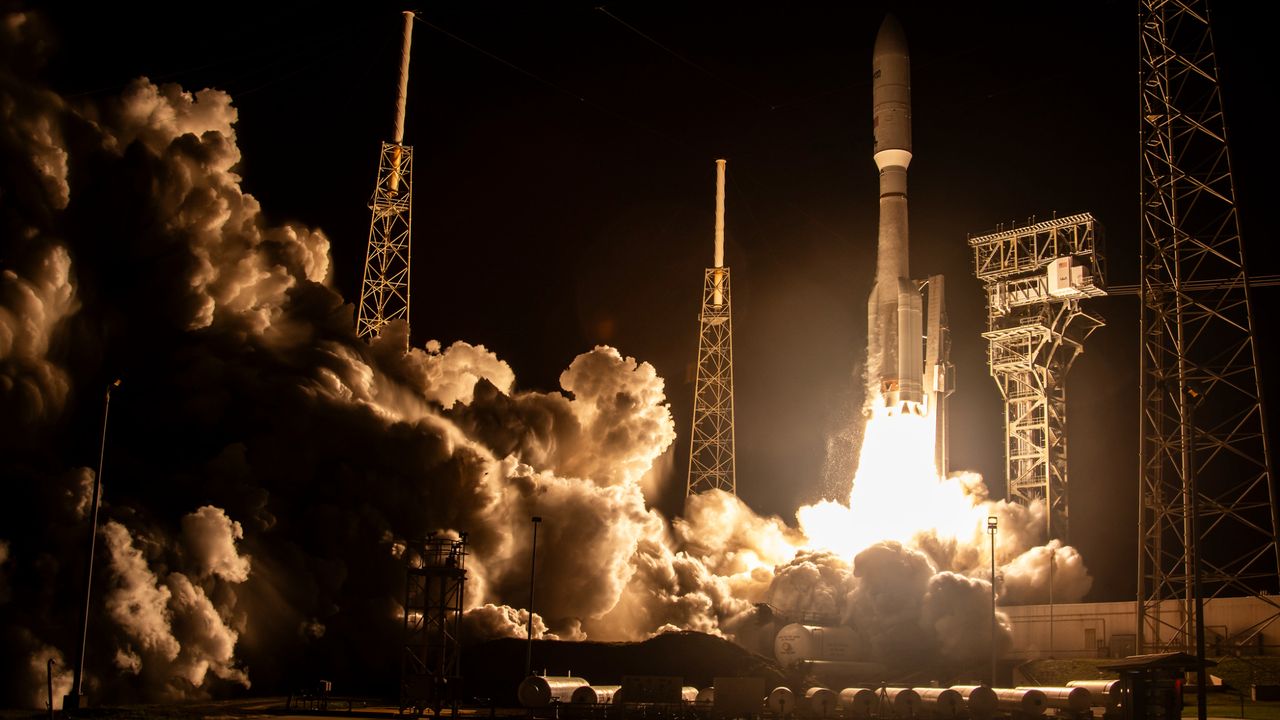
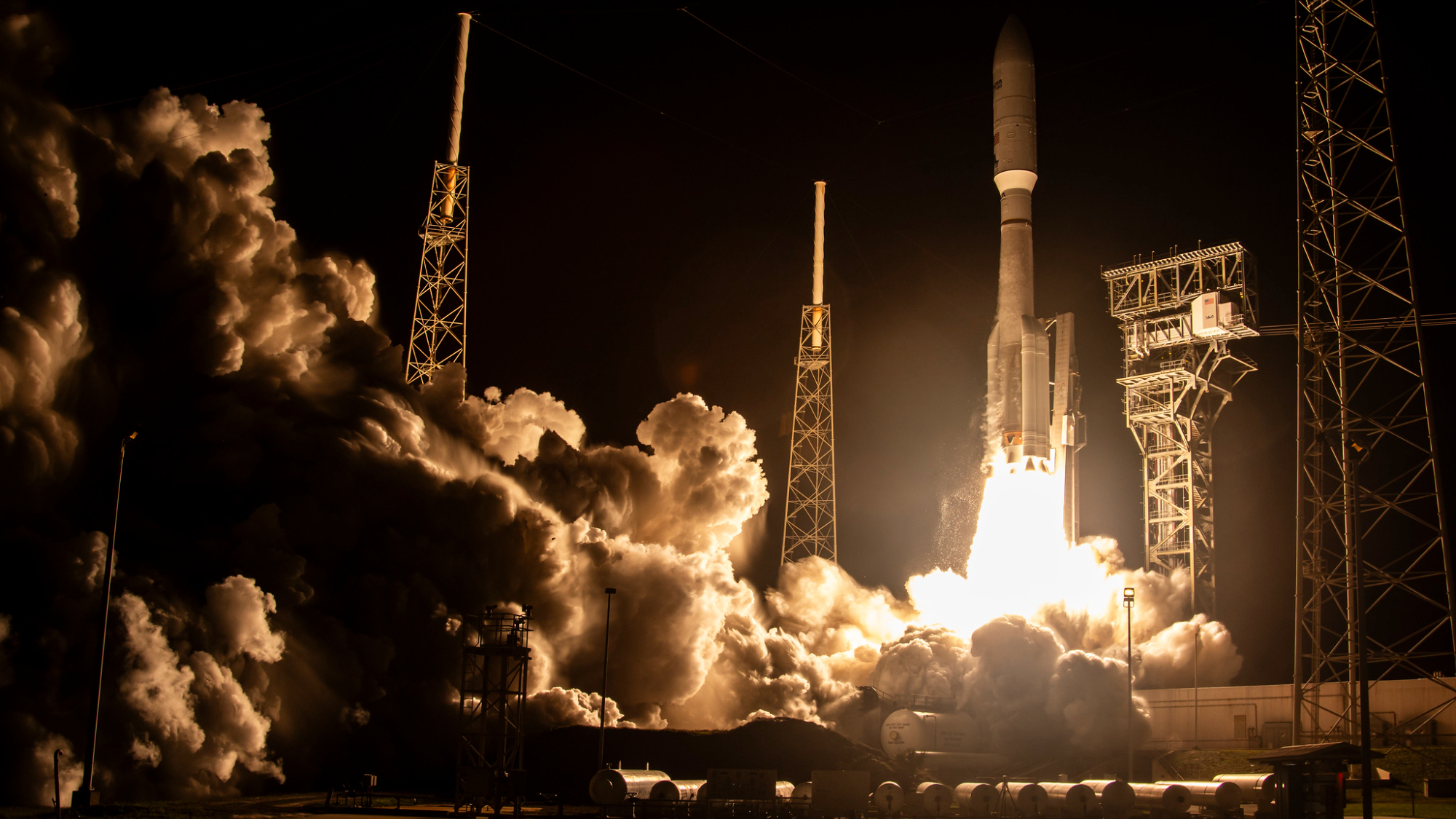
 A United Launch Alliance Atlas V rocket launches 27 Amazon Leo internet satellites to orbit on Dec. 16, 2025. (Image credit: ULA) Share this article 0 Join the conversation Follow us Add us as a preferred source on Google Newsletter Get the Space.com Newsletter
 Breaking space news, the latest updates on rocket launches, skywatching events and more!
Contact me with news and offers from other Future brands Receive email from us on behalf of our trusted partners or sponsors By submitting your information you agree to the Terms & Conditions and Privacy Policy and are aged 16 or over.You are now subscribed
Your newsletter sign-up was successful
Want to add more newsletters?
An account already exists for this email address, please log in. Subscribe to our newsletter Rocket Launch: Amazon Leo 5 - YouTube Watch On
 A United Launch Alliance (ULA) Atlas V rocket will launch its heaviest-ever payload on Saturday morning (April 4), and you can watch the action live.
The Amazon Leo megaconstellation, previously known as Project Kuiper, will eventually consist of about 3,200 satellites in low Earth orbit. It's Amazon's answer to SpaceX's Starlink network, which beams internet service down from more than 10,000 satellites (and counting).
Amazon Leo is still in its early stages; just 212 of the spacecraft have reached orbit to date over the course of eight launches (not counting a 2023 liftoff that sent up two prototype satellites).
The Atlas V has flown four of those operational missions. Three employed SpaceX's Falcon 9, and the other one used Arianespace's Ariane 6 heavy lifter.
Saturday's launch, which Amazon calls LA-05, will be the first Atlas V mission to loft 29 Amazon Leo satellites; the others carried 27 of the spacecraft.
Get the Space.com NewsletterContact me with news and offers from other Future brandsReceive email from us on behalf of our trusted partners or sponsors"The increase is a result of detailed engineering work between Amazon Leo and ULA, and is made possible by a new, higher-performing version of the RL10C engine used on the rocket's Centaur upper stage," Amazon representatives wrote in a mission description. "While the engine has flown on previous missions, LA-05 marks the first time the program has completed the extensive engineering and safety analysis required to use it with our larger payload."
And that payload is larger in a significant way, according to the LA-05 mission description: "With 29 satellites aboard, LA-05 will mark the heaviest payload ever flown on an Atlas V."
 Mike WallSpaceflight and Tech Editor
Michael Wall is the Spaceflight and Tech Editor for Space.com and joined the team in 2010. He primarily covers human and robotic spaceflight, military space, and exoplanets, but has been known to dabble in the space art beat. His book about the search for alien life, "Out There," was published on Nov. 13, 2018. Before becoming a science writer, Michael worked as a herpetologist and wildlife biologist. He has a Ph.D. in evolutionary biology from the University of Sydney, Australia, a bachelor's degree from the University of Arizona, and a graduate certificate in science writing from the University of California, Santa Cruz. To find out what his latest project is, you can follow Michael on Twitter.
View MoreYou must confirm your public display name before commenting
Please logout and then login again, you will then be prompted to enter your display name.
Logout MORE FROM SPACE... 1NASA is sending astronauts back to the moon. Can you see the Artemis 4 landing sites from Earth?
- 2How to watch the new 'lost' Doctor Who episodes from anywhere in the world
- 3Pulsars to the extreme: Spinning dead stars found blasting radio signals from the 'edge of their magnetic reach'
- 4NASA's Artemis 2 astronauts are cruising to the moon. So why are they doing CPR tests today?
- 5DJI Avata 360 drone review