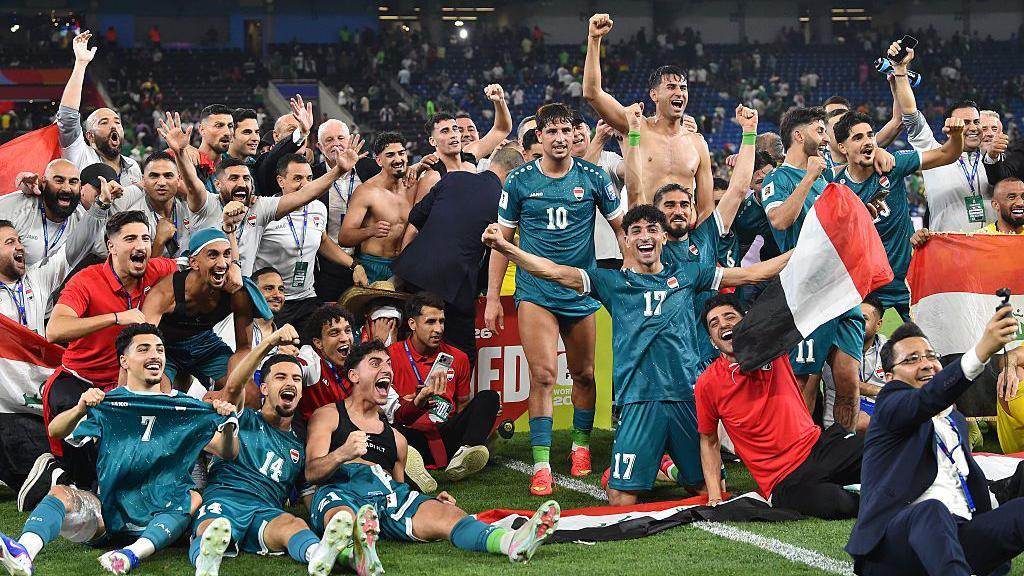
 Image source, Getty ImagesImage caption,
 Iraq qualified for their first World Cup in 40 years with a play-off win in March
ByJohn DuerdenBBC Sport- Published30 minutes ago
It was fitting that Iraq secured a place at the 2026 World Cup by beating Bolivia in Mexico, the location of their first ever appearance on the global stage back in 1986.
Karim Allawi was a player 40 years ago as the Lions of Mesopotamia lost all three games against Paraguay, Belgium and the hosts but now he is a fan, desperately hoping that his successors can fare a little better even if games against Norway, France and Senegal look daunting.
The 66-year-old will, along with the vast majority of the 46 million people in the football-mad country, be watching on 16 June as Iraq take on Erling Haaland's Norway in Boston.
"This is truly a group of death and tougher than 1986," Allawi told BBC Sport.
"France are multiple-time world champions, Norway are one of the strongest developing European teams, and Senegal are African champions who have qualified for the World Cup several times.
"I hope they deliver strong performances and achieve better results than we did in 1986."
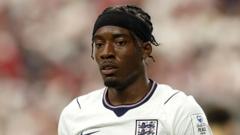
Compared to the past team, this Iraq side, ranked 57th in the world, is full of players with European experience such as Ali Al-Hamadi of Ipswich Town, former Manchester United midfielder Zidane Iqbal, now at Utrecht in the Netherlands, and Kevin Yakob, fresh from helping AGF become champions of Denmark.
Hiring Graham Arnold, who took Australia to the second round of the 2022 World Cup, in 2025 has also paid off.
The 62-year-old helped Iraq through the third and fourth rounds of qualification, a tight play-off victory against the United Arab Emirates before the win against Bolivia. That was the 21st game on a long road to the finals.
The celebrations may have died down but the excitement remains. TV sports reporter Nawar Faeq Al-Rikabi told the BBC: "People may think we are the weakest team in the group but anything could happen.
"We will be fine, there is no pressure on the Iraqi players, they just have to perform and we have quality players who can perform."
The addition of Arnold could make the difference. "In 2022, Argentina found it very hard to win against Australia," added Al-Rikabi. "It will be the same with us. He is very experienced and I think we will do something really good."
The target is to improve on 1986. "To score more than one goal would be a new achievement, to win a game would be a great achievement, to qualify for the next stage would be terrific. People have waited so long and we are now ready."
Al-Hamadi and Iqbal named in Iraq's World Cup squad
- Published20 hours ago
World Cup: Every squad as they are announced
- Published16 hours ago
The World Cup line-up is complete - here's what you need to know
- Published1 April
Wars, political challenges and sanctions
There has always been talent in Iraq but due to mainly off-pitch factors, it has taken four decades to return.
"Just like the country, the national team went through many difficult circumstances, including wars, political and economic challenges, and at times international sanctions," Allawi said.
"There was also, at times, a lack of proper planning for the qualifiers and insufficient preparation for matches. That is why it took such a long time."
And then there was Saddam Hussein. In 1984, the dictator placed his son in charge of Iraq football.
Uday Hussein instigated a reign of terror over the national team, a regime of cruel punishments and torture with full details emerging after the fall of the regime in 2003 – players being forced to train with concrete balls, being flogged and imprisoned and much more besides.
Allawi is reluctant to talk about those times. "To put it briefly, during that period, there was a very strict principle of reward and punishment in place," he said.
The US-led invasion that toppled Saddam also created years of instability that still affect football even today.
The national team has not played a World Cup qualifier in Baghdad since. In March 2020, Fifa gave the green light to the southern city of Basra, meaning that, at last, crucial home games did not have to take place in Jordan, Malaysia, Iran and elsewhere.
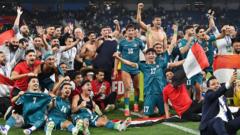
In 2026, conflict in the Middle East almost caused March's play-off against Bolivia to be postponed with some players, as well as coach Arnold struggling to get out of the country and into Mexico. In the end, they made it and returned victorious, on an open-top bus parade through the crowded streets of a delighted Baghdad.
BBC to show Scotland's first World Cup game since 1998
- Published10 December 2025
What would it cost England and Scotland fans to go to World Cup?
- Published3 May
Echoes of the 80s
When qualification was achieved in 1985, with a 3-1 win over Syria, the Iran-Iraq war meant that the game was played in Saudi Arabia.
"We were also playing our matches outside the country, which made the feeling even greater," said Allawi.
"It was similar when we came back, there was also a huge public attendance, and many celebrations were organised by the people, especially festivals and public gatherings. We were a good team."
This golden generation reached all three Olympics in the 1980s and won all kinds of regional championships.
Allawi played his part along the road to Mexico. "Throughout all the qualification matches, I was a starter but at the World Cup I was on the bench because of the injury I suffered the day before the Paraguay game. It was very unfortunate."
So were Iraq in a 1-0 loss that is still discussed to this day in Baghdad. Iraqi legend Ahmed Rahdi headed home an equaliser against the South Americans but the referee blew the whistle for half-time as the corner was on its way into the area.
"The referee did not count the goal and we suffered from poor decisions, against Belgium too, we had a red card and came close to equalising," said Allawi.
"Despite that, it was a special time, the atmosphere of the World Cup is completely different from any other tournament with massive crowds, legendary players everywhere.
"You try to get to know them and interact with players from different countries.
"They remain very good memories for us and I am sure that the players in the team now will say the same in years to come."
Related topics
World Cup fixtures and group standings

How to watch the World Cup on the BBC
- Published10 December 2025
Everything you need to know about the World Cup
- Published1 April