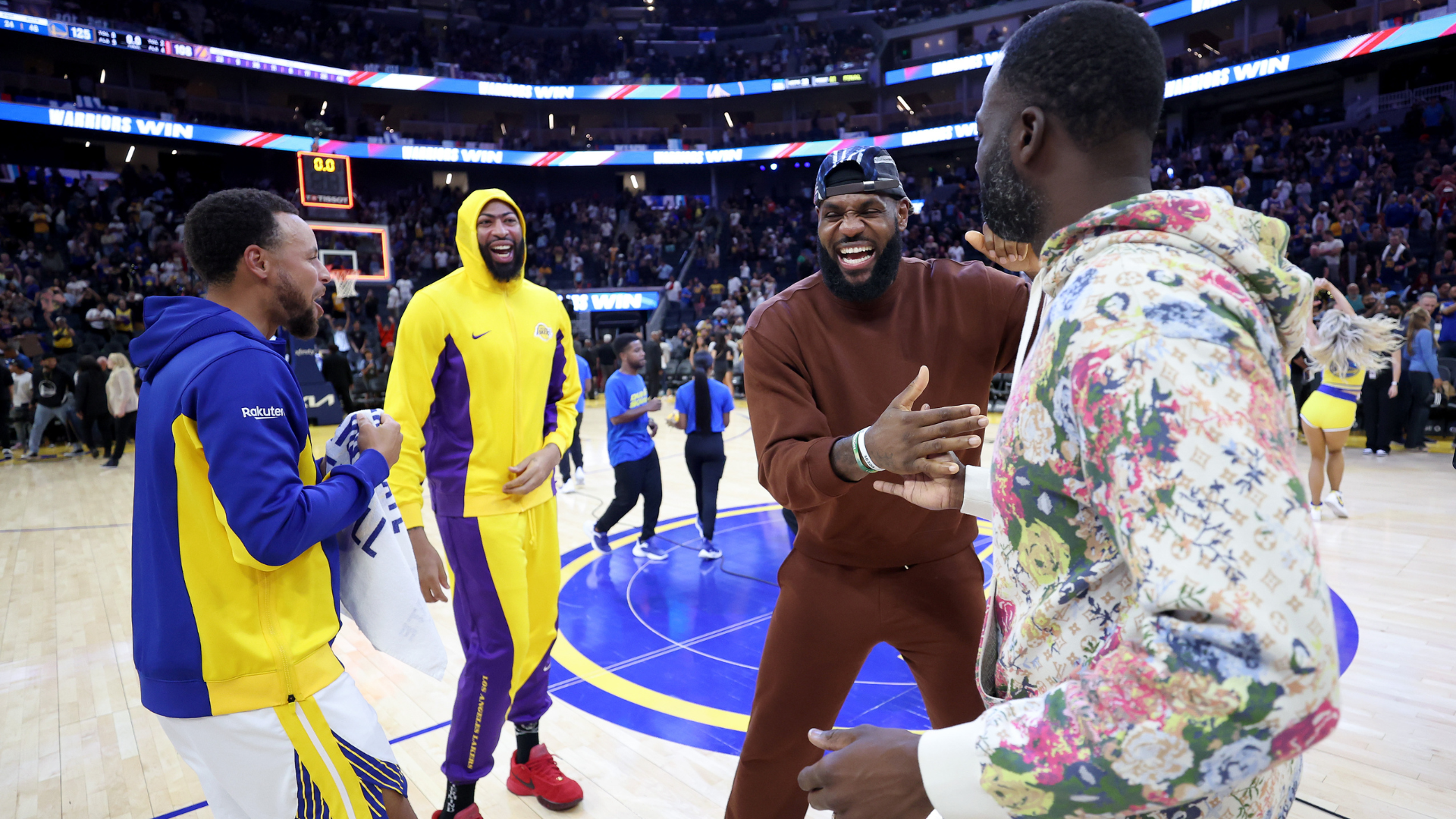
For most of the offseason, Draymond Green was expected to pick up his $27.7 million player option to return to the Golden State Warriors for the final season of his contract. On Monday, however, Green wound up declining that player option, technically making him an unrestricted free agent. The expectation should certainly still be for him to return to Golden State. Now, however, it seems as though he might be trying to bring some big names with him.
On Sunday, Yahoo's Kevin O'Connor reported that the Warriors are attempting to add both LeBron James and Anthony Davis to their roster for next season. Doing so would unite one of the most accomplished foursomes in NBA history, placing James, Davis, Green and Stephen Curry in Golden State. But actually uniting those four Hall of Famers was always going to be a multi-step process.
Green opting out is just the first potential step in that direction. So let's look at what his decision means for Golden State's ambitious pursuit of the duo that won the Los Angeles Lakers their 2020 championship.
What Green's decision does to Golden State's cap sheet
James has been making either a max or near-max salary for 19 years now. The Warriors have no means of generating the cap space it would take to pay him that much, though fortunately, it doesn't seem as though anyone else does either, and with the Lakers seemingly focused on spending their financial flexibility on a center and some wings, there does not appear to be a substantial offer for James on the table at this moment.
That puts his market somewhere in the range of the non-taxpayer mid-level exception, which starts at around $15 million. Using the full mid-level hard caps your team at the first apron. This was the first major impediment to Golden State's pursuit of James. The Warriors, with Green at his option figure, would have had around $20 million in space below that line if De'Anthony Melton also picks up his own $3.5 million player option. Let's assume for now that Melton opts out, so that figure is closer to $24 million.
However, in addition to James, they not only would have needed to fill out five roster spots to reach 14 players, but they also seemingly plan to try to bring back Kristaps Porziņģis, whom they acquired at the deadline. Porziņģis will seemingly have offers in the mid-level range as well, so paying both him and James with Green making $27.7 million likely would have been impossible without offloading more salary.
But now? The Warriors are looking at around $51 million in first-apron room without Melton accounted for. Assume that they devote one roster spot to second-round pick Laejae Jones at the rookie minimum, and another two to veterans earning minimum salaries. Bringing AD to Golden State would involve trading Jimmy Butler away. Davis makes around $2 million more than Butler does, so we'll have to factor that in here as well. That would leave Golden State around $43 million in spending power left to divide among James, Porziņģis and Green for their three final mandatory roster spots.
Why would Green willingly take such a big pay cut? Free agents will typically sacrifice a hefty, one-year salary in exchange for a longer deal at a lower average, annual salary. In theory, Green could re-sign with the Warriors on a multi-year deal at whatever his new cap figure is, or, if he prefers to avoid the limitations imposed by the hard cap, he could sign a one-year deal with a player option for a second with the idea that he could opt out next summer and re-sign at a more appropriate number. Remember, Green's agent is Rich Paul, who also represents James and Davis. Klutch Sports surely has an idea of what the Warriors are trying to do, and the sides will presumably work together closely to make this happens if it's what everyone wants.
It should be noted, though, that Davis is not a free agent. He cannot unilaterally elect to join the Warriors. So let's figure out what a trade might look like with the Washington Wizards.
What would it cost to get Anthony Davis?
Anthony Davis has played 29 games since the Lakers traded him in 2025. The 20 games he did play in Dallas last year showed real signs of decline. He is still a productive player, but he was an All-NBA Second Team selection in the 2023-24 campaign, his last healthy season. Little we saw in Dallas last season suggests he's still capable of that level of performance. He is a complicated fit on most rosters, given his preference for playing power forward rather than center. He will also earn supermax money this season, and he has a player option for even more next season.
Put all of this together and Davis had minimal trade value at the deadline. The Wizards nominally traded two first-round picks to get him, but those picks were about as weak as any you'll ever see traded. One of them originally belonged to Oklahoma City, so it predictably came in at No. 30. The other was Golden State's 2030 pick... protected 1-20, so any of the remotely valuable outcomes associated with that pick would remain with the Warriors.
Arguably, the real value Washington paid for Davis was helping the Mavericks get out of the luxury tax last season and taking on the $12 million or so owed to D'Angelo Russell and Jaden Hardy this season. The deal was a financial reset for Dallas more than anything. In terms of pure, individual trade value, Davis simply didn't generate much.
Davis has done nothing individually to raise his trade value, but circumstances have moved in Washington's favor. If Golden State wants James and getting Davis is the key to securing a commitment from LeBron, then the Wizards have the Warriors over a barrel. They can justifiably demand more from the Warriors under the logic that they are effectively trading them both Davis and James. The most famous example of this phenomenon in NBA history came in 2019, when the Oklahoma City Thunder effectively traded the Los Angeles Clippers both Paul George and Kawhi Leonard. That deal gave the Thunder Shai Gilgeous-Alexander and a historic haul of draft picks.
There's no world in which the Warriors pay anywhere near that much to secure Davis. Remember, Leonard was a reigning Finals MVP at that point. He and George were at the peak of their powers. Davis is moving into his age-33 season, and James, should he play next season, will be in his age-42 season. With Stephen Curry moving into his age-39 season, this would be a one or two-year push in which the Warriors, at a minimum, would be underdogs against the Thunder or San Antonio Spurs. The Warriors may want to do this, but they shouldn't mortgage their future to do so.
The Warriors control all of their own future first-round picks besides that top-20 protected one in 2030. If the Wizards can extract even a single good, unprotected pick deep in the future, that will represent an arbitrage win for them in the broader Davis transaction scheme. They'll surely demand multiple in the negotiation. They will probably argue that the matching money they're taking back, Butler, is negative salary.
Butler is recovering from a torn ACL. He will presumably miss the beginning of the season, and even when he returns, it will be his age-37 season. We don't know what he'll look like. The Wizards frankly do not have minutes to offer at the wing after drafting AJ Dybantsa No. 1 overall. They have too many important youngsters in that positional range between Kyshawn George, Will Riley and Bilal Coulibaly. They targeted Davis in part because, aside from Alex Sarr, their frontcourt was pretty barren.
The Wizards could theoretically buy Butler out and try to use any financial flexibility gained to pursue another big man, but Butler likely wouldn't be eager to participate in a buyout because it would cost him his Bird Rights, making it harder for him to get paid in 2027 free agency. As the Heat know, Butler can be somewhat difficult when he's trying to secure a contract extension. Maybe he could be rerouted to a third party, but the league isn't brimming with teams eager to add a 37-year-old coming off of a torn ACL.
So if the Warriors want Davis, and James by extension, the Wizards are probably going to have to be compensated meaningfully. Let's imagine that happens. What would this hypothetical Warriors team look like?
How good would the Warriors be with James and Davis?
If it were five or six years ago, this version of the Warriors would be the unquestioned championship favorite. Obviously, the primaries here are far older at this stage. They're not the same players they once were, and the NBA has grown less forgiving for older players. The league's modern pace of play wears down even younger, healthier teams. Steve Kerr's penchant for using deep rotations and minimizing workloads would help on this front, but it would only go so far.
Last season, Curry played only 43 games as he dealt with an injury -- runner's knee -- that is most commonly associated with overuse. James missed the beginning of last season with sciatica, a condition that becomes more common as people age. Notably, Warriors big man Al Horford also dealt with sciatica last season. He just signed a new two-year deal to remain with Golden State, moving into his age-40 season.
If you assume good health, there's plenty to like here. Part of the problem with playing Davis at power forward is that he can't shoot like a power forward. Porziņģis and Horford can play center defensively, but shoot well enough to play forward offensively. James, at this point, is mostly a power forward on defense, but he can play anywhere on offense. Green can guard anyone. Curry is the greatest off-ball player in NBA history. He's perhaps the most fittable player in NBA history.
Who's guarding the ball? Remember, Moses Moody is recovering from a torn patellar tendon. How healthy will he be when the season begins? How much faith are the Warriors prepared to put in No. 11 overall pick Yaxel Lendeborg? Fortunately for Golden State, he's an unusually old rookie at 24. He's actually older than Jonathan Kuminga, whom they traded in his fifth season last year. He should be able to slot in as a useful role player right away, but on-ball defense on opposing guards would be a problem he'd likely have to solve. Gary Payton II could potentially be signed to help on this front as well.
Look out for another point guard with one of their minimum salary slots. The Hall of Famers all obviously have the ball a fair bit, but as defenses press more, ball-handling is a critical component of surviving the regular season. Brandin Podziemski is the only other proven guard on this roster, though rookie Will Richard showed promise last season. The Warriors have been looking for a dependable backup point guard for some time. That desire informed their ill-fated acquisition of Dennis Schröder. If the Warriors wanted to stick with the "old guys making one last push" theme, they could perhaps give Mike Conley a call in free agency. More likely, they'd pursue someone a bit younger.
At this stage in their careers, these Expandables would be enormous underdogs against the loaded Thunder or Spurs. Where they'd fall in the Western Conference hierarchy would depend on the rest of the offseason. How are the Lakers replacing James and getting a center? Where are the Timberwolves getting a power forward? Is Jaylen Brown going to Portland? These questions and more will settle the pecking order beneath San Antonio and Oklahoma City. The Warriors might be the third-best team at their best among that group. Their regular-season record probably wouldn't reflect that. Winning from October through April is a young man's game. There's a world in which this group, purely because of health issues, becomes the most dangerous play-in team in NBA history.
Is that worth a major pick investment in Davis? If you're thinking purely in terms of championship equity, the answer is probably no. If you're thinking about any moral obligation you owe to Curry after four championships, the answer is more complicated. Is it wrong to wonder if Golden State should do this because it would be really, really cool?
This is, again, all dependent on price, and that's not just about draft picks. Does trading for Davis mean extending him? How much would that cost? Golden State is extremely flexible beyond this season. Curry's supermax deal expires in 2027. Maybe he could take a bit of a pay cut to help afford Davis for the foreseeable future, but if Davis extends at anywhere close to the max, given his injury history, that deal feels likely to age poorly.
But there's something to be said for doing something historic and memorable, even if it's unlikely to result in a trophy. Even if James spends only one year with the Warriors, the photos and clips will last forever. That counts for something. So does allowing Curry to finish his career on a team that's genuinely trying. Think about how fun Golden State's Play-In Tournament win over the Clippers was. Nobody watching that game had any illusions about the Warriors contending for a championship. But, in the words of The Athletic's Jay King, "it was special to see the Warriors touch God one more time."
That, ultimately, is what this would be about. One last chance to appreciate Curry, James, Davis and Green in real, high-stakes games. Even without a banner, those are memories fans in the Bay Area and beyond would cherish forever. That isn't worth mortgaging the future, but it's worth something. For now, the ball at least appears to be rolling. The Warriors are several steps away from finishing their grand plan, but Green opting out was a necessary first step.
Add CBS Sports on Google Join the Conversation comments