Elections
Virginia joins a national effort to ensure only popular vote winners become president April 14, 20268:34 AM ET
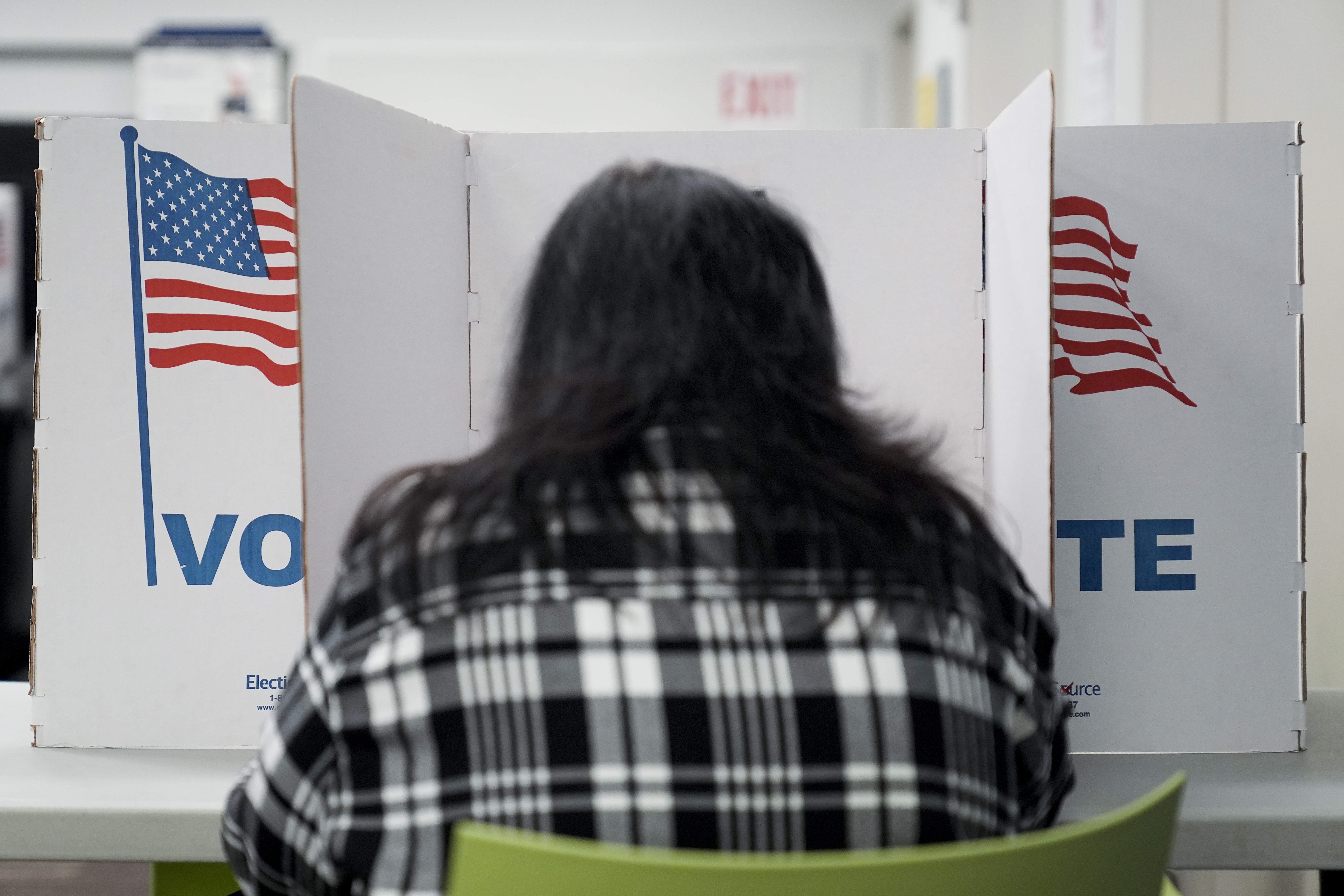
A person marks their ballot at a polling place in Falls Church, Va., during early voting for the 2024 election. Stephanie Scarbrough/AP hide caption
toggle caption Stephanie Scarbrough/APA national effort to circumvent the Electoral College has gained another state.
Virginia Gov. Abigail Spanberger signed a bill Monday that adds the state to the National Popular Vote Compact, an agreement among states to award their presidential electoral votes to the nationwide popular vote winner.
With Virginia, the total number of states signed on to the interstate compact is now 18, plus the District of Columbia, for a total of 222 electoral votes.
The compact doesn't go into effect, though, until there are enough states signed up to reach the required 270 electoral votes to elect a president.
"This [effort] started 20 years ago and it's been slow and steady … constant forward momentum across these 20 years," said Alyssa Cass, a strategist for the National Popular Vote Project and a Democratic consultant. "Bills have been introduced in almost every state, most passed in a bipartisan way. This is on the five-yard line of making this a reality."
But with dozens of electoral votes to go, it's unclear which other states would seek to enact the compact next. And even if it were to cross the 270 threshold, legal challenges would likely await.
A Democratic trifecta paved the way for passage in Virginia
The measure advanced in Virginia after last year's elections gave Democrats the governor's office and full control of the legislature.
Democratic Virginia House of Delegates member Dan Helmer told NPR that getting the state to join the compact was at least a decade-long process. But he linked the effort to new threats against American democracy.
"We have a new generation of Democrats in Virginia," he said, "and what that means is we have people who appreciate the threats that are happening to our democracy today and are ready to take action. And the National Popular Vote Compact is one of those actions that we can take to protect American democracy right now."

Elections
Only a fraction of House seats are competitive. Redistricting is driving that lower

National
Virginia court allows Democrats' redistricting vote in their plan to counter to Trump
According to the Pew Research Center, a majority of Americans say they would prefer the winner of the presidential election to be determined by popular vote, not the Electoral College.
There is a wide partisan divide on this issue, though. According to Pew's survey — which was conducted before President Trump won both the popular vote and the Electoral College in 2024 — while 8 in 10 Democrats favor replacing the Electoral College with a popular vote system, only 46% percent of Republicans back it.
Part of this split could be at least partially driven by the fact that the last two presidents elected without the popular vote were Republicans: George W. Bush in 2000 and Trump in 2016.
But Patrick Rosenstiel, a senior consultant to National Popular Vote and self-described "conservative Republican," said he rejects the premise that the Electoral College helps Republicans. He said his party would also benefit from a popular vote model.
"I think the idea that any candidate, Republican or Democrat, can focus on the interests of simply the battleground states denies them the opportunity to speak with a full-throated support of most American voters," he said. "If we turn this to a system in which every voter in every precinct is politically relevant in the presidential election, not just a handful of precincts in a handful of battleground states, that obviously changes the outcome of the elections."
Cass, the Democratic consultant, made a similar point in explaining why many voters don't like the Electoral College.
"[The] presidential election is decided by voters in a handful of battle states," she said. "The votes of four out of five Americans who live in safely blue or safely red states are essentially irrelevant."
Cass also believes that a popular vote model would encourage more Americans to participate in elections.
Constitutional questions
Supporters of this effort say an interstate compact is a significantly easier lift than a constitutional amendment. Cass argues that the Constitution gives power to states to assign electors however they want.
"[This] has been consistently upheld even by the most conservative of courts," she said. "It was designed to be supported by the language of the Constitution."
But some legal scholars disagree. Some have argued that the framers of the Constitution explicitly rejected the idea of popular elections for president.
Others argue that electoral changes — such as universal suffrage and lowering the voting age — have historically required a constitutional change, and this change should go through a similar process. Patrick Valencia, who's now Iowa's deputy solicitor general, has written that this compact is ultimately an effort to "usurp the constitutionally required electoral procedures" by technically keeping the Electoral College in place and just changing the rules of how those votes are assigned.
Rosenstiel said lawsuits would be likely if the compact gets to 270 electoral votes. But he argues that the compact is based in solid constitutional law, specifically Article 2, Section 1 of the document.
"Every ruling from any court and this current [Supreme Court] has said that states have latitude and what is called a plenary power to award electors," he said. "So, while I believe there'll be a court challenge, I believe it will be summarily won by the forces of good here, which are the people who want every voter to matter in every state."


