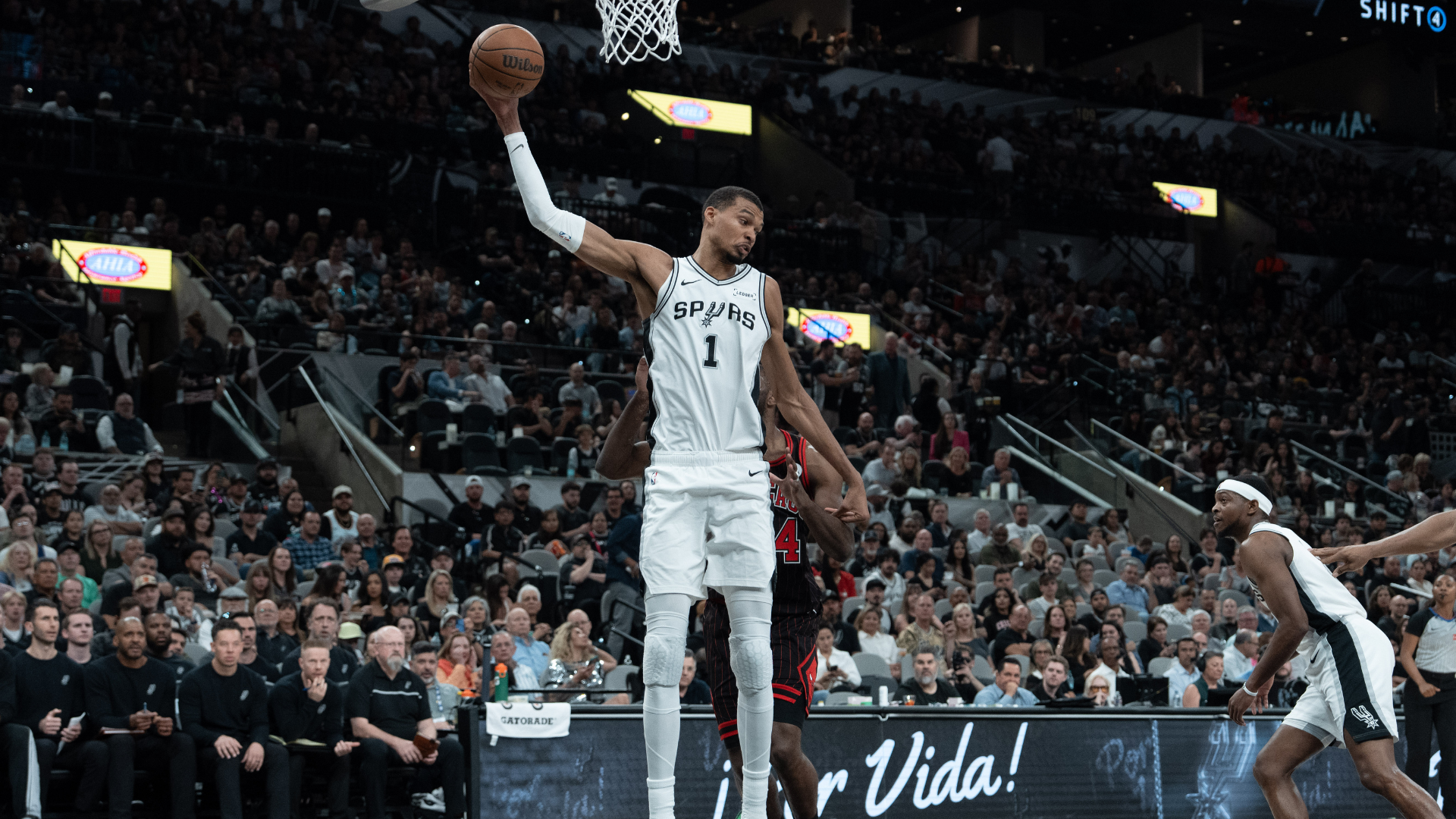
 Victor Wembanyama has changed the NBA MVP calculus, and his case is becoming increasingly hard to refute
 If defense really is 50% of basketball, why isn't Wembanyama the runaway favorite?
 By Brad Botkin Mar 31, 2026 at 3:21 pm ET • 7 min read
  Imagn Images
 Last week, I was talking to an NBA scout about Darius Acuff Jr. and how his defense, or lack thereof, may or may not impact his draft value. At the end of the conversation, I asked: "Hey, while I have you, do you have any thoughts on the MVP race?"
"Yeah," the scout laughed. "I'm glad I don't have to vote."
That about sums up what has become the nearly impossible task of identifying one player -- in a league overflowing with talent -- as more valuable than everyone else. Anyone near the top of the candidate list has a strong case. Recently, San Antonio Spurs star Victor Wembanyama broke down his case into three parts.
"My first one would be that defense is 50% of the game, and that [defense] is undervalued so far in the MVP race," Wembanyama said. "I believe I'm the most impactful player defensively in the league.
"[The] second argument would be that we [the Spurs] almost swept OKC in the season, and we dominated them three times with their real team. ... The third argument would be that [offensive] impact is not just points."
The first point drew the ire of Draymond Green (shocking, I know), who was disgusted that Wembanyama even had to verbalize it. "Wemby said: 'Defense is 50% of the game,' and it was like, oh, no one realized that?'" Green said. "No one realized that 50% of the game we play is on that end of the floor?
"... It's an indictment on the [way the] game of basketball [is covered]," Green continued. "... We got this guy defending entire teams and nobody took it into account until he said defense is 50% of the game."
Let's be clear. For Green to suggest that nobody is taking Wembanyama's defense into account when determining his MVP candidacy is ridiculous. Wembanyama (+225 at DraftKings) is the second-leading favorite behind Shai Gilgeous-Alexander (-300) to win the award for crying out loud, despite all the other top candidates being decidedly more productive offensive players, at least in totality.
Where MVP candidates rank leaguewide in "points plus points generated by assists" per game: 1. Nikola Jokić (53.6) 2. Luka Dončić (52.8) 3. Shai Gilgeous-Alexander (48.0) ... 40. Victor Wembanyama (31.5)
— Andy Bailey (@AndrewDBailey) March 29, 2026
For the record, Cade Cunningham creates 49.9 total points per game. Jaylen Brown is at 42.5. Wembanyama plays significantly fewer minutes than all of these guys. Still, even through a per-36 minutes lens, Wembanyama's playmaking is not yet in the MVP class, even if his scoring extrapolates to over 30 points per game. As it stands, Wembanyama and Giannis Antetokounmpo are the only two players in the league who average at least 24 points in fewer than 30 minutes per game.
Now, before Green gets all worked up about how nobody knows anything about basketball except him, yes, we all understand that points -- whether you've scored or assisted them -- are not the be-all end-all of offensive value.
Nobody is a better example of this than Green's teammate, Stephen Curry, whose gravity creates offense all over the court without him ever having to touch the ball. By and large, the best offensive players in the league are creating scoring opportunities that stretch well beyond a traditional box score.
Sometimes this can be reflected in secondary assists, but not always. The Spurs, for instance, generate more corner 3-point attempts than any team in the league (12.4 per game), and this is disproportionately due to the attention Wembanyama commands when he rolls to the rim. In the clip below, it's Davion Mitchell who has to abandon Devin Vassell to help down on the 7-foot-4 guy angling for a lob dunk. From there, it's a simple skip pass into a wide-open look. Bang.
Really enjoying the growth from Stephon Castle when it comes to reading the defense *and* passing. Another slip from Victor Wembanyama, Castle sees the help and gets it right to Vassell in the corner. pic.twitter.com/6paid99U50
— Steve Jones (@stevejones20) March 23, 2026
Wembanyama created those three points without ever touching the ball. There's no individual stat for it, but it speaks to the Spurs operating at an offensive rate of 121.1 points per 100 possessions when Wembanyama is on the floor, per Cleaning the Glass.
That's right in line with every non-Nikola Jokić candidate. It's one point higher than the Lakers with Luka Doncic, the Celtics with Brown and the Pistons with Cunningham, and one point lower than the Thunder with Gilgeous-Alexander. Wembanyama ranks fifth league-wide in offensive box plus-minus and is nearly identical to Anthony Edwards and Cunningham in offensive win shares.
All of which is to say, Wembanyama is an extraordinary offensive player. Not quite as extraordinary as Jokić, Dončić or Gilgeous-Alexander, but extraordinary nonetheless. Can the same be said of the other candidates as defenders? Absolutely not. The simple truth is the offensive gap between Wembanyama and these other guys, even Jokić, is a ravine, but the defensive gap is the Grand Canyon.
Player
MVP odds (via DraftKings)
Shai Gilgeous-Alexander
-300
Victor Wembanyama
+225
Luka Dončić
+1500
Nikola Jokić
+6000
Jaylen Brown
+25000
Which, in turn, begs the question: Is defense really 50% of the game? If it is, then how is Wembanyama not the runaway favorite for MVP? The first potential answer to that has already been touched on: He only plays 29 minutes a game. His impact in those minutes, to whatever degree you value on/off splits, is unmatched, even by Jokić. But in a hair-splitting MVP debate, your team playing more than one and a half quarters per game without you is a legitimate factor.
But the defensive part of the MVP equation is what is really interesting. In general, people use bad defense as a knock on certain candidates (hey there, Luka). But if you look at the history of the award winners, it's largely offensive-centric guys: Curry, Jokić, SGA, James Harden, Russell Westbrook, Kevin Durant, Steve Nash, Dirk Nowitzki, Derrick Rose, Allen Iverson. Even good defenders like Antetokounmpo, Joel Embiid, LeBron James and Kobe Bryant won the award because of their offensive dominance. You have to go back to Kevin Garnett in 2004 to find an MVP who could even be argued as an equally dominant defender.
That's not necessarily because voters don't value defense in the same way they do offense (though this almost certainly is a factor on some level), but rather because defense is more generally regarded as a group project while an elite offensive player can single-handedly control an entire possession and, by extension, a game.
In most cases, this is probably true. It's why elite hitters are inherently more valuable than elite defenders in baseball; you know a hitter is going to come to the plate four times a night. You can be an elite shortstop and only get one or two balls hit your way in a given game, and most of those plays are routine for even an average defender. To be a top baseball defense, every player on the field has to be able to do their part because you can't steer the ball to a particular position. It goes where it is hit.
In basketball, you can steer the ball in a particular direction. And often, it's away from the best defenders. Sure, they still hold value as helpers, particularly as rim protectors, but there are plenty of possessions in which the best defenders are only minimally involved as offenses target weaker links.
Spurs' Victor Wembanyama ready to 'press the gas' for stretch run: 'I want to win the MVP and DPOY' Jack Maloney
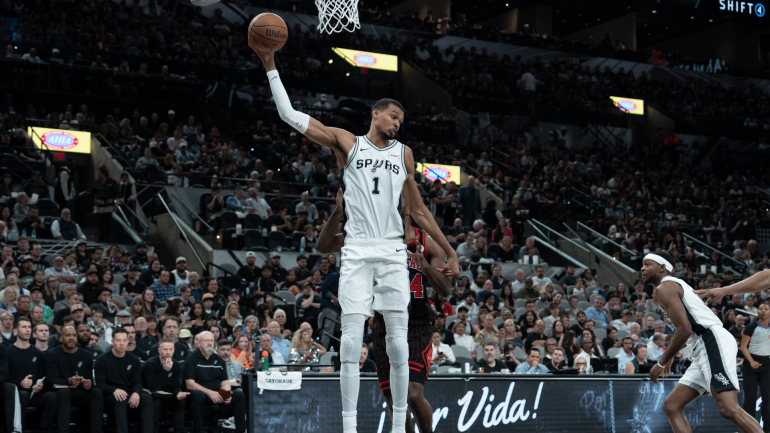
If ever there were an exception to that rule, however, it's Wembanyama, whose all-floor impact is a modern marvel. This guy can be on the opposite side of the court and still alter a possession, if only in the heads of these elite scorers. His ground coverage changes the calculus that basketball players have spent a lifetime learning. A shot that has always required two feet of space now requires four.
The 7-foot-4 Wembanyama doesn't guard one player so much as he does an area. From one spot, he can control 10 feet in any direction with his reach alone, to say nothing of his incredible instincts and movement. He leads the league with 3.1 blocks per game (a monster number given his limited minutes), and he discourages 10 more from even being attempted in the first place.
Wembanyama is not your typical elite defender. And as such, this is not your typical MVP race. He has changed it from a historically offense-based award to one that must genuinely consider defense equally.
That doesn't mean that he will win, or, honestly, even that he should. Again, every one of these guys has a strong case. Wembanyama has merely made his. Given his age, minutes and defensive dependence, it's one of the most unique cases we've ever seen. And with each passing day, it's getting harder and harder to refute.
Join the Conversation comments