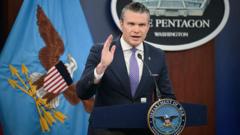
US Defence Secretary Pete Hegseth has called on allies to "step up" over the Strait of Hormuz, echoing earlier comments from President Donald Trump.
On Tuesday morning, Trump wrote on social media to tell countries to "go get your own oil", adding that "the U.S.A. won't be there to help you anymore, just like you weren't there for us".
Hegseth reiterated the president's view during a news conference on Tuesday, saying it was not just the job of the US to secure what he called a "critical waterway".
Iran has effectively closed off the Strait, one of the world's busiest oil shipping channels, since the US and Israel attacked it on 28 February.
Over the last three weeks, as Iran took control of the Strait, the Trump administration has whipsawed from asking Nato and European allies for help, to saying it doesn't need any help, to accusing them of disloyalty, to saying the requests for help were a "test", to now increasingly angrily demanding that allies go and reopen the Strait themselves - implying that it is not America's problem.
This comes with a threat that the US could abandon its alliances, a potentially history-defining shift.
Follow live updates on this story
In his Truth Social post on Tuesday, the president said countries "like the United Kingdom" that could not get jet fuel because of the restrictions around the Strait should "build up some delayed courage, go to the Strait, and just TAKE IT".
He said he was addressing countries "which refused to get involved in the decapitation of Iran".
"The hard part is done," the president added.
Trump reiterated his point in an interview with the BBC's US partner CBS News.
"Countries have to come in and take care of it. Iran has been decimated, but they're going to have to come in and do their own work," he said, adding that "there's no real threat" in the Strait.
The Wall Street Journal earlier reported that Trump has told aides he is willing to end the military campaign against Iran even if the Strait remains largely closed.
Instead, he is reportedly considering bringing the current fighting to an end, having severely damaged Iran's navy and missile stocks, and will continue to pressure Iran diplomatically to reopen the flow of trade.
The BBC has contacted the White House for comment on the report.
Watch: Why is it so hard to pass through the Strait of Hormuz?During his press conference on Tuesday, Hegseth drove home the sentiment of Trump's social media post on Tuesday, arguing that the US had "set the conditions of success" and that the Strait was "not just an American problem set".
"There are countries around the world who ought be prepared to step up on this critical waterway as well. It's not just the United States Navy," he said.
About 20% of the world's oil and liquefied natural gas (LNG) usually passes through the Strait, and the war has sent global fuel prices soaring.
In their recent 15-point peace plan, US negotiators said Iran would be required to reopen the Strait - among other demands - as a precondition for ending the war.
But on Monday, a spokesperson for Iran's foreign minister once again denied there had been talks with US officials. Esmaeil Baqaei said Iran had "had no negotiations with America in these thirty-one days," referring to the duration of the war.
Hegseth did not list reopening the Strait among his war objectives in his prepared statement on Tuesday, but he later described it as "the goal".
Like Trump, he singled out the UK, saying its "big bad Royal Navy" should get involved. The UK has said it won't be "dragged into" the war.
Hegseth said: "A lot has been laid bare. A lot has been shown to the world about what our allies would be willing to do for the United States of America... the president is pointing out you don't have much of an alliance if you have countries that are not willing to stand with you when you need them."
Hegseth also told reporters the timeline of the war could now be six to eight weeks, a break from the previous four-to-six-week timeline that was earlier set out by the administration.


