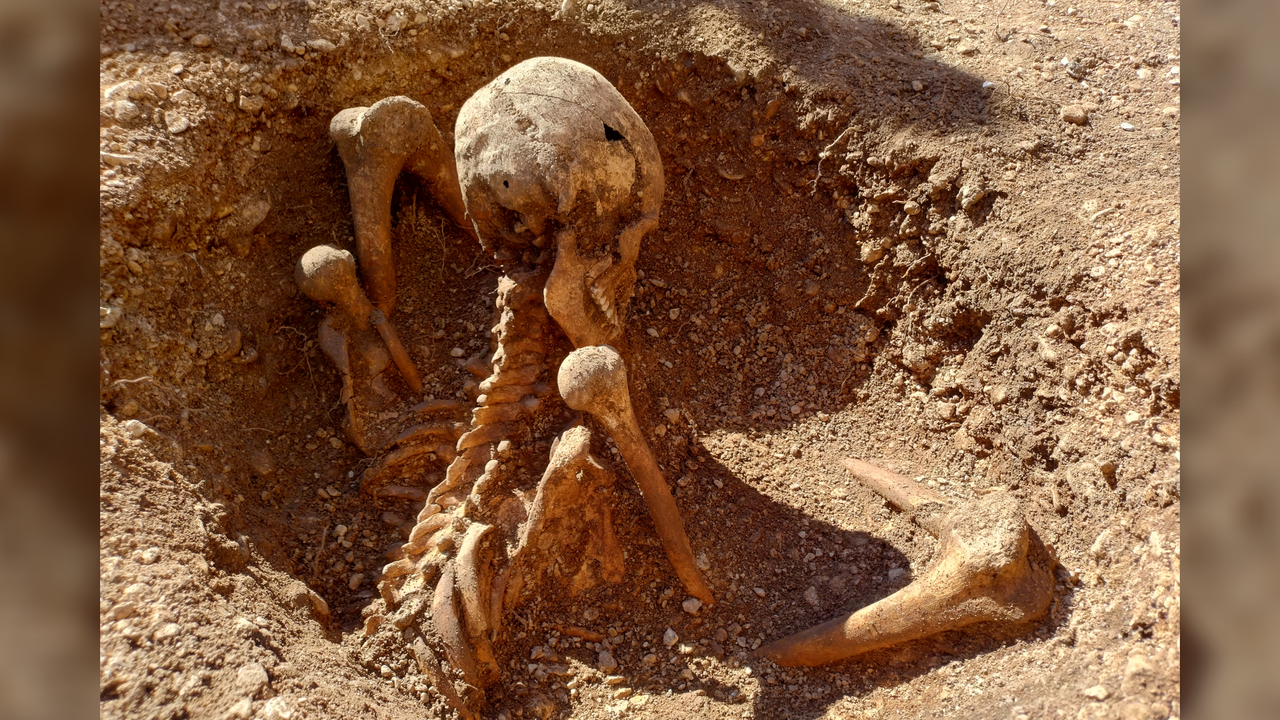
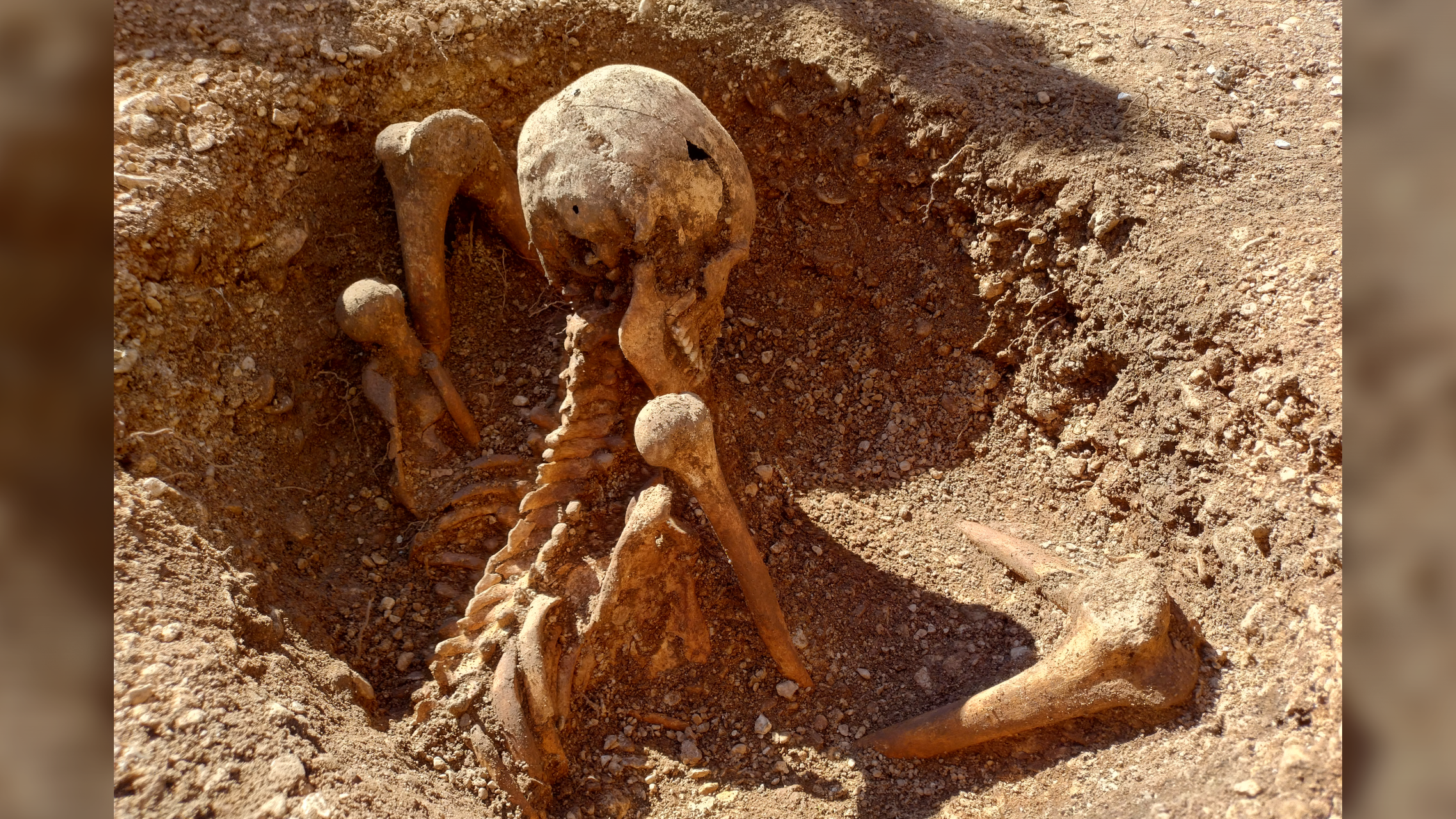
 Archaeologists have unearthed several human skeletons from the Late Iron Age near a primary school in Dijon, France. (Image credit: Frederic Bourigault/Getty Images) Share this article 0 Join the conversation Follow us Add us as a preferred source on Google Newsletter Get the Live Science Newsletter
 Get the world’s most fascinating discoveries delivered straight to your inbox.
Become a Member in Seconds
Unlock instant access to exclusive member features.
Contact me with news and offers from other Future brands Receive email from us on behalf of our trusted partners or sponsors By submitting your information you agree to the Terms & Conditions and Privacy Policy and are aged 16 or over.You are now subscribed
Your newsletter sign-up was successful
Want to add more newsletters?
Join the club
Get full access to premium articles, exclusive features and a growing list of member rewards.
Explore An account already exists for this email address, please log in. Subscribe to our newsletterAround 2,400 years ago, more than a dozen Celtic men — possibly warriors — were buried in unusual upright seated positions in what is now Dijon, France, according to a recent discovery of their graves next to a primary school.
The grim find was made by experts with France's National Institute for Preventive Archaeological Research (Inrap) in 2025 and 2026, the institute announced in a translated statement Wednesday (March 18).
The burials date to the Late Iron Age (450 to 25 B.C.), when the Gauls — a loose association of Celtic tribes — lived in France. Each of the 18 graves had a circular pit approximately 3.3 feet (1 meter) in diameter, and the graves were regularly spaced in two straight lines. The deceased were buried seated on the bottom of the pits, facing west, with their arms resting at their sides and their legs akimbo.
Article continues belowArchaeologists' initial analysis of the Celtic burials revealed that all of the skeletons were from physically active, healthy men who died at 40 to 60 years old. But unhealed cut marks on several of the skeletons pointed to violent deaths.
One male skeleton was found wearing a black stone armband around his left elbow. The style of the accessory helped archaeologists place his date of death between 300 and 200 B.C. His skull revealed that he had suffered two blows from a sharp object, like a sword. At least five other skeletons had cut marks on their arm bones, possibly meaning they died in some kind of ancient combat.
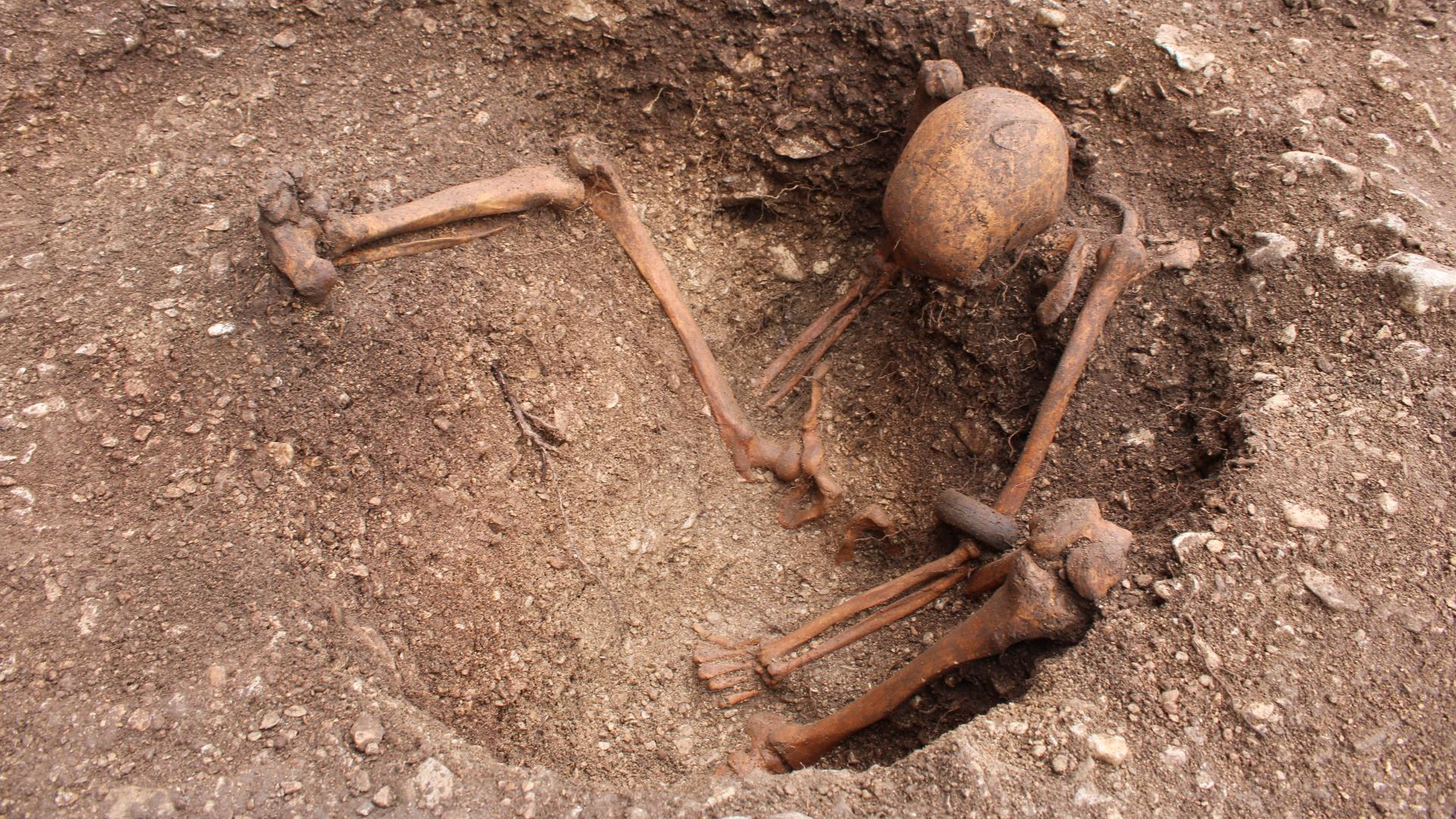
Seated skeletons are an unusual discovery, according to Inrap. Only about 50 similar burials have been found from a dozen archaeological sites in France and Switzerland, all dated to the Late Iron Age. These burials are often discovered at the edges of settlements and always contain seated or crouching male skeletons, suggesting that only specific people were buried in this way — possibly warriors, important ancestors, or other political or religious elites.
RELATED STORIES—Curse tablet found in Roman-era grave in France targets enemies by invoking Mars, the god of war
—6,300 years ago, dozens of people were murdered in grisly victory celebrations in France
During the same excavation, archaeologists also uncovered a Roman-era cemetery containing 22 infant burials dated to the first century A.D. The children were buried lying on their backs or sides in stone or wooden coffins. Some were given coins or ceramics as grave offerings.
Sign up for the Live Science daily newsletter nowContact me with news and offers from other Future brandsReceive email from us on behalf of our trusted partners or sponsorsAfter the Celtic and Roman-era cemeteries were abandoned, farmers used the land for grape growing, and in 1243, the Cordeliers convent was founded there by Franciscan friars. Today, the archaeological site is situated next to a primary school.
Celtic quiz: Test your knowledge about these fierce tribes once described by Julius Caesar
 Kristina KillgroveStaff writer
Kristina Killgrove is a staff writer at Live Science with a focus on archaeology and paleoanthropology news. Her articles have also appeared in venues such as Forbes, Smithsonian, and Mental Floss. Kristina holds a Ph.D. in biological anthropology and an M.A. in classical archaeology from the University of North Carolina, as well as a B.A. in Latin from the University of Virginia, and she was formerly a university professor and researcher. She has received awards from the Society for American Archaeology and the American Anthropological Association for her science writing.
View MoreYou must confirm your public display name before commenting
Please logout and then login again, you will then be prompted to enter your display name.
Logout LATEST ARTICLES 1Should compulsive shopping and gaming be considered an addiction? Psychiatrists are considering expanding the definition.
- 2First Americans quiz: How much do you know about the first people to reach the Americas?
- 3Monte Verde, one of the earliest Indigenous sites in South America, is much younger than thought, study claims. But others call it 'egregiously poor geological work.'
- 41,800-year-old nails discovered in 3 burials in Roman necropolis, possibly to 'protect' both the living and the dead
- 5'Dark oxygen' discovery on the seafloor is 'fundamentally at odds with thermodynamics' and should be retracted, experts say