
 Getty Images
Scientists at Oxford University have made a new vaccine that could be used within months to help tackle the Ebola emergency.
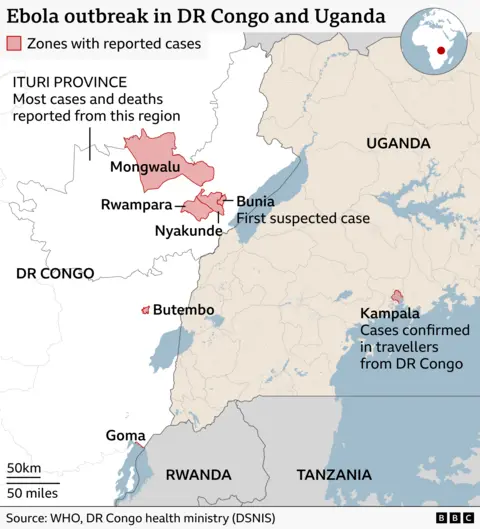
The outbreak, centred on the Democratic Republic of Congo, has reached 750 suspected cases and 177 deaths.
The rare species of Ebola involved - known as Bundibugyo - kills around a third of those infected and has no proven vaccine yet.
They say they are working urgently in case the outbreak spirals and their experimental vaccine is needed.
On Sunday, the World Health Organization (WHO) declared a public health emergency of international concern, but stressed the outbreak was not a pandemic.
The WHO has since upgraded the risk from the current Ebola outbreak from 'high' to 'very high' in the Democratic Republic of Congo. Regionally, the risk is now high, the WHO said today, but remains low internationally.
The Oxford vaccine
There are no guarantees the vaccine will prove effective. It will take animal research and then trials in people to know for sure.
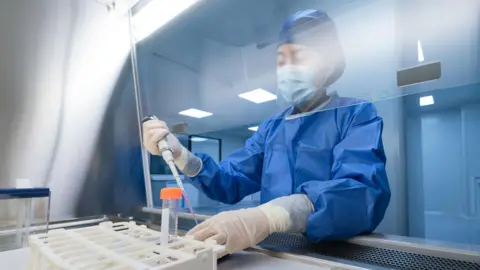
The vaccine uses the same technology the team developed during the Covid pandemic.
It is a highly adjustable technology - known as ChAdOx1 - that can be quickly tweaked so it works against different infections.
During the pandemic it was loaded with genetic code from the Covid-virus.
This time it has been prepared with genetic code from the Bundibugyo species of Ebola.
It uses a common cold virus that normally infects chimpanzees but has been genetically engineered to make it safe for people.
Researchers use this modified cold virus to carry and deliver important genetic material about the Bundibugyo Ebola virus to cells, instructing them to recognise and fight off the actual disease.
The vaccine does not cause an infection or Ebola symptoms, but trains the immune system to give protection.
The BBC understands that animal testing is already under way in Oxford.
The Serum Institute of India is lined up to mass produce the Ebola vaccine once Oxford can supply medical-grade material.
Prof Lambe, the Calleva Head of Vaccine Immunology at the Oxford Vaccine Group, told BBC News: "Once we get starting material to them they can go fast and they can go big."
The World Health Organization says the vaccine could be available for use in clinical trials in two to three months.
Lambe says speed is a priority: "People are worried about this outbreak, generally, you prepare for the worst case scenario - hopefully contact tracing and quarantine is all that's needed, but we can't take our foot off the gas."
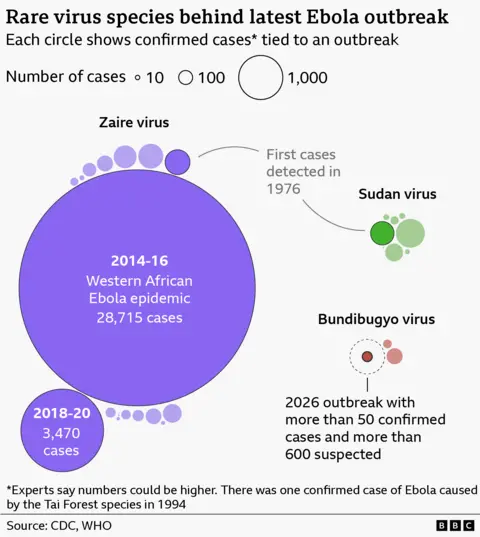
This current Ebola outbreak is challenging because it is caused by a rare species of the virus.
There are six species of Ebola virus, but only three cause large outbreaks in people.
Bundibugyo has only caused two previous outbreaks - in Uganda in 2007 and DR Congo in 2012 - and has not been seen for over a decade.
There is an Ebola vaccine for the more common Zaire species of Ebola, but there is no proven vaccine for Bundibugyo.
Another experimental Bundibugyo vaccine is in development, but it is expected to take six to nine months for any dose of that to be ready for testing.
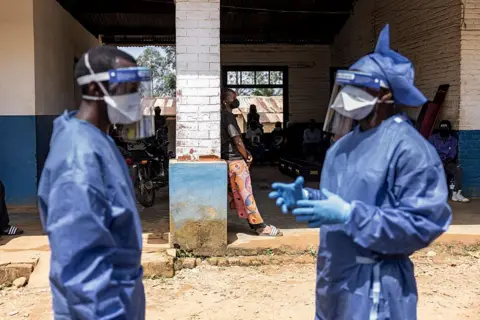 Getty ImagesHealth workers wearing protective equipment stand outside the General Referral Hospital during the Ebola outbreak response on May 21, 2026 in Mongbwalu, Democratic Republic of Congo.
 Ebola vaccines would not be used en mass in the same way as during the Covid pandemic.
Instead, they are used in a technique called ring vaccination - where only the people most likely to get infected are immunised, including the close contacts of cases of Ebola as well as healthcare workers who are treating sick patients who can be very infectious.
The Oxford research team had already been working on similar vaccines for the Sudan species of Ebolavirus and Marburg virus.