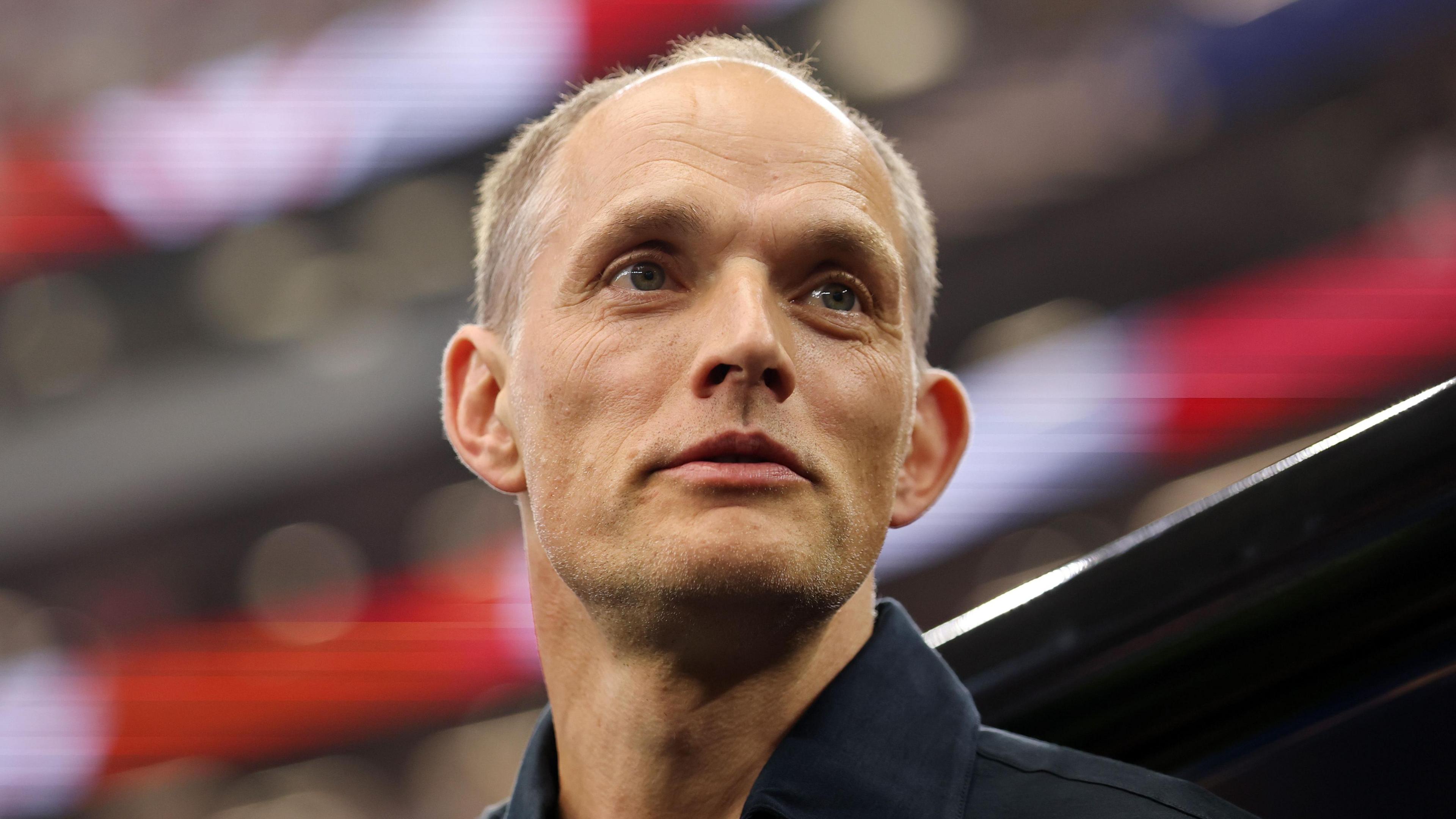
 Image source, Getty ImagesImage caption,
 Thomas Tuchel's side laboured against Ghana's low block
ByUmir IrfanFootball tactics correspondent- Published44 minutes ago
We should begin this article by saying in England's 0-0 draw with Ghana, Carlos Queiroz's men played extremely well, committing to their approach with great intensity.
They successfully executed Queiroz's tactics, which nullified key elements of the system England coach Thomas Tuchel has adopted for this World Cup.
What Tuchel has said - as well as the squad he has picked and England's performances in the US and before the tournament - suggest the German is unlikely to change his plan despite the Boston stalemate.
So why did England look so bright against Croatia but get stuck against Ghana? And why might Tuchel not be that worried by the performance and result in England's second game of the tournament?
No need to panic for England - but this was a reality check
- Published11 hours ago
England held to goalless draw by Ghana
- Published13 hours ago
What are Tuchel's England trying to do?
At its core, this England side looks to entice pressure. This can be across the pitch, but Tuchel's men mainly aim to draw opponents on to them in deeper parts of the field.
They often do this by passing the ball back to the defenders or goalkeeper Jordan Pickford.
England will commit numerous players to this initial build-up phase, including striker Harry Kane, who drops into holding midfield positions to provoke the opposition into leaving their half.
When their opponents do step forward, England look to accelerate play, aiming directly for attackers who are running in behind and are facing fewer defenders.
The "14 or 15 starters" that Tuchel has talked of are players that suit this idea precisely.
Centre-backs such as John Stones and Marc Guehi are comfortable in possession in order to draw pressure, while for Bayern Munich Kane drops deep and launches accurate long passes for team-mate Luis Diaz.
Further forward, Jude Bellingham, Morgan Rogers, Anthony Gordon, Marcus Rashford, Bukayo Saka and Noni Madueke are all powerful runners capable of attacking into space against fewer defenders.
Simply put, England aim to pull defences out of their shape in order to exploit the space this creates.
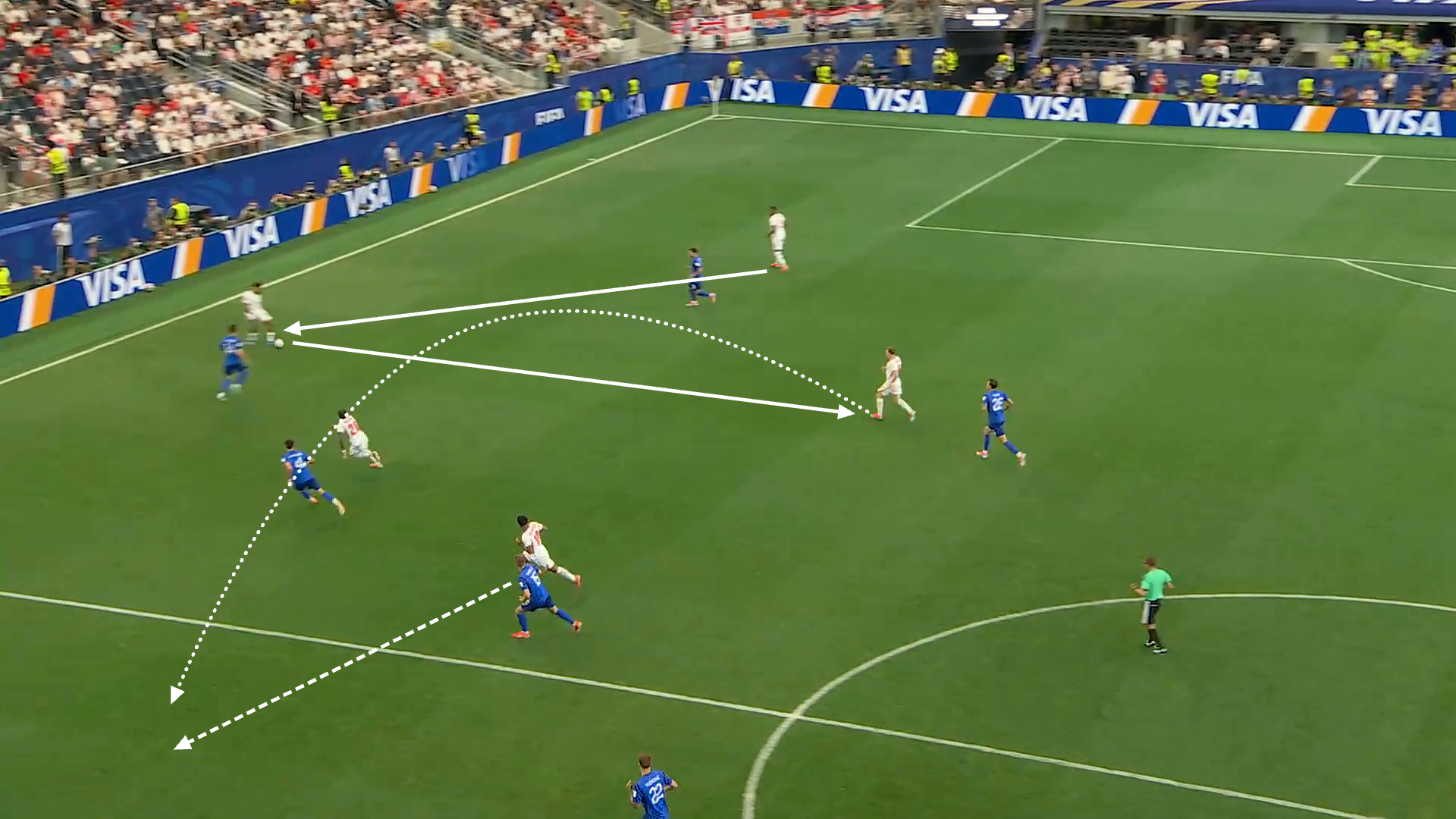 Image caption,
 England's third goal against Croatia encapsulates many of their principles under Tuchel: short build-up play to attract the press, combination play in triangles out wide, and direct passes for runners in behind
Why England could dominate Croatia
England flourished against Croatia because Zlatko Dalic's side took the bait and pressed from the front. In attempting to do so, their pressing unit was outnumbered and outplayed.
As Elliot Anderson and Kane dropped deep, England's defenders found them with ease. They then played in a direct manner into their runners, who had space against isolated Croatia defenders.
Trends from club level have carried into international football, with more teams defending in a front-foot manner.
It is not uncommon to see higher defensive lines and man-to-man pressure, with teams preferring not to give high-level opposition the majority of the ball close to their goal for 90 minutes.
This England squad is built to exploit that trend.
As the 13th-ranked nation in the world, there might also have been an element of pride for Croatia. Setting up in a deep block is not what such a big team's players or fans expect.
Even if a more pragmatic gameplan would benefit some of the 'stronger' nations, the message using that tactic sends out might well deter a country like Croatia from using it.
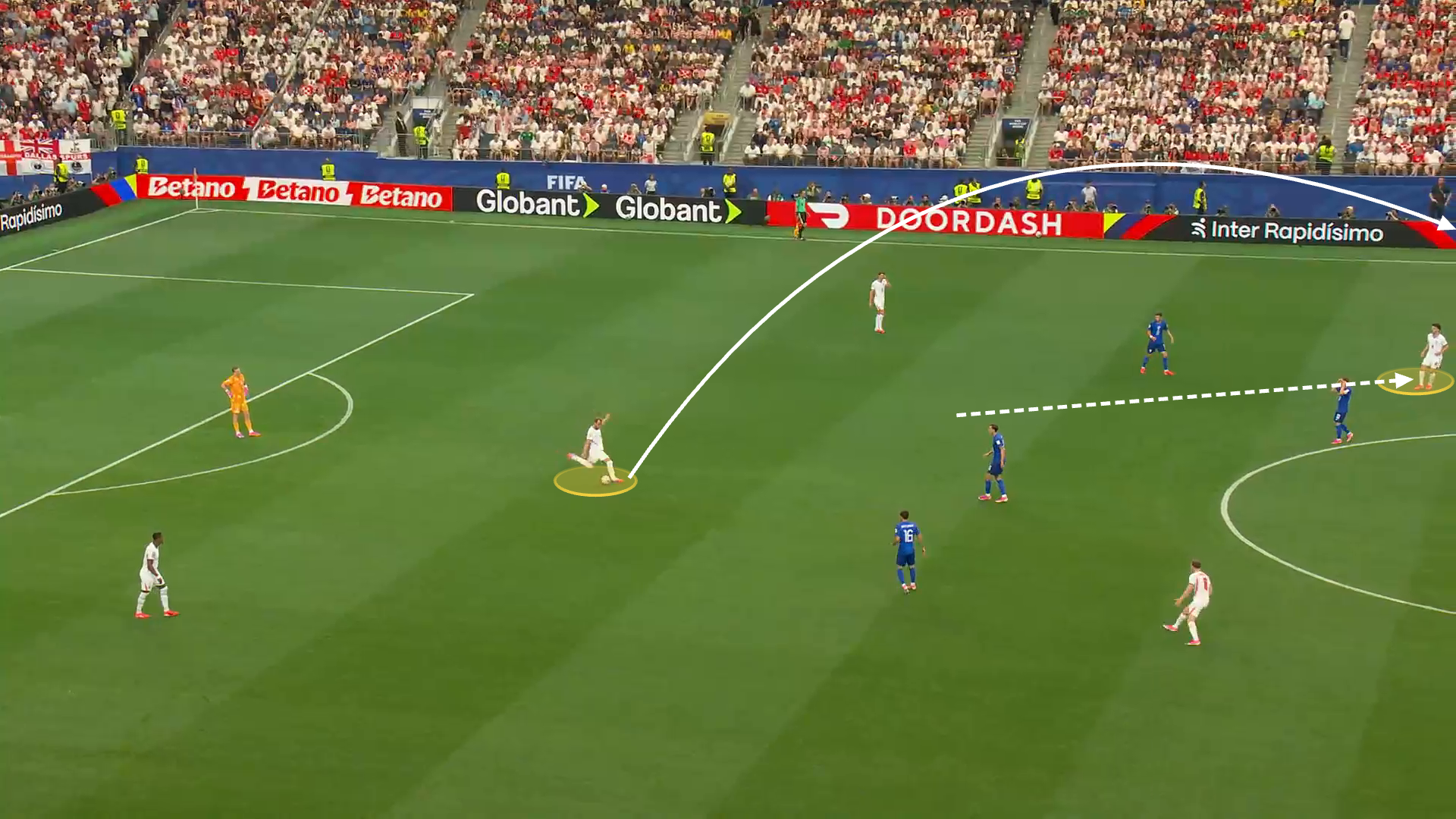 Image caption,
 Croatia's forward players step up but nobody tracks Kane deep. The team gets stretched vertically with a high forward line and a deep back line. Kane then plays a long pass looking for Bellingham, Gordon or Madueke, who are three against three in the opponent's half
How Ghana could frustrate England
Ghana, coming into the tournament in poorer form, did not have these concerns.
Ranked 64th in the world, there was no shame in Queiroz's decision to employ a 4-5-1 low block against fourth-ranked England. Both fans and players are likely to have been on-board with this.
And Ghana's tactics were ideal for more reasons than just their shape.
Teams tasked with playing in a more defensive manner often still look to step up the pitch, picking their moments to press. Ghana rarely did this.
Aware of England's favoured method of creating chances - fast attacks after enticing pressure - Ghana consciously refused to step out of their defensive shape, leaving little space in behind for England to target.
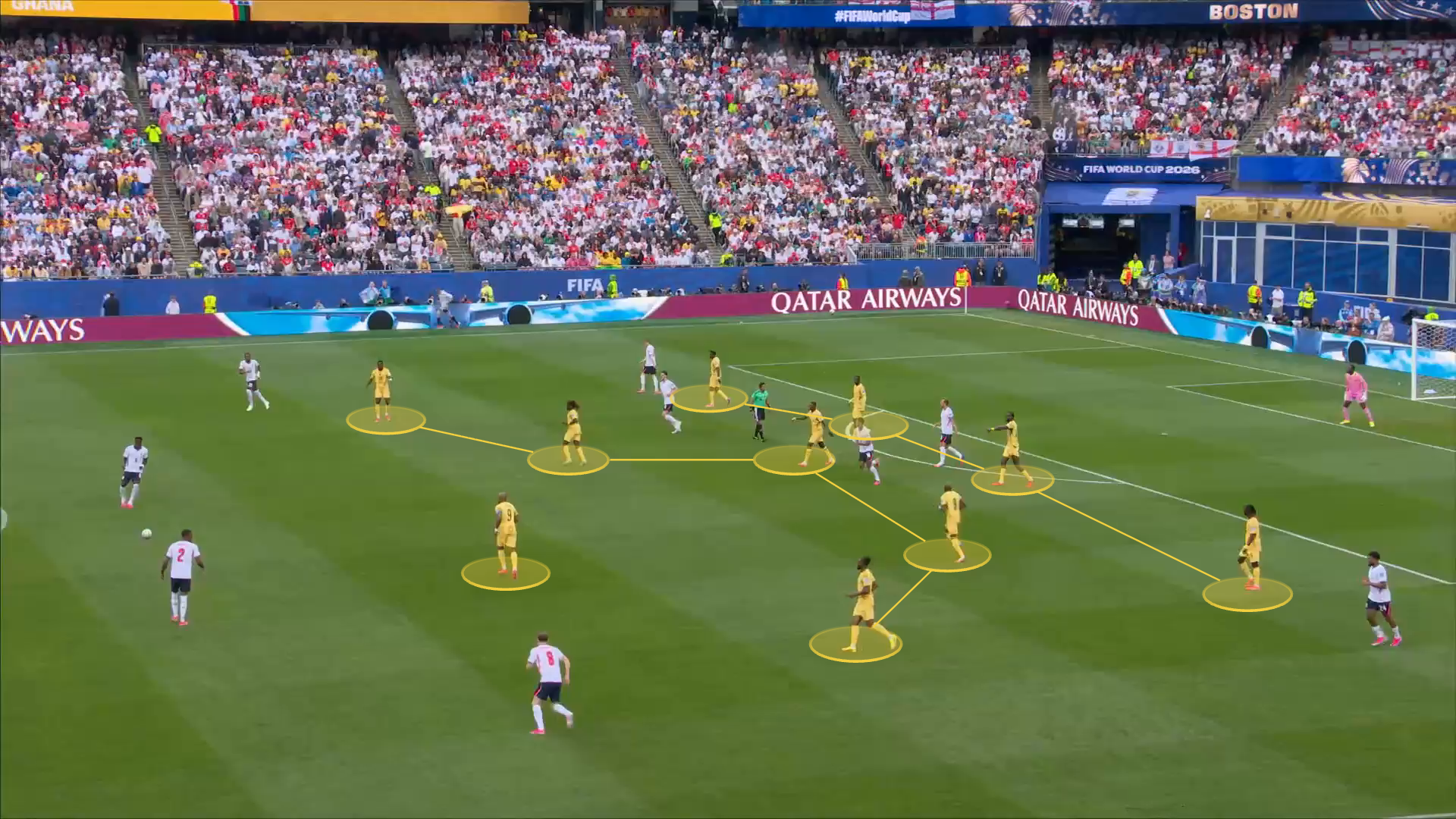 Image caption,
 Ghana defended in a 4-5-1 block and were conscious not to press too readily. England's defenders ended up taking a large number of touches, with Queiroz's side focusing on blocking space and passing lanes
How did England try to solve Ghana problem?
England did still try to entice pressure before playing into open space but this was done horizontally instead of vertically.
During the first-half hydration break, Tuchel instructed his players to play "short, short, short", before asking them to play a "long switch".
With Ghana refusing to step forward, Tuchel wanted his team to play numerous short passes on one side of the pitch to draw Ghana over towards the ball, before playing a long pass to the far-side winger who, in theory, would find himself in space and one against one.
This worked, but only to an extent - because Ghana's full-backs both had great games. After this, they were trying to play accurate crosses into a crowded penalty area.
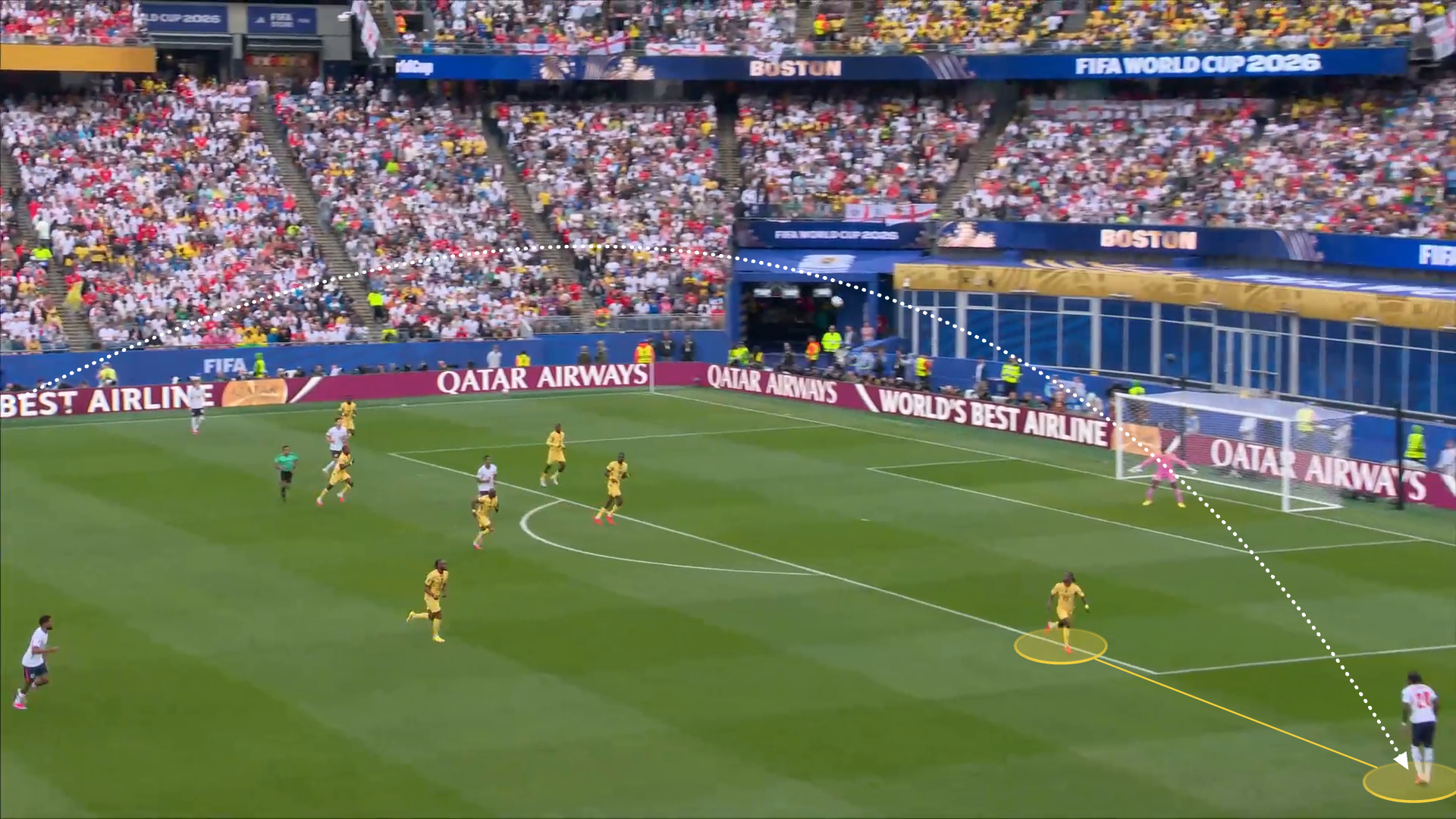 Image caption,
 This was one of England's best methods of chance creation against Ghana. After attracting play towards the left, a big switch is played to Madueke on the right, who finds himself with lots of space and one against one
Tuchel's tactics were good, but the way Ghana set up created a game that did not suit his personnel.
Much of England's creative work under Tuchel is funnelled through Anderson and Kane, but Ghana's players went man to man to keep them quiet.
"I was kind of man-marked there by [Thomas] Partey for a lot of the game," Kane explained. "I didn't have the space to drop deep, and then arrive later in the box."
This stifled England's build-up against an already stubborn defence and minimised their threat.
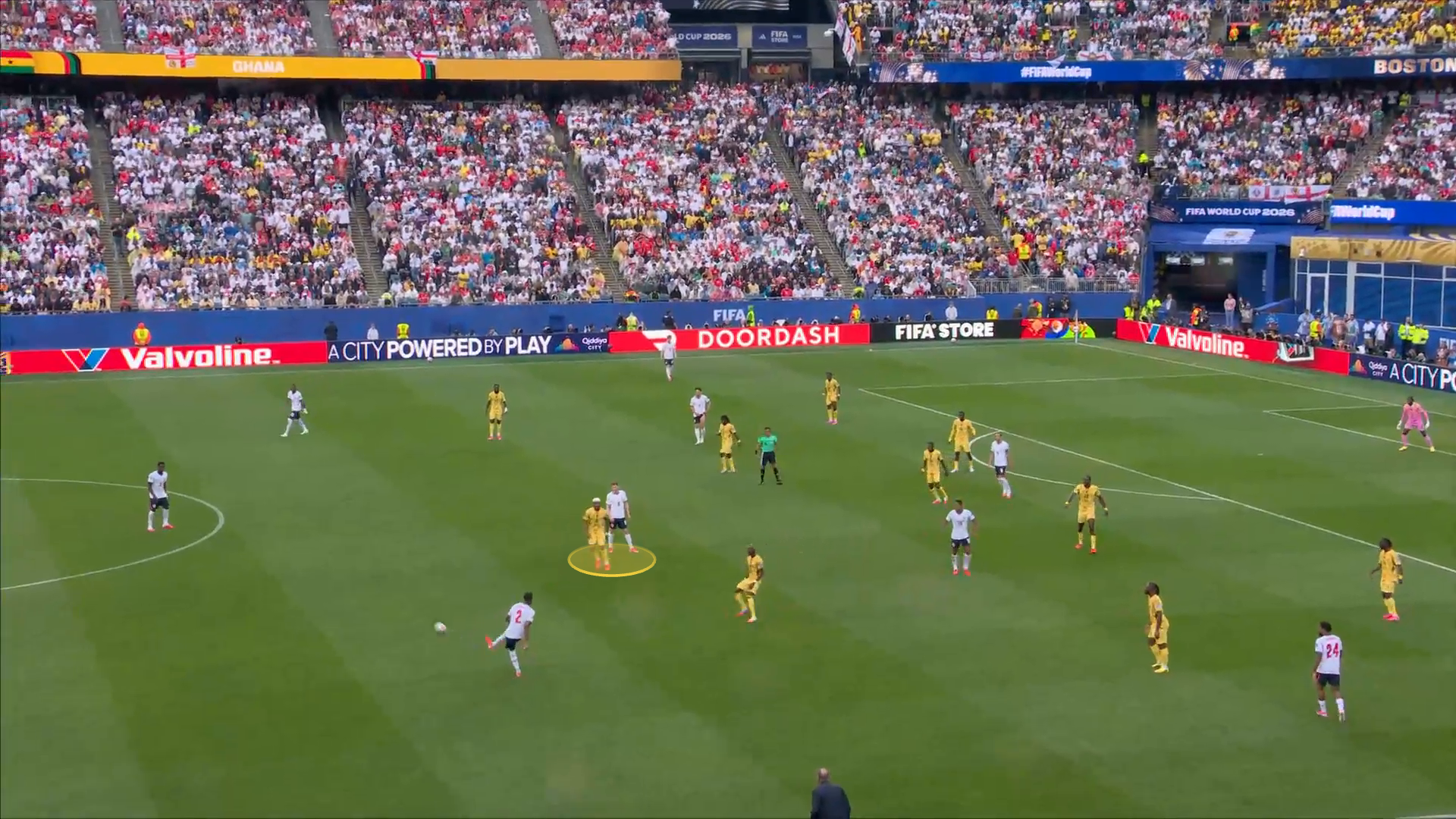 Image caption,
 There was a clear effort from Ghana to have their striker Jordan Ayew mark Elliot Anderson out of key build-up situations
England's third and fourth goals against Croatia were created through these wide triangles, but Ghana reduced this threat by matching them up three against three.
And lastly, when tasked with unlocking a compact and deep block, England's squad perhaps lacked some of the small-space dribbling and passing quality Tuchel left at home in the form of Phil Foden and Cole Palmer.
As good as Declan Rice and Jude Bellingham are, they thrive in space, which is why they are in Tuchel's midfield.
When the conditions of the game do not match the player's strengths, not having an obvious plan B becomes a point of contention.
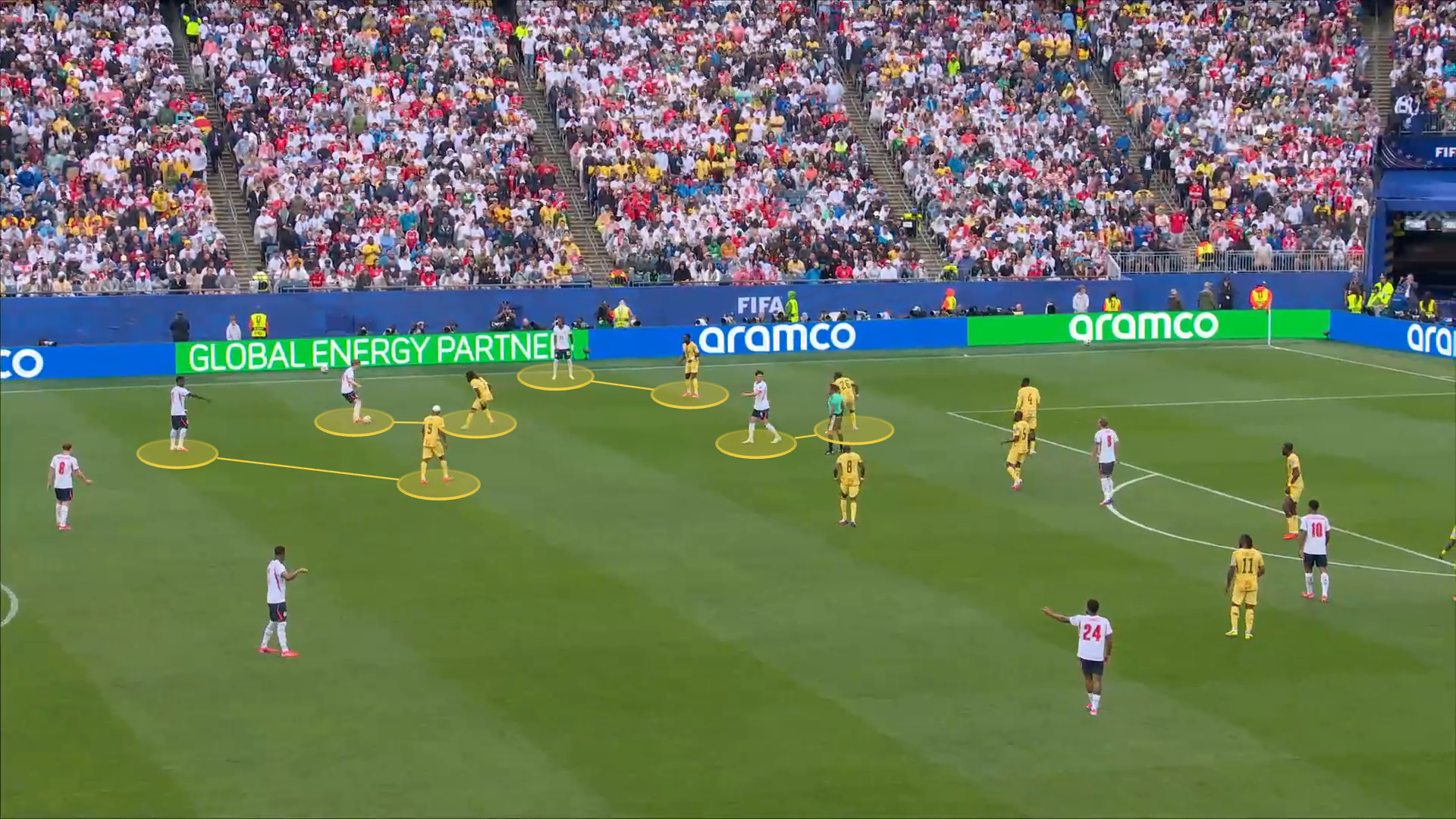 Image caption,
 Here we can see Ghana's right-sided players ensuring England are unable to get overloads in wide areas
Tuchel system is opposite to Southgate's
This is the opposite dilemma to the one faced by Tuchel's predecessor Gareth Southgate.
Tuchel entered the job with a pre-existing idea of his system, perhaps created as a solution to wider football trends, and then sought the best English players to fit its roles.
Instead of building a system first, Southgate prioritised the quality of his players before creating tactics around them.
Tuchel's system gives a clear tactical solution to execute and has defined roles. Substitutes are players that replace team-mates doing a similar job, so the dynamic of the team barely changes.
The tactics also work best when an opponent tries to impose themselves upon England and look to win the ball back in forward areas - teams such as Spain and Germany for instance.
However, the approach is less effective when sides do what Ghana did.
Against sides with lesser quality, Southgate's England were dominant because the starting XI possessed more individual quality and were encouraged to solve problems themselves.
Faced with the likes of Spain though, without a clear gap in player quality, the lack of clear roles or tactical solutions meant England could not dominate and came up short when it mattered.
World Cup's best matches, moments, goals & players so far - ranked
- Published5 hours ago
The draw and performance against Ghana was not dazzling but the point puts England closer to finishing first in Group L.
In tournament football, not losing is often the most important thing. Portugal won Euro 2016 after going through their group with three draws. Indeed, they only won once in normal time all tournament.
If England have a squad primed to exploit the natural tendencies of better sides, then the latter rounds of this World Cup should produce more impressive knockout performances than during the Southgate era.
To reach that point however, England may have to suffer games that resemble attack versus defence training drills - hoping that set-piece routines come off and that other nations do not emulate Ghana's pragmatism.