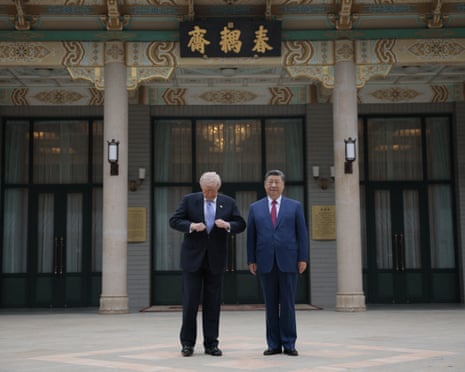
 Donald Trump and Xi Jinping at the Zhongnanhai Garden in Beijing. The US president has offered no details about a breakthrough on the Iran war. Photograph: Evan Vucci/AFP/Getty ImagesDonald Trump and Xi Jinping at the Zhongnanhai Garden in Beijing. The US president has offered no details about a breakthrough on the Iran war. Photograph: Evan Vucci/AFP/Getty ImagesTrump-Xi accord on Iran elusive as US president’s China trip winds down
China calls for ceasefire and opening of seaway, while Donald Trump says Xi feels ‘very similar’ about ending the war in Iran
Donald Trump has claimed that the US and China “feel very similar” about ending the war in Iran but offered no details about a possible breakthrough.
The US president was speaking alongside Xi Jinping of China at the Zhongnanhai garden in Beijing on the second and final day of the leaders’ summit.
“We did discuss Iran,” Trump said. “We feel very similar about [how] we want it to end. We don’t want them to have a nuclear weapon. We want the straits open.”
What is the Thucydides Trap and why did Xi Jinping mention it in his meeting with Donald Trump?Read moreHe added: “We want them [Iran] to get it ended because it’s a crazy thing there, a little bit crazy. And it’s no good, it can’t happen.”
There is much speculation about how much pressure the US is putting on China, the biggest buyer of Iranian oil, to use its leverage with Iran to encourage the country to reopen the strait of Hormuz. And there is a question mark over whether or not Beijing would be willing to accede to that pressure.
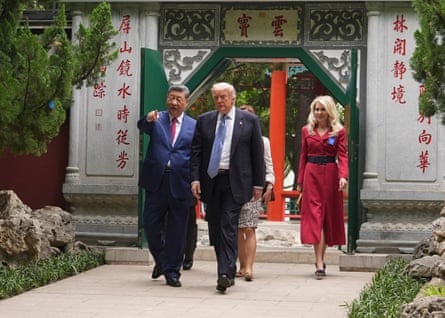 Donald Trump walks with Xi Jinping at the Zhongnanhai leadership compound. Photograph: Mark Schiefelbein/Reuters
US trade representative Jamieson Greer said in an interview with Bloomberg TV on Friday that the Chinese “don’t want to be on the wrong side” on the Iran issue. “It’s really important for China to have the strait of Hormuz open,” Greer said.
Earlier, the US secretary of state, Marco Rubio, said the US hoped “to convince [China] to play a more active role in getting Iran to walk away from what they’re doing now and trying to do now in the Persian Gulf”.
But in an interview with NBC News on Thursday he downplayed the idea that the US was seeking support from Beijing. “We’re not asking for China’s help. We don’t need their help,” Rubio said.
China’s foreign ministry on Friday again called for a ceasefire in Iran and said the strait of Hormuz should be opened “as soon as possible”.
About half of China’s crude oil passes through the waterway, but the bigger threat for the Chinese economy is if the conflict in the Middle East causes a global recession that dents demand for its exports.
But many in Beijing feel that the crisis in Iran is not China’s responsibility.
Zhou Bo, a retired senior army colonel and a senior fellow in the Center for International Security and Strategy at Tsinghua University, said: “On Iran, China definitely wants to help but I read what Rubio said: he actually seems to shift the burden to the Chinese side. In China, we have a saying: it is like, ‘Why should I clean your shit?’”
The White House readout of the more than two hours of talks between Trump and Xi on Thursday said the leaders “agreed that the strait of Hormuz must remain open to support the free flow of energy” and that “President Xi also made clear China’s opposition to the militarisation of the strait”.
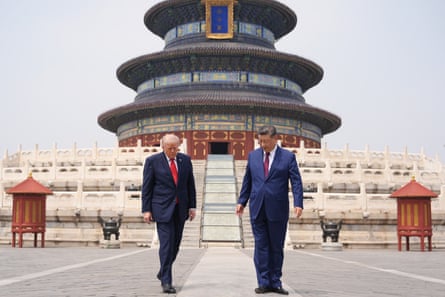 Trump walks with Xi at the Temple of Heaven. Photograph: Mark Schiefelbein/AP Photo
But Trump raised eyebrows during a TV interview when he suggested that finding Iran’s enriched uranium was primarily for show after Israel demanded it as a goal.
“I just feel better if I got it, actually, but it’s – I think, it’s more for public relations than it is for anything else,” the US president told Fox News host Sean Hannity.
The Chinese readout of Thursday’s meeting just made a brief reference to the “situation in the Middle East”.
Chinese state media rapidly published a flurry of articles echoing the language of “constructive strategic stability” that was part of the Chinese government’s readout of Thursday’s meeting. The Xinhua news agency said that the term meant “harmony without uniformity and seeking common ground while reserving differences”. The concept is “full of wisdom and demonstrates responsibility”, Xinhua said.
Trump, for his part, has revelled in Chinese hospitality and flattery. He was heard saying on his way into the tea room at the Zhongnanhai garden that Xi was giving him roses for the Rose Garden, according to a White House pool report.
“This has been an incredible visit,” he said as the men sat together in an opulent wood-panelled room with a huge golden carpet. “I think a lot of good has come of it. We’ve made some fantastic trade deals – great for both countries … we’ve really done some wonderful things, I believe.”
Trump added: “We’ve settled a lot of different problems that other people wouldn’t have been able to solve.”
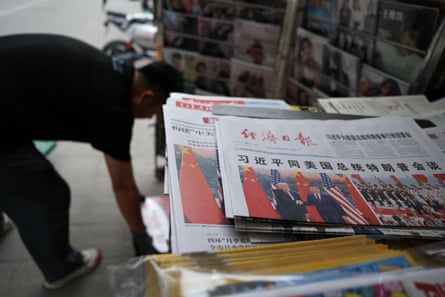 Newspapers with images of Xi Jinping meeting Donald Trump at the Great Hall of the People. Photograph: Tingshu Wang/Reuters
He told Fox News that China agreed to buy US oil, soybeans and 200 Boeing planes. But on key issues including Taiwan, there seems to have been little by way of concrete agreement.
Instead, Xi and Trump spent Friday morning “pausing to admire the ancient, vigorous trees and colourful roses in the garden” of Zhongnanhai, Xi’s residence, according to the official Chinese readout.
The readout said the two sides “reached important consensus on maintaining stable economic and trade relations”, but it did not elaborate.
“The two sides also exchanged views on some regional hotspots,” the readout concluded.
Julian Gewirtz, a former director for China on the national security council during the Biden administration, said the new Chinese formulation about US-China relations was about “locking in this current phase of strategic stalemate for the remainder of Trump’s term and ideally beyond”.
“Xi Jinping has been working for years to be ready for this moment, to bring an American president to Beijing as a peer, widely acknowledged as such around the world. And now it is happening,” Gerwirtz said.
Wu Xinbo, a professor of international studies at Fudan University and a Chinese government adviser, said the balance of power between the US and China was “shifting towards greater parity”.
“In the past, it always seemed as though the United States held the upper hand, constantly exerting pressure on China and taking the offensive. Now, however, it’s fair to say that the two countries have reached a new point of equilibrium,” Wu said.
At a busy intersection near Trump’s hotel, the crowds that gathered to catch a glimpse of the presidential motorcade were thinner on Friday morning than on Thursday evening, with the heavy police presence encouraging people not to loiter. Many grumbled about the inconvenience caused by the repeated road closures.
Asked for their views on Trump, the word that came up again and again from Beijingers was “unpredictable”.
“What he says isn’t necessarily what it means,” said one Trump-watcher, who declined to give his name.
Additional research by Yu-chen Li
Explore more on these topicsShareReuse this content