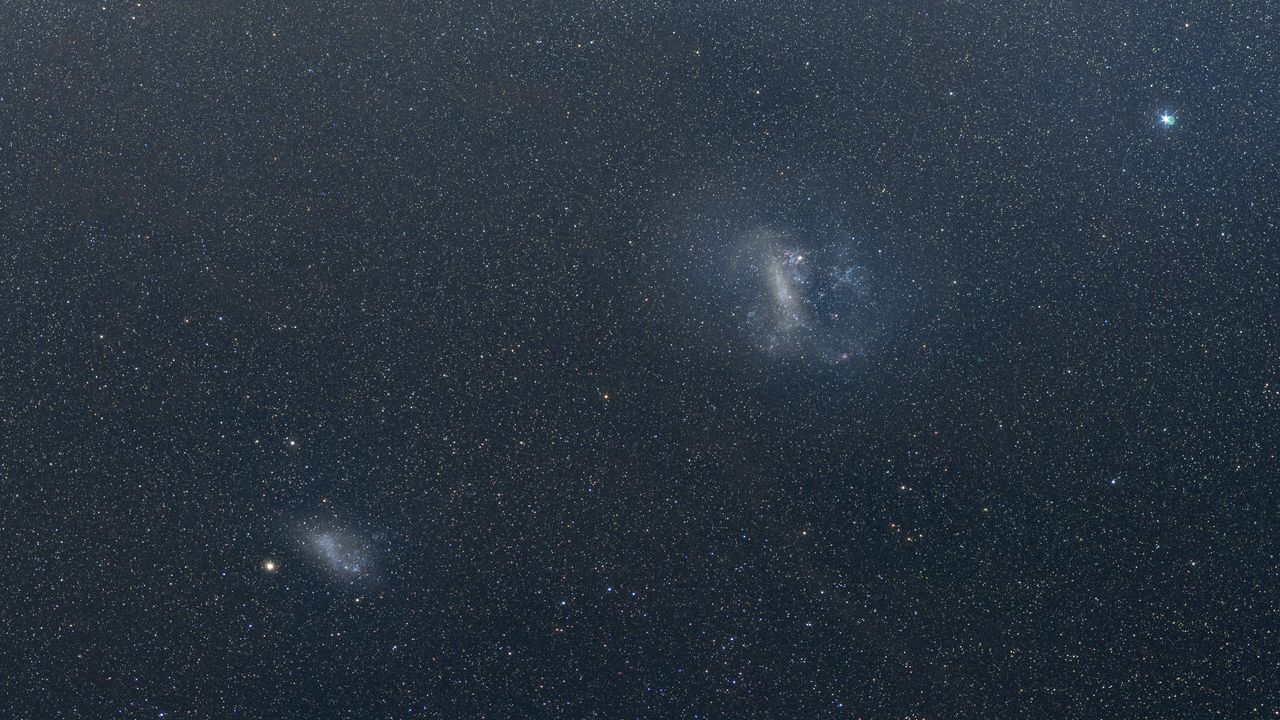
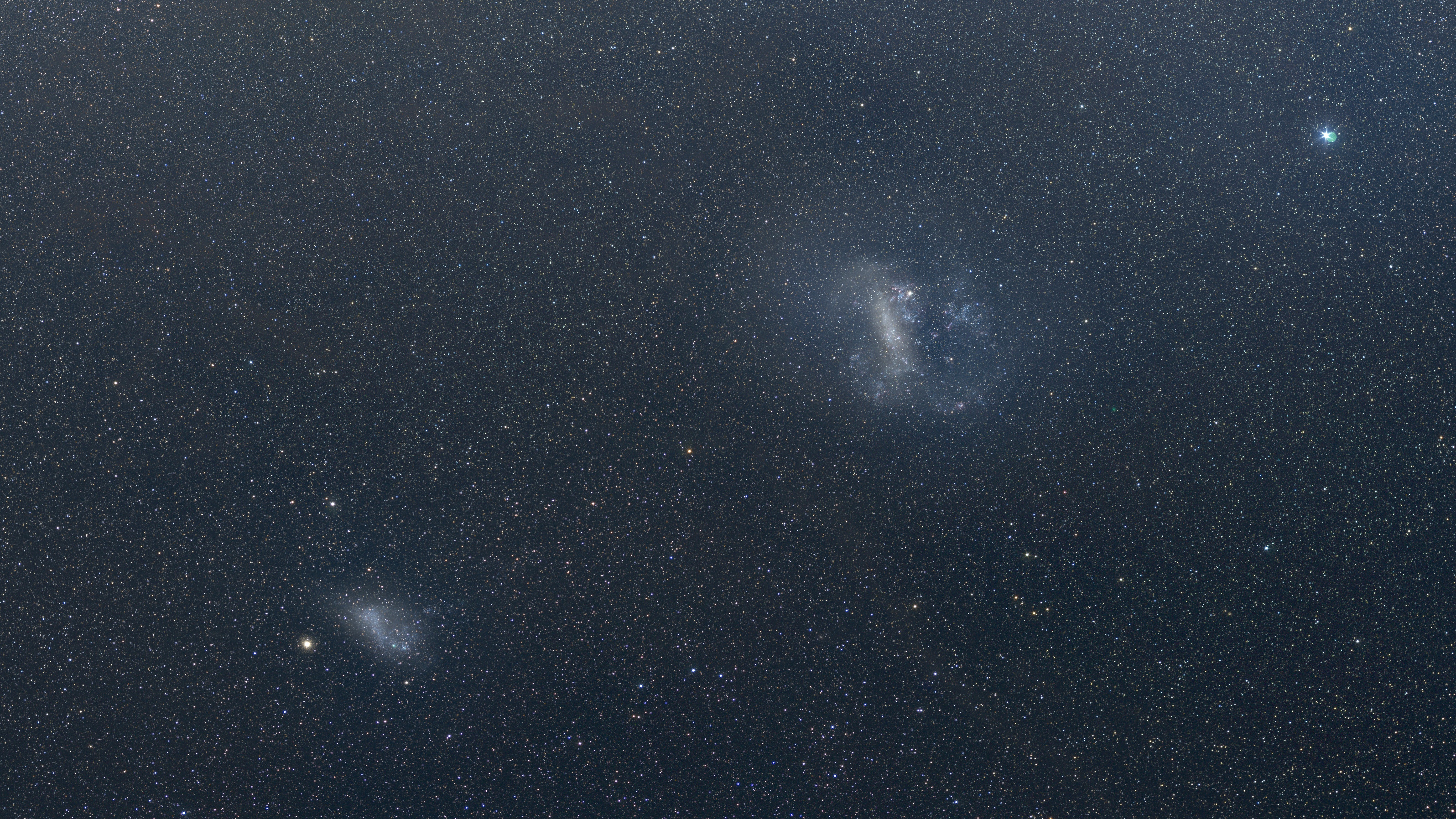
 This visible light mosaic shows the LMC and SMC. Separated by about 21 degrees, the two galaxies are readily visible from the Southern Hemisphere as faint, glowing patches in the night sky. (Image credit: Axel Mellinger, Central Michigan University/NASA Visualization Studio) Share this article 0 Join the conversation Add us as a preferred source on Google Newsletter Subscribe to our newsletter
 The Small Magellanic Cloud seems to be coming undone at the gravitational hands of its sibling galaxy, the Large Magellanic Cloud, which has been found to be unwrapping its little brother's stars.
The Small and Large Magellanic Clouds (SMC and LMC for short) are two dwarf irregular galaxies passing close to the Milky Way. The LMC is about 163,000 light years away from us, while the SMC is further away at about 200,000 light-years from us. Both are subject to disruption from the Milky Way's gravity, which triggers bursts of star formation within them and rips away a stream of gas from both, called the Magellanic Stream.
However, new results from the Visible and Infrared Survey Telescope for Astronomy (VISTA) at the European Southern Observatory's Paranal mountaintop site in Chile have shown the Milky Way isn't the only galaxy affecting the SMC. It turns out that the diminutive galaxy's bigger brother, the LMC, is also a disruptive influence.
As part of VISTA's Survey of the Magellanic Clouds (VMC), the four-meter aperture telescope has spent the past 11 years carefully mapping the motions of millions of individual stars in the Magellanic Clouds. VISTA's near-infrared vision sees through some dust in the Magellanic Clouds, giving it a clearer view of the stars.
"When I saw the results for the first time, I was amazed by the quality of the measured stellar motions," said Florian Niederhofer of Germany's Leibniz Institute for Astrophysics Potsdam (AIP) in a statement. "By combining observations that have been taken over a time baseline of more than a decade, we were able to map the internal kinematics of the Small Magellanic Cloud with a level of detail that is outstanding for observations from the ground."
Niederhofer's team published the results from the LMC in 2022, revealing how stars moved through the dwarf galaxy's off-center bar feature, which is similar to a galactic bar often found in the center of large spiral galaxies including the Milky Way. There were no major shocks there, but the results of the SMC measurements have caught everyone by surprise.
Previous measurements implied that the motion of stars in the SMC were indicative of the rotation of the dwarf galaxy, but according to these new results, that was a misinterpretation. Instead, stars are moving en masse outwards from the core of the SMC, in directions generally aligned along an axis pointing from (as seen from Earth) southeast to northwest. Extend that line, and it points all the way back to the LMC. This is exactly what we would expect if gravitational tidal forces from the LMC were tugging on the part of the SMC closest to it, stretching the SMC.
The average velocity of these stars is 10.6 miles (17 kilometers) per second, and over the course of a few hundred million years these stars could travel several thousand light-years. This gives an indication of how much the SMC has been distorted perhaps over billions of years. In the past its structure must have been more compact and defined, as opposed to its amorphous shape today.
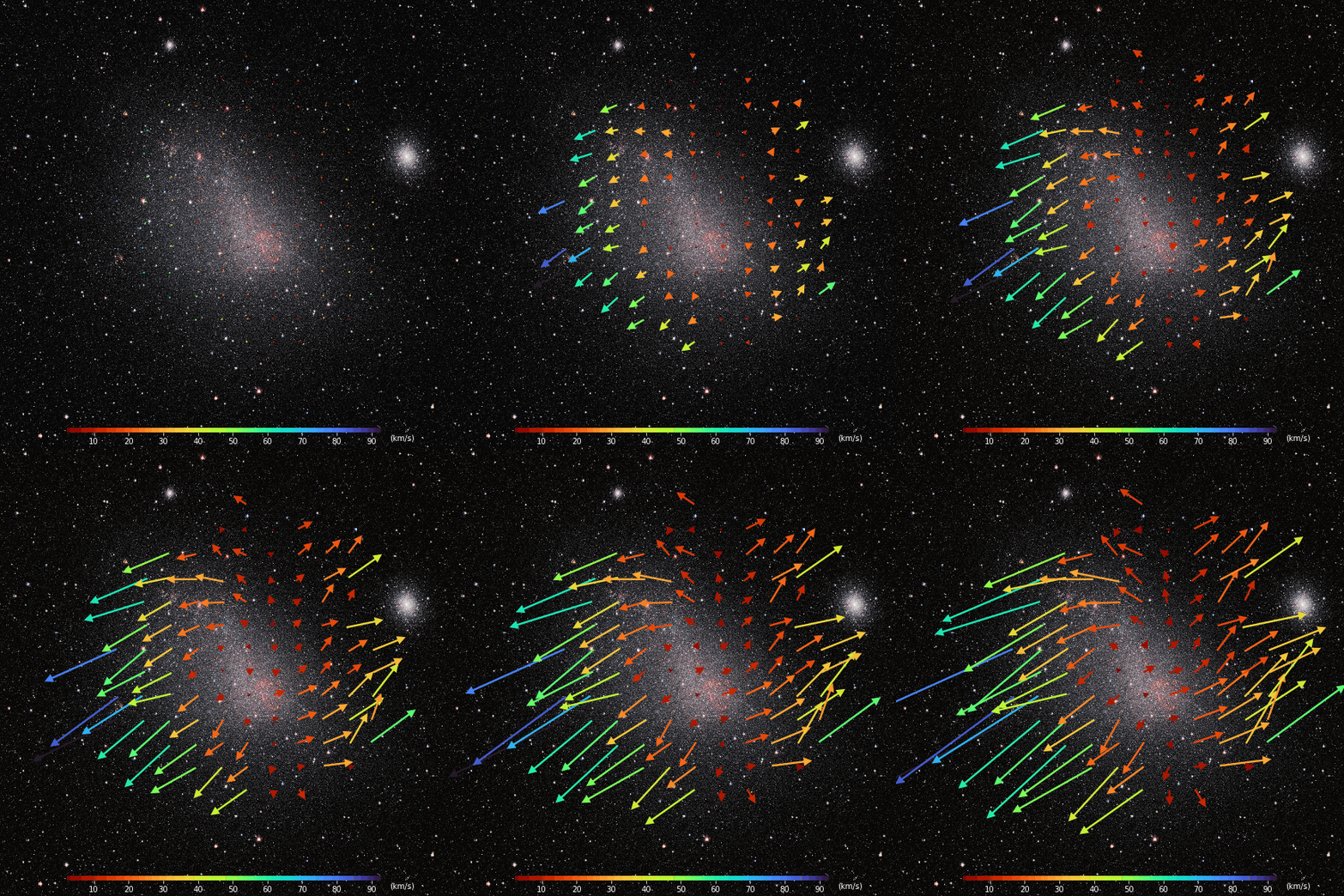
"The results reveal large-scale tidal expansion throughout the SMC and challenge long-standing assumptions that the Small Magellanic Cloud behaves like a rotating disk," said the AIP's Sreepriya Vijayasree, who is the lead author of the research paper describing the findings. "The study shows that the internal motions of stars in the Small Magellanic Cloud are dominated not by orderly rotation, but by gravitational disturbances caused by repeated encounters with the LMC over billions of years."
The motions of the stars are like a time machine, a legacy of past events that have become imprinted on how the stars travel through space. Another case in point is that VISTA has also detected that older red giant stars in the SMC all seem to have their own bulk motion northward. These red giants are stars that were born around two billion years ago, and their motion is the result of some other gravitational interaction dating back to that time. Given that astronomers believe the Magellanic Clouds to be passing close to our galaxy for the first time, this mysterious interaction two billion years ago may not have even taken place near the Milky Way.
As for the future, the Magellanic Clouds are slowing as they interact with the Milky Way's halo, and recent simulations have shown that then Magellanic Clouds are destined to merge with the Milky Way in billions of years' time. Until then, the two dwarf galaxy siblings will stick together, even if the big brother does continue to pick on the little one.
The findings were published in Astronomy & Astrophysics.
View MoreYou must confirm your public display name before commenting
Please logout and then login again, you will then be prompted to enter your display name.
Logout Keith CooperContributing writer
Keith Cooper is a freelance science journalist and editor in the United Kingdom, and has a degree in physics and astrophysics from the University of Manchester. He's the author of "The Contact Paradox: Challenging Our Assumptions in the Search for Extraterrestrial Intelligence" (Bloomsbury Sigma, 2020) and has written articles on astronomy, space, physics and astrobiology for a multitude of magazines and websites.