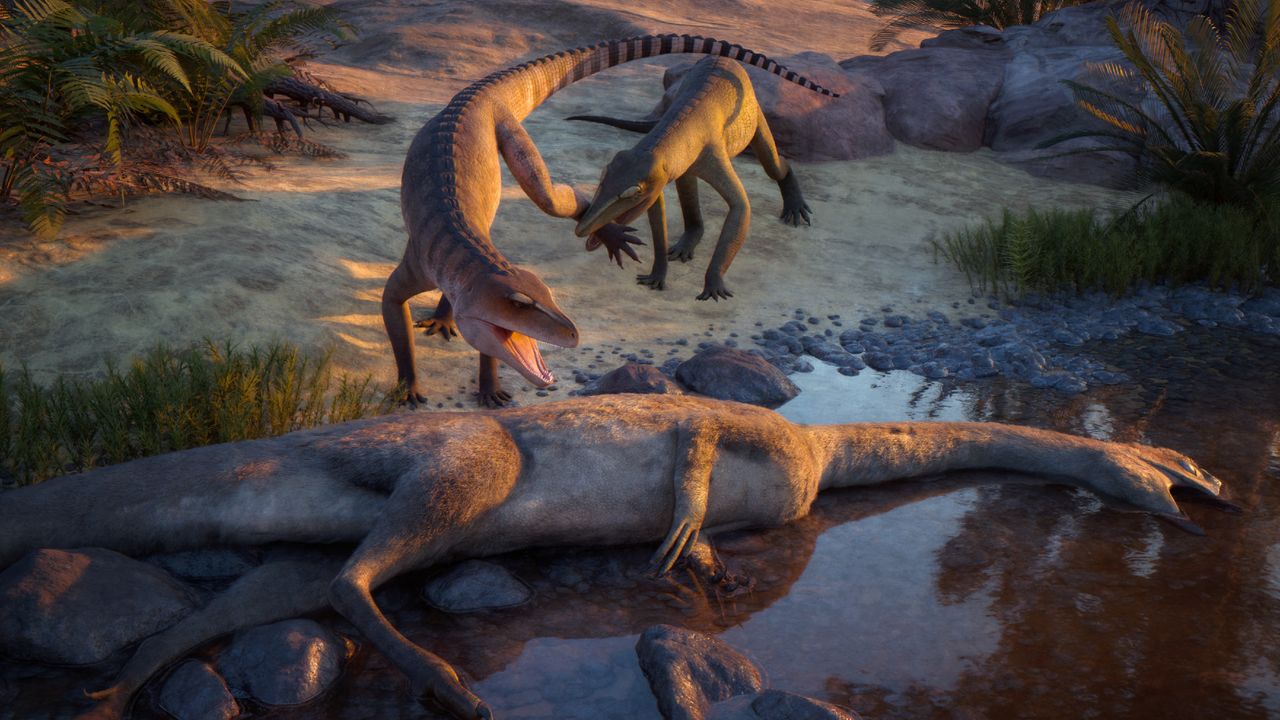
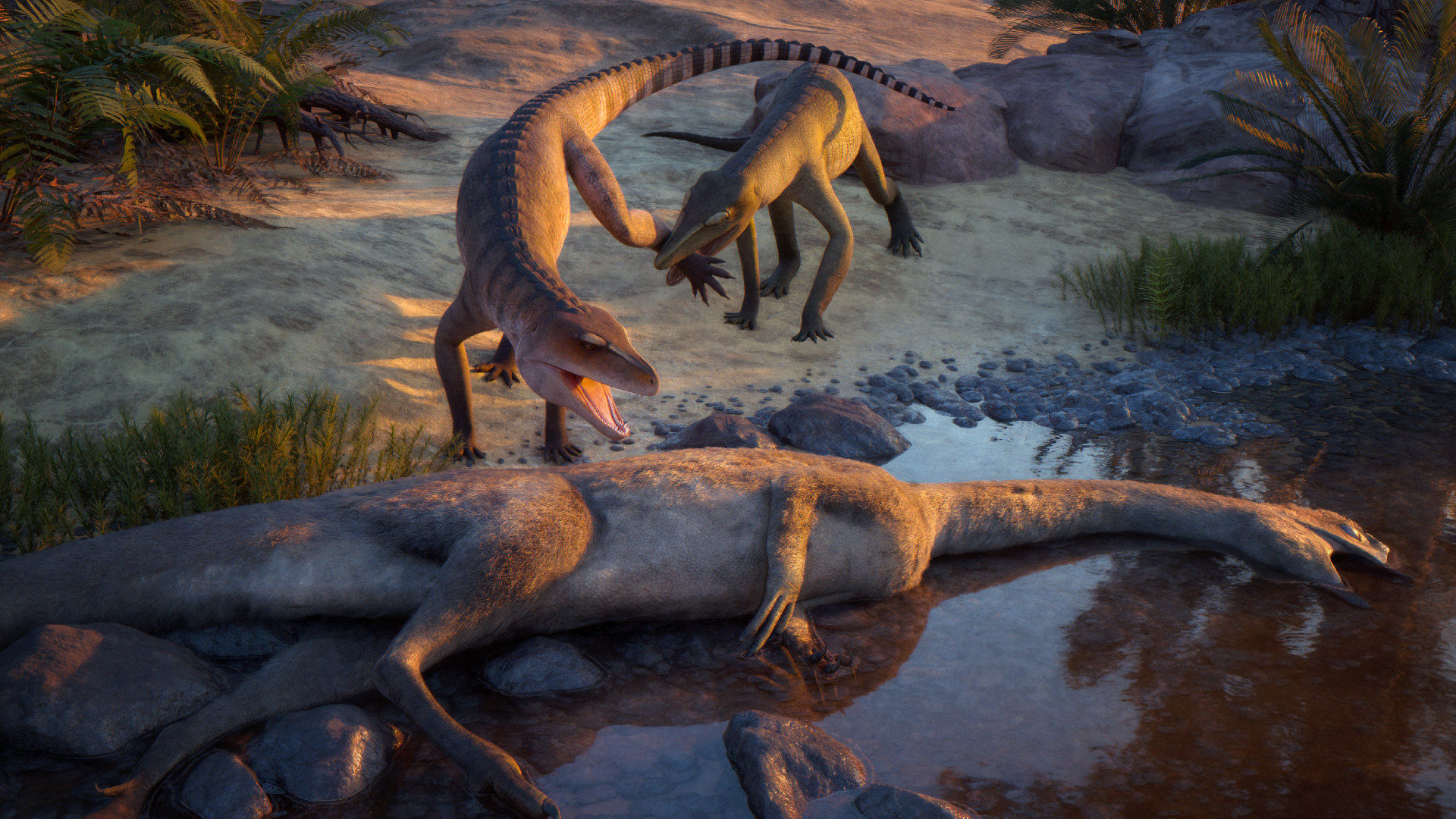
 The newly named genus and species Eosphorosuchus lacrimosa (left) is bitten by Hesperosuchus agilis (right) near a Coelophysis carcass at what is now Ghost Ranch, New Mexico. (Image credit: Julio Lacerda) Share this article 0 Join the conversation Follow us Add us as a preferred source on Google Newsletter Sign up for the Live Science daily newsletter now
 Get the world’s most fascinating discoveries delivered straight to your inbox.
Become a Member in Seconds
Unlock instant access to exclusive member features.
Contact me with news and offers from other Future brands Receive email from us on behalf of our trusted partners or sponsors By submitting your information you agree to the Terms & Conditions and Privacy Policy and are aged 16 or over.You are now subscribed
Your newsletter sign-up was successful
Want to add more newsletters?
Join the club
Get full access to premium articles, exclusive features and a growing list of member rewards.
Explore An account already exists for this email address, please log in. Subscribe to our newsletterDuring the Triassic around 205 million years ago, a newly-identified relative of modern crocodiles stalked its prey, but not in the water, a new study finds.
Like other ancient crocodile cousins, this newly identified species hadn't yet ventured into the water. Instead, it hunted its prey on land, much like a modern fox or jackal, the researchers said.
The specimen was originally discovered decades ago, in 1948 at Ghost Ranch, New Mexico, in a well known dinosaur death bed. At the time, it was tentatively cataloged as a specimen of Hesperosuchus agilis, a small, early relative of crocodiles and alligators. But now, the new study shows that the creature's unusually short snout and thick, reinforced skull set it apart as an entirely new genus and species, though the creature lived — and died — at the same time and place as H. agilis.
"This is the first really strong evidence we have of coexistence between two functionally different-looking crocodylomorphs," study co-author Miranda Margulis-Ohnuma, a paleontologist at Yale University, told Live Science. Crocodylomorphs include modern crocodiles, alligators, caimans and their extinct relatives.
The fossil of the short-snouted creature, newly dubbed Eosphorosuchus lacrimosa, was uncovered in a Late Triassic (237 million to 201 million years ago) formation. The animal's skull, the bones of one of its back legs, one vertebra, and three scales were preserved. The creature would have been about the size of a large dog.
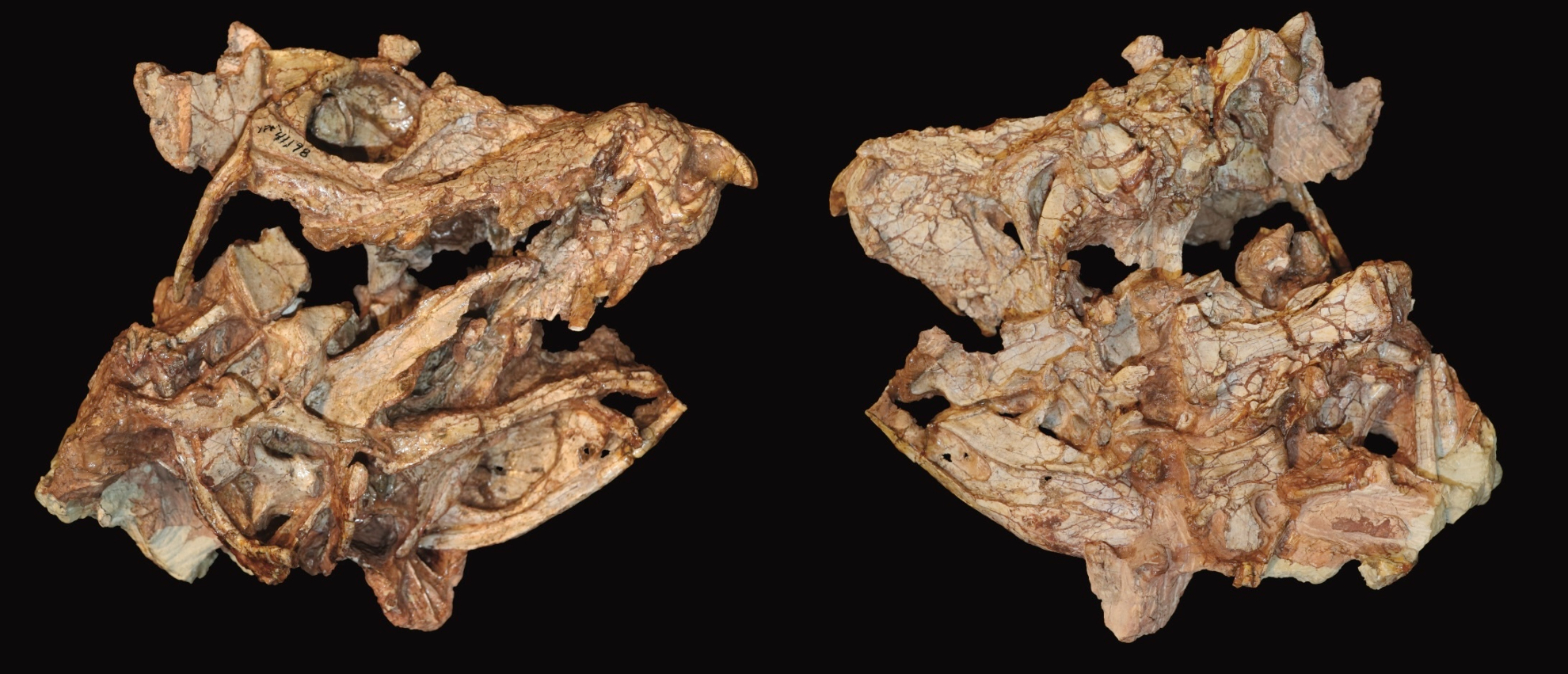
"It was in the basement of the Peabody Museum [at Yale] for, literally, 75 years," Margulis-Ohnuma said. "People would sometimes come visit and look at it, but it had never been identified."
Sign up for the Live Science daily newsletter nowContact me with news and offers from other Future brandsReceive email from us on behalf of our trusted partners or sponsorsIn the new study, published Wednesday (April 15) in the journal Proceedings of the Royal Society B: Biological Sciences, Margulis-Ohnuma and her colleagues categorized the fossil in detail and compared it with a fossil of H. agilis found about 15 feet (5 meters) away. The animals in this section of Ghost Ranch lived at the same time, and they died and were buried in a single event, possibly a flood.
E. lacromisa has a much shorter snout than H. agilis, the team found. It also has a larger, triangular postorbital — a bone in the skull — and matching features on its lower jaw that may have accommodated strong muscles for chomping. Together, those traits suggest the creature had a very powerful bite.
Because E. lacrimosa and H. agilis lived alongside each other, the team suspects they occupied different ecological niches. For example, crocodilians with shorter snouts may have fed on larger, less-agile prey than species with longer snouts did.
RELATED STORIES- 70 million-year-old hypercarnivore that ate dinosaurs named after Egyptian god
- 240 million-year-old 'warrior' crocodile ancestor from Pangaea had plated armor — and it looked just like a dinosaur
- Triassic 'tank' unearthed in Texas was a croc cousin that lived 215 million years ago
"It's really cool that it's not a lineage that's just struggling to take off — at this point, there's already diversity," Margulis-Ohnuma said. "We're really getting a snapshot of the very beginning of functional diversity across crocs."
Scientists don't know much about the early stages of crocodylomorph evolution. There aren't many of these animals preserved in the fossil record, Margulis-Ohnuma said, and many crocodylomorph species from the Triassic are represented by a single fossil specimen.
"For early crocs, we're very data deficient, so every new fossil that comes out is changing the story," Margulis-Ohnuma told Live Science. "If we can continue to describe this material that we have, and ideally find new fossils, it will change the story every single time."
Article SourcesMargulis-Ohnuma M, Ruebenstahl A, Meyer D, Bhullar B-AS. 2026 A short-snouted ‘sphenosuchian’ with unusual feeding anatomy demonstrates that ecological specialization occurred early in crocodylomorph evolution. Proc. R. Soc. B 293: 20260130. https://doi.org/10.1098/rspb.2026.0130
 Skyler WareLive Science Contributor
Skyler Ware is a freelance science journalist covering chemistry, biology, paleontology and Earth science. She was a 2023 AAAS Mass Media Science and Engineering Fellow at Science News. Her work has also appeared in Science News Explores, ZME Science and Chembites, among others. Skyler has a Ph.D. in chemistry from Caltech.
View MoreYou must confirm your public display name before commenting
Please logout and then login again, you will then be prompted to enter your display name.
Logout LATEST ARTICLES 1There were 'audible screams of delight': Why Artemis II sightings of meteor flashes on the moon have scientists giddy
- 2Physicists witness pinpricks of darkness moving faster than the speed of light
- 3Mini lake meets snowy rim of Canada's oldest ice mass
- 4Stone Age tombs in Scotland reveal 'webs of descent' among male relatives
- 5'Oslo patient' likely cured of HIV after getting stem cell transplant from his brother, who is genetically resistant to the virus