Breaking space news, the latest updates on rocket launches, skywatching events and more!
Contact me with news and offers from other Future brands Receive email from us on behalf of our trusted partners or sponsors By submitting your information you agree to the Terms & Conditions and Privacy Policy and are aged 16 or over.You are now subscribed
Your newsletter sign-up was successful
Want to add more newsletters?
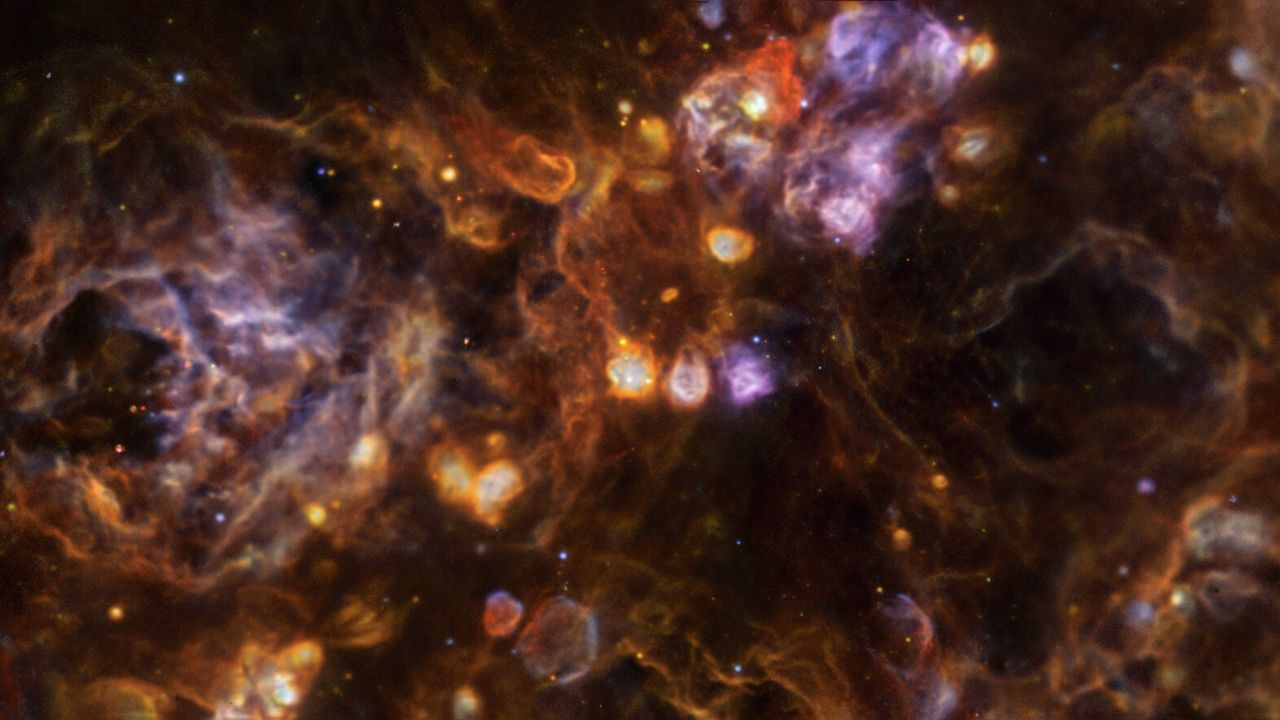
An account already exists for this email address, please log in. Subscribe to our newsletter A closeup of the nearby Triangulum galaxy, also known as Messier 33. (Image credit: ESO/A. Feltre, F. Belfiore, G. Cresci et al.)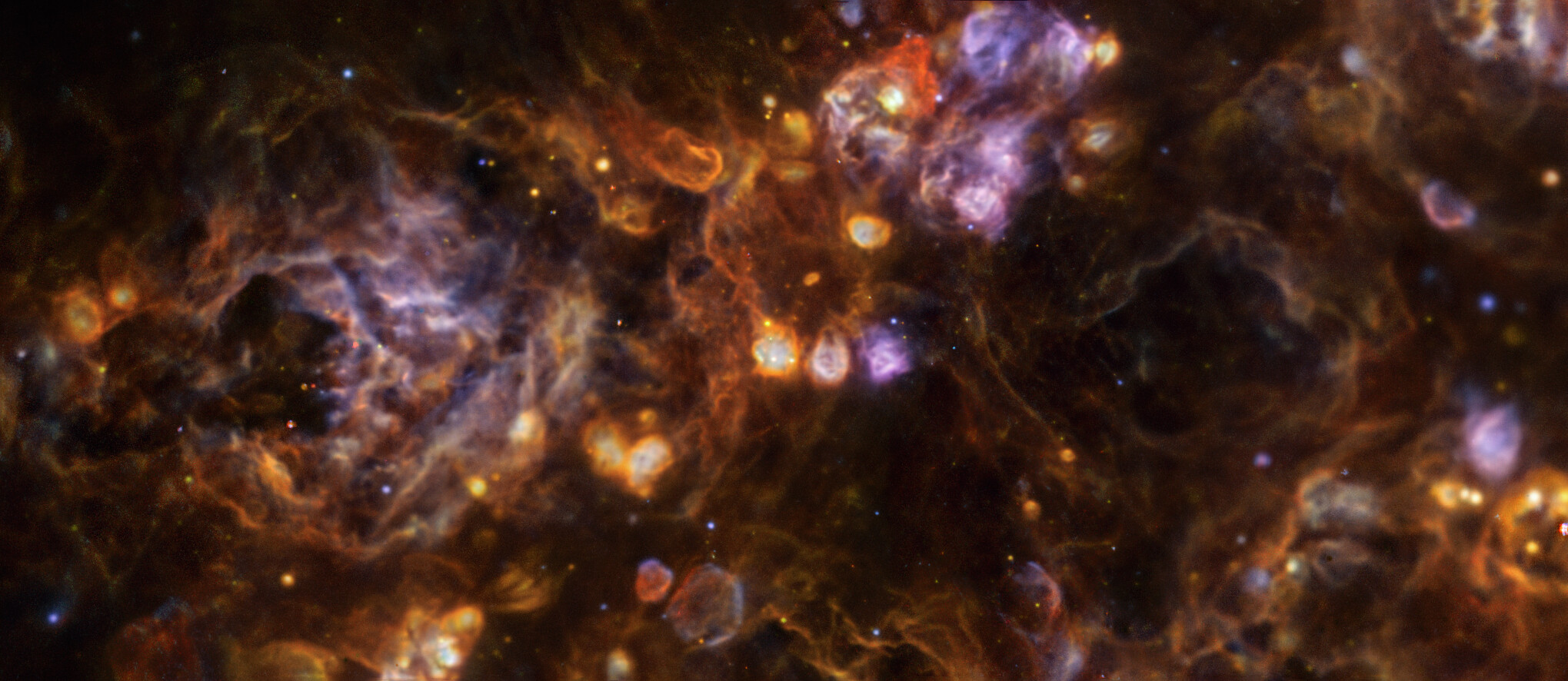
The aptly named Very Large Telescope captured a colorful new portrait of the Triangulum Galaxy, revealing complex clouds of gas in between the galaxy's 40 billion stars.
What is it?
This image was captured by the European Southern Observatory's (ESO) Very Large Telescope (VLT) in Chile's Atacama Desert and depicts clouds of gas in the Triangulum Galaxy, found some 3 million light-years away from Earth.
Astronomers used the VLT's Multi Unit Spectroscopic Explorer (MUSE) instrument to separate light from the Triangulum Galaxy (also known as Messier 33, or M33) into its constituent wavelengths, revealing the presence of different elements in clouds of gas between the galaxy's young stars.
Article continues belowIn the image, blue represents oxygen, green represents hydrogen, and red denotes the presence of sulfur.
Why is it amazing?
According to Anna Feltre, a postdoctoral researcher at the INAF-Astrophysical Observatory and author of a new study about the Triangulum Galaxy, this new image is a reminder that the space between stars is far from empty.
"This cosmic interplay produces a spectacular and dynamic landscape, revealing that the birthplaces of stars are far more beautiful and complex than we ever imagined," Feltre said in an ESO statement accompanying the new image.
Stars — particularly young, still-forming ones like those found in the central region of the Triangulum Galaxy — shape their surrounding environments with radiation, ionizing clouds of gas and causing those clouds to glow. This process is what's seen in the highlighted VLT image.
Get the Space.com NewsletterContact me with news and offers from other Future brandsReceive email from us on behalf of our trusted partners or sponsors Article SourcesFeltre et al. (2026). M3D: Mosaicking M33 with MUSE datacubes - I. Unveiling the diversity of H II regions in M33 with MUSE. Astronomy & Astrophysics https://doi.org/10.1051/0004-6361/202557122
 Brett TingleyManaging Editor, Space.com
Brett is curious about emerging aerospace technologies, alternative launch concepts, military space developments and uncrewed aircraft systems. Brett's work has appeared on Scientific American, The War Zone, Popular Science, the History Channel, Science Discovery and more. Brett has degrees from Clemson University and the University of North Carolina at Charlotte. In his free time, Brett enjoys skywatching throughout the dark skies of the Appalachian mountains.
View MoreYou must confirm your public display name before commenting
Please logout and then login again, you will then be prompted to enter your display name.
Logout MORE FROM SPACE... 1Northern lights dazzle worldwide as strong G3 geomagnetic storm sparks stunning show (photos)
 - 2Are mysterious 'Little Red Dots' discovered by the James Webb Space Telescope actually baby galaxies under construction?
- 3Could our universe exist because black holes ate up all the antimatter?
- 410 iconic William Shatner 'Star Trek' moments to celebrate his 95th birthday
- 5See the delicate crescent moon dance with the 'Seven Sisters' of the Pleiades tonight