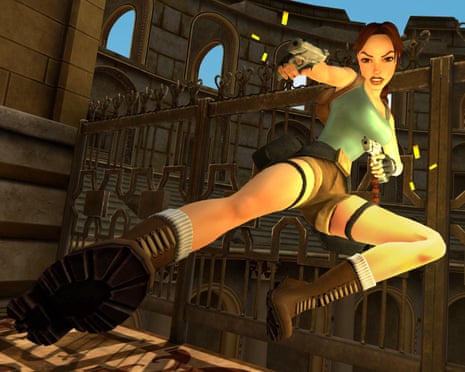
 ‘I’m still carrying the scars of her creation’ … a later incarnation of Lara Croft. Photograph: Aspyr‘I’m still carrying the scars of her creation’ … a later incarnation of Lara Croft. Photograph: AspyrTomb Raider’s creators on how the game changed their lives: ‘Skint staff were suddenly pulling up in sports cars’
‘Giving Lara Croft pistols meant we could show off her acrobatics. And when she goes to Peru, we threw in a T rex!’
Paul Douglas, lead programmer and co-creator
I joined Core Design in the summer of 1994 and met Toby Gard, who showed me his concept sketches for Tomb Raider. He’d already come up with the title and drawn a mock-up box cover with a woman holding two pistols.
I was working on a golf game called The Scottish Open when Toby persuaded me that we should pitch his idea to Jeremy Heath-Smith, Core’s co-founder, who gave us the go-ahead to make a prototype. If I had stuck to the golf game, I would have had a much easier life.
We had a couple of brainstorming sessions, and settled on the game’s four main pillars: platforming, puzzles, combat and story. Combat was always the weakest element but we didn’t have time to improve it. We also came up with the plot and level themes, and whittled a long list of interesting archaeological locations, including Petra and Angkor Wat, down to four: Peru, Greece, Egypt and Atlantis.
Lara was originally Latina and her appearance was more realistic, almost androgynous. We felt that more stylised movement would play better, so her physique changed to reflect that. She became a British mercenary and then, thanks to scriptwriter Vicky Arnold, an aristocrat who tracks down historical artefacts just for fun.
Toby and I came up with the movement metrics by measuring out a hopscotch grid in the car park. Lara was three paces tall and each block in the game’s environment was four paces. All of the gameplay systems grew from those measurements and constraints.
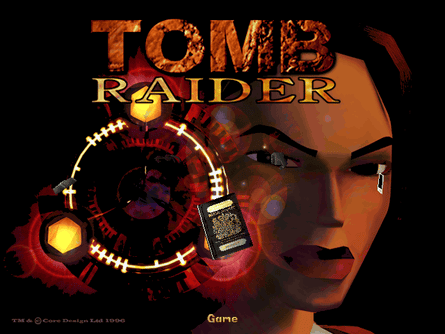 ‘I like to think the quality of the game spoke for itself, regardless of how Lara was sexualised’ … the 1996 Tomb Raider title screen. Photograph: MobyGames
It was brutal getting it delivered on time. I took just three days of holiday in two years. Toby and I were in the office until 2 or 3am every day, including weekends, for the best part of a year. Toby made himself sick with the stress.
We were on the cusp of 3D games going mainstream and the action-adventure focus made us somewhat unique. Then the marketability of Lara thrust Tomb Raider into the stratosphere. The game’s publisher, Eidos Interactive, took the character and ran with it. I like to think the quality of the game spoke for itself, regardless of the way Lara was sexualised.
We never imagined Tomb Raider would blow up in the way it did. It was the right time, right place, and it was different from the competition. We showed that ideas that go against conventional wisdom – a female character will never sell! – can uncover new territory and find success. It was gratifying and humbling to see our hard work rewarded by so many people playing the game. We managed to bottle lightning, although I’m still carrying the scars of its creation.
Heather Stevens, level designer
We developed most of Tomb Raider in a big Victorian building on Ashbourne Road in Derby. We sat there sweating our guts out in the summer and freezing cold in the winter. I was the only female developer, but that didn’t faze me. I felt respected and was almost seen as a sister by some – the team was like a family. It was a defining time in my life.
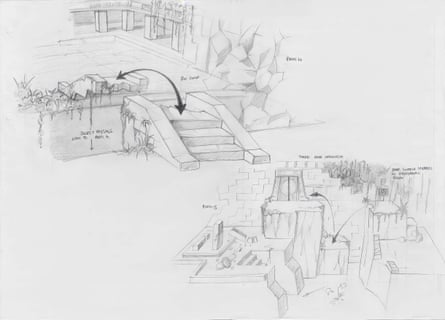 ‘Women hadn’t really been portrayed like that’ … Heather Stevens’ level concept sketches. Photograph: Heather Stevens
Toby was lovely. Very eccentric and a bit of a genius. He’d put together a demo that was like a simple top-down version of Prince of Persia, with an Indiana Jones-like character jumping and tumbling from platforms. Although management thought no one would want to play a female character, they went with it. There’s a certain empathy you get from playing Lara. It’s probably the number of times she dies and that awful scream. She was taciturn and mysterious: a loner who played her own game and didn’t answer to anybody. Women hadn’t really been portrayed like that before.
Giving Lara pistols enabled us to show off her acrobatic movement. She was mostly pursued by animals rather than people. Hearing a bat, or the growl of a bear, was much scarier than a gunshot. You felt at the mercy of the wild. And we pushed the 3D environment to its limits. We only had so much memory and processor speed, but we were clever with it, giving players the sense that they were in this vast, cavernous space that was actually lots of rooms bolted together.
Before designing a level, we always had a team meeting where we’d come up with a rough schematic. We all enjoyed history. We chucked in whatever myths and legends we thought would be fun and interesting. Our imaginations ran wild – to the point where we threw a T rex into Peru!
Eidos saw the potential of Lara, rather than the game, so they focused on her. That was the right thing to do, but I think it went a bit too far with what she was wearing or the poses she was put in for some marketing campaigns. They showed a lack of imagination by oversexualising her.
I knew we’d made a great game, but it didn’t really sink in until I saw the sales figures. It was life-changing for all of us. People who were skint before were suddenly pulling up in sports cars. I was able to buy a house from the royalties.
Lara is right up there with iconic characters such as Mario and Sonic the Hedgehog. Feeling as if you’ve left a mark, and connected with millions of people through something you’ve created, is amazing.
Explore more on these topicsShareReuse this content