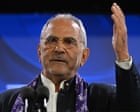
 President José Ramos-Horta says Timor-Leste is alert to the dangers of organised crime. Photograph: Mick Tsikas/AAPPresident José Ramos-Horta says Timor-Leste is alert to the dangers of organised crime. Photograph: Mick Tsikas/AAPTimor-Leste is vulnerable to ‘infiltration by foreign organized crime’, president José Ramos-Horta says
Australian federal police say they are working with tiny nation to respond to threat of online scam centres
Timor-Leste is vulnerable to “infiltration by foreign organized crime”, the country’s president, José Ramos-Horta, has warned.
His comments come as Australian federal police confirmed to the Guardian the force is providing support to local law enforcement in Timor-Leste, including a December 2025 visit from the agency’s digital forensic and cyber experts.
“The AFP is increasing its focus on cybercrime and digital forensics capability development within the region in response to the threat of online scam centres,” a spokesperson said.
On Tuesday a joint investigation between the Guardian and the Organised Crime and Corruption Reporting Project revealed an alleged connection between three individuals involved with a proposed “blockchain theme” resort project in Dili and the Prince Group, which was sanctioned by the US and UK governments in October.
The Cambodia-based Prince Group describes itself as a real estate and financial and consumer services conglomerate but US authorities allege that it ran compounds reliant on human trafficking that targeted victims globally with online fraud.
Q&AWhat is Prince Group?
ShowPrince Holding Group (Prince Group) is Cambodia-based business conglomerate focused – according to its website – on “real estate development, financial services and consumer services”.
In October 2025 US authorities indicted Prince Group's founder, Chen Zhi, on wire fraud and money laundering charges, describing the group as “one of the largest transnational criminal organizations in Asia”.
Authorities allege the group operated forced-labour scam compounds engaged in “industrial scale cyber fraud”, including through cryptocurrency investment fraud schemes, which targeted victims around the world, resulting in billions of dollars in losses. According to the indictment, Prince Group ran dozens of business entities in more than 30 countries.
Prince Group has denied the allegations of criminal activity, describing them as baseless and says they are aimed at unlawfully seizing billions.
Authorities seized US$15bn in bitcoin and froze Chen’s UK assets, including several luxury London properties. Hong Kong and Singapore froze or seized assets linked to the company worth more than US$450m. More than 100 business entities – registered in Cambodia, Singapore, Hong Kong, Palau and Taiwan, among others – and 17 individuals were placed on a sanctions list because of alleged links to Chen.
“Today the FBI and partners executed one of the largest financial fraud takedowns in history,” the FBI director, Kash Patel, said of the indictment.
The alleged scam kingpin, who also holds passports from Cyprus and Vanuatu, was arrested in Cambodia and extradited to China in January. It is not clear what charges he faces there. China’s foreign affairs ministry said authorities were collaborating to combat cross-border telecom fraud scams.
After Chen's arrest, the Cambodian government said it had stripped him of his Cambodian citizenship and honorific title.
Last year the UN issued a warning about the risk of unnamed scam networks infiltrating Timor-Leste. This followed the raid of an alleged unrelated scam operation in Oecusse, a remote pocket of the country, in August.
“Together with the government and our entire society, we remain alert to the dangers of organized crime,” Ramos-Horta wrote in a statement published on the president’s website on Wednesday in response to the Guardian’s report.
He added: “But I cannot accept information that comes merely from media reports or from certain individuals in Timor-Leste – people who may wish evil upon the country or seek to tarnish the name of Timor-Leste, they are the ones produce false information against those who wish to invest in Timor-Leste …
“Currently, I do not see any organized crime installed in Timor-Leste.”
mapPrince Group’s founder, Chen Zhi, was indicted by the US for alleged wire fraud conspiracy and money laundering conspiracy, and billions of dollars in bitcoin was seized. In January, Chen was extradited to China but it is not clear what charges he faces there.
A spokesperson for the Prince Group denied the US and UK allegations, saying they were “nothing more than a cash grab” and that Chen and the Prince Group of companies had never had any connection to any “scam” business.
“They are innocent of the absurd allegations used simply as air cover by a multitude of governments to seize billions in assets from an innocent entrepreneur, all while destroying legitimate businesses and hurting tens of thousands of hard-working people.”
Private jets, deserted shores and an unbuilt resort: alleged links to sanctioned ‘scam’ empire revealed in Timor-LesteRead moreThe spokesperson said neither Chen nor the Prince Group had any knowledge or connection to Timor-Leste or any activity in that country. “The inclusion of speculation around Chen and Prince in this reporting is just salacious rumor-mongering with no foundation,” they said.
The three individuals involved in the proposed resort project in Timor-Leste were also sanctioned by US authorities in October for their alleged involvement in another real estate development connected to Prince Group. They have not been charged and there is no allegation the Timor-Leste project received Prince Group funds.
Current shareholders in the project denied any involvement with organised crime or any other wrongdoing, and said the three alleged Prince Group associates had been immediately dismissed from the resort after the US sanctions were announced.
The joint investigation also examined the role of an investor and the face of the resort in Timor-Leste, Lin Xiaofan – also known as Frank Lin. There is no suggestion Lin is sanctioned or a member of Prince Group, and he is not accused of any criminality.
“Timor-Leste possesses abundant natural resources and strong potential for tourism development,” Lin said of his interest in the project. He said all his activities in the country had been “conducted within a legal and compliant framework, in cooperation with relevant authorities”.
In the statement published on the president’s website, Ramos-Horta said he had welcomed Lin “just as I welcome any investor from countries across Asia and Europe”.
“Like many investors, Mr. Lin arrived with ideas, plans, and dreams of making significant investments in Timor-Leste, though these have not yet materialized,” he wrote.
He added: “Mr. Lin has done nothing wrong in Timor-Leste. It is the government that will decide whether to accept any investment, and if that investment is good for Timor-Leste, then the government will decide accordingly.”
A Department of Foreign Affairs and Trade spokesperson said the Australian government was “working closely with Timor-Leste to address transnational crime and strengthen regional security and resilience”.
In January Anthony Albanese visited Dili to establish a Parseria Foun ba Era Foun (“Parseria”), which is Tetum for a New Partnership for a New Era, alongside his counterpart, the prime minister of Timor-Leste, Xanana Gusmão.
The agreement committed the two counties to regular communication, consultation and collaboration on common security interests, including on transnational crime.
-
Do you know more? Email [email protected] or [email protected]