Rick Pitino says the game is 'the best I've ever witnessed,' and we agree
 By Zachary Pereles Mar 30, 2026 at 2:38 pm ET • 8 min read
  Getty Images
 WASHINGTON, D.C. -- In 1964, Bob Dylan sang that the times, they are a-changin'.
You know what he said directly before that? "And you better start swimmin' or you'll sink like a stone."
He didn't whine or complain that the waters had grown. He said change was necessary. Adapt or die.
Maybe, if we could take that attitude to college basketball, we'd be better off. In fact, I'm sure of it. If this past weekend didn't tell you otherwise, I'm not sure what you're watching. I had the treat of watching three games featuring four legendary programs and four superstar coaches, and decided by a total of 10 points.
It reminded me why I love the sport in the first place: Basketball is beautiful.
College basketball is not perfect. It is not close to perfect. This week started off with Will Wade leaving NC State, after just one season, for LSU without saying goodbye. NIL played a big role. It didn't feel great for the health of the sport. After his hire just a year prior, he had taken Jim Valvano-esque pictures. You won't find two people on more opposite ends of the spectrum in Wolfpack lore than Valvano, whom fans revel in, and Wade, whom they revile.
Even on Thursday, when Jon Scheyer's Duke, Dan Hurley's UConn, Tom Izzo's Michigan State and Rick Pitino's St. John's had their media availabilities, much of the discussion was with what's "wrong" with the sport. The fact that roster building is a 24/7/365 enterprise. The lack of transparency. The money. The transfer portal. The lack of Cinderellas.
Duke's all-time collapse says it again: Jon Scheyer has a March problem -- until proven otherwise Zachary Pereles
"I don't know what keeps me in it," Izzo said. "I do question it sometimes. I'm not ready to give into the system, even though I think the system is completely broken."
He continued later: "If a majority of coaches think something's wrong, it's probably wrong. For administrators to sit in their ivory towers and never come down to the basement and figure that out is disheartening."
When Izzo finally perked up, cracked a big smile and said, "Let's get back to the Sweet 16, man!" he was told the session was over. He cackled and threw up his hands.
"I am excited about being in the Sweet 16!" he said on his way out. The fact that he even needed to clarify it reflected how college sports can feel these days.
But then the games began. Duke trailed St. John's by 10 in the second half before turning the game around thanks to Caleb Foster, playing five-on-five basketball for the first time since breaking his foot less than three weeks earlier. He wore a boot and used a scooter to get around when he wasn't on the court. Thank goodness his back hadn't been hurt, too, because he put Duke on it when the Blue Devils needed him most. It brought tears to Scheyer's eyes postgame.
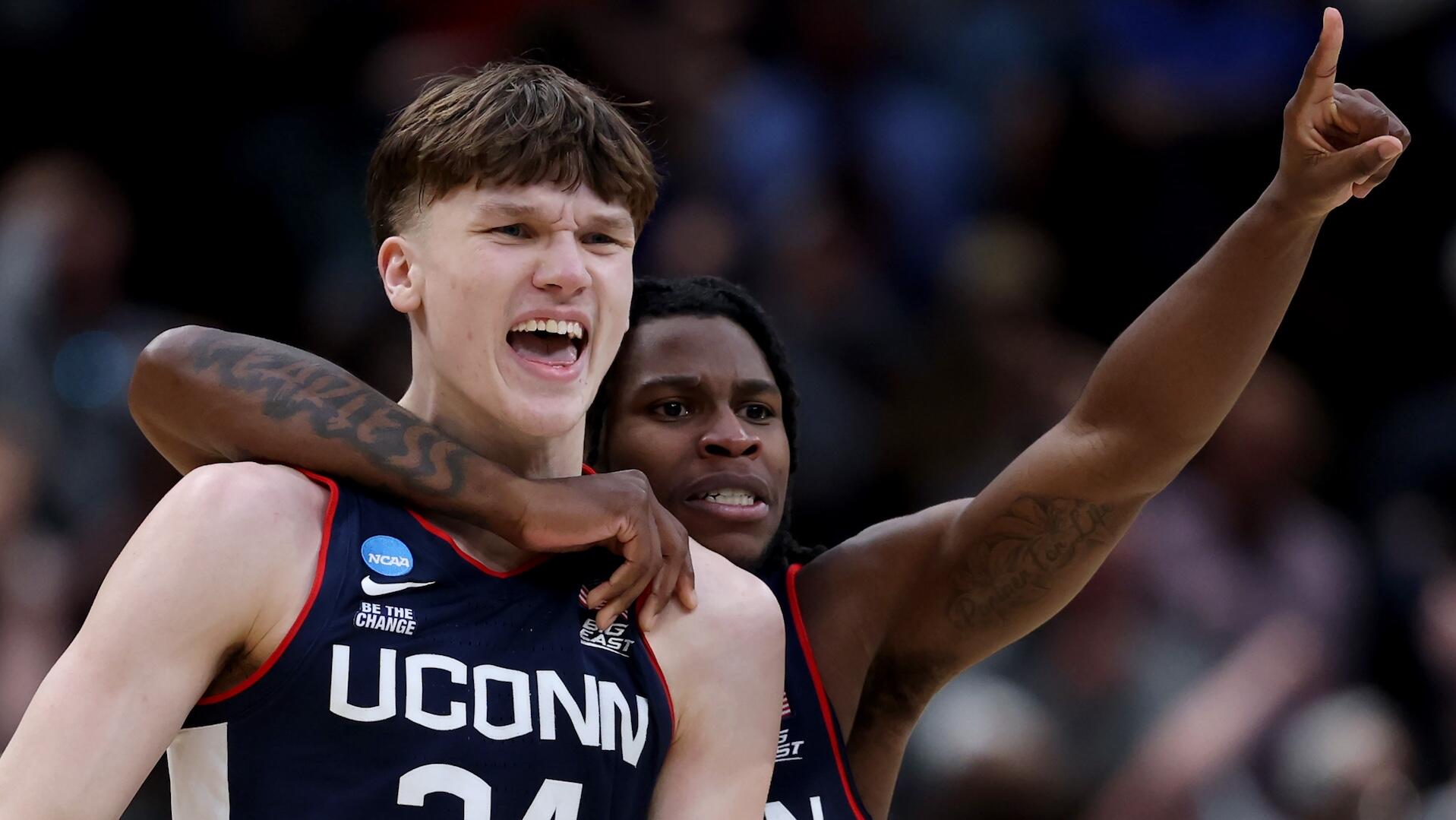
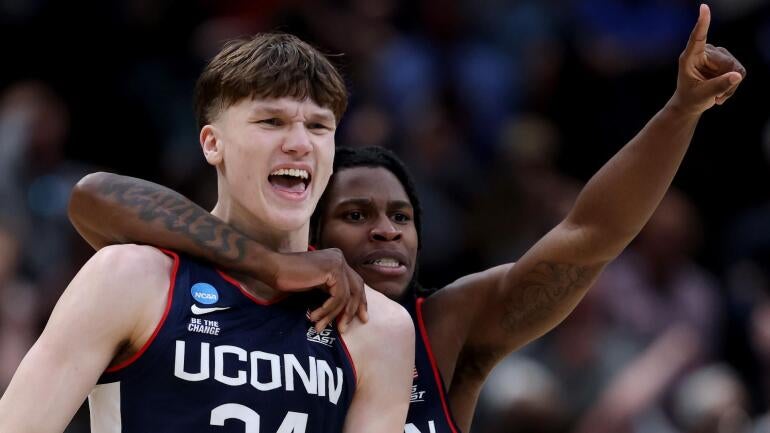
Then came an absolute humdinger of a game between UConn and Michigan State. The Huskies led by 19, but Michigan State scratched and clawed and even took the lead. In the end, it was too much Alex Karaban and too much Tarris Reed Jr., and UConn escaped by four.
Two days later, the Blue Devils and the Huskies somehow managed to not just top both of those games but produce an all-timer. This time, UConn trailed by 19 early. It trailed by 15 at halftime. No. 1 seeds were 134-0 all-time when leading by 15 or more at halftime.
They're now 134-1 after Braylon Mullins' epic game-winner from near midcourt. Hurley's parents' reactions summed it up best: His dad, legendary high-school coach Bob, couldn't process what had happened. His mom, Christine? Three words: "Holy f---ing shit!"
"Holy f---ing shit," indeed.
This weekend and this tournament have shown the sport at its finest.
"What's on court, the way the game is being played on court, is the best I've ever witnessed," Pitino said. "There's a lot of good to it. There's still some things that need to be worked out. I think the play of about 30, 40 teams I've seen this year is much higher than I've ever witnessed."
The idea of there being no "blue bloods" due to the influx of money and European talent isn't 100% true, nor is it 100% a bad thing. If anything, it makes the on-court product better and increases parity. The greatness of a tradition-rich program still matters. But it's not all that matters. This year was the first since 1954 that none of Kansas, Kentucky, North Carolina or UCLA was among the final 16 teams left.
"If you shortcut anything in today's college basketball, you try to get by on nostalgia, you've got no shot," Hurley said.
Instead, we have Arizona in its first Final Four in 25 years and Illinois in its first in 21 years. We have Michigan in the Final Four two years after the program, coming off an 8-24 season and the firing of the legendary Juwan Howard, seemed to be on life support. We have UConn in its third Final Four in four years, proving that consistent excellence can be achieved with exceptional coaching, exceptional talent and exceptional commitment.
Maybe teams like Arizona and Illinois don't touch your heart like a traditional Cinderella. Pitino has an answer there, too: He thinks Cinderellas will be back at some point.
"But what's even better than that is the fact the blue bloods no longer control basketball any longer," he said. "There's no difference between Kentucky, North Carolina than Illinois or St. John's. There's no difference anymore. There's no difference between Michigan State, who is a blue blood, to any of the other teams from the conferences, from Mississippi, when they get it going. It's all going to be the same."
Ole Miss made the Sweet 16 for the second time ever last year. Maryland made it for just the second time in 20 years. Four years ago, Florida Atlantic made the Final Four, and San Diego State made the national championship.
Remember, in "The Times They Are A-Changin'" Bob Dylan also sang "For the loser now will be later to win" and "The first one now will later be last."
Maybe he was a clairvoyant college basketball viewer in addition to a songwriter.
There is still plenty of magic in March, even if it's not what we've traditionally associated with it. How about a Long Island University walk-on, Eddie Munyak, scoring his first career points in the waning moments of a blowout loss to Arizona and celebrating as if he had just won a national championship? How about Foster's miraculous recovery?
How about VCU's Terrence Hill Jr. scoring 34 points to lead a 19-point comeback win over North Carolina ... with a torn tendon in his right thumb?
How about Chase Johnston's first 2-pointer of the entire season being 12-seed High Point's game-winner over 5-seed Wisconsin?
How about Bill Raftery screaming "Take me to the Balkans!" on a thunderous dunk by Illinois' Zvonimir Ivišić (Croatia), and days later, David Mirković (Montenegro) rocking an Amazon-bought cowboy hat because, "Why not? We in Texas."
I wish every fan could cover one NCAA Tournament game. Sit in wonder courtside as these stupendously talented young men do their thing. Go to the press conferences and locker rooms and get to know them. Every player and coach I talked to this weekend was thoughtful, patient, polite and sincere.
Listen to Cayden Boozer, all of 18 years old, with tears in his eyes and blood on his jersey, with his world having crashed down minutes earlier, handle a heartbreaking situation with grace and responsibility with dozens of cameras and microphones jammed in his face. Listen to Cameron Boozer do the same moments later, and then watch him and Nik Khamenia embrace and say "I love you."
Listen to Karaban and Reed talk about Hurley and UConn. Listen to Carson Cooper, Jaxon Kohler and Jordan Scott talk about Izzo. Listen to Bryce Hopkins talk about Pitino and St. John's revitalizing a career full of ups and downs.
Listen to how Houston's Kelvin Sampson talks about seniors Emanuel Sharp and Milos Uzan.
"That's why you choose coaching, Sampson said. "... Winning the games is why we do it, right? We want to compete at the highest level and be competitive. But, you know, people will forget who won games or what your records were. That will be forgotten. But being able to coach kids like Milos and Emanuel and be able to stay a part of their lives, you know, five, 10 years from now -- of course, they got a lot longer than I do, but however long that is, you just hope that you get to see 'em.
"They will eventually get married and have kids and you get to share that with 'em. But relationships is why you do it."
And listen to how Sharp talked about Sampson sticking with him through injury, through growth, through improvement: "I love coach. I love him hard."
2026 Final Four: Evaluating Michigan vs. Arizona, UConn vs. Illinois as March Madness reaches final weekend Cameron Salerno
Listen to Solo Ball talk about why he loves basketball.
"When I first started I was always overlooked, so I feel like that's always been my motivation," Ball said. "I started off really small. My freshman year of high school, I came in 5'4," size 13 feet, 6'4" wingspan. People was never looking at me at all. That's really why I kept bouncing school to school. I was just trying to find the right opportunity. I just continued to believe in myself. I think that's what just made me love this game so much. I just put in so much time, so many hours ...
"I don't know what I'd be doing if I can't play basketball."
Yes, these players make money. Yes, many change schools, some multiple times. Yes, the glass slipper hasn't fit Cinderella in a few years. Yes, the players who stay may be in short supply. We can cherish them while also cherishing the players who look for better opportunities and the influx of foreign talent.
The great stories are still there. The great relationships are still there. The great basketball is more widespread than ever. Isn't that worth celebrating?
I suppose you can continue to harp against this era of college basketball, to do anything you can to not enjoy it. The sport's not perfect. I'm not here to tell you how to feel.
But you'll sink like a stone. And I'll tell you this: Swimming's a whole lot more fun.
Join the Conversation comments