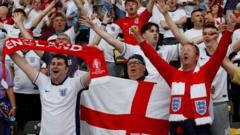
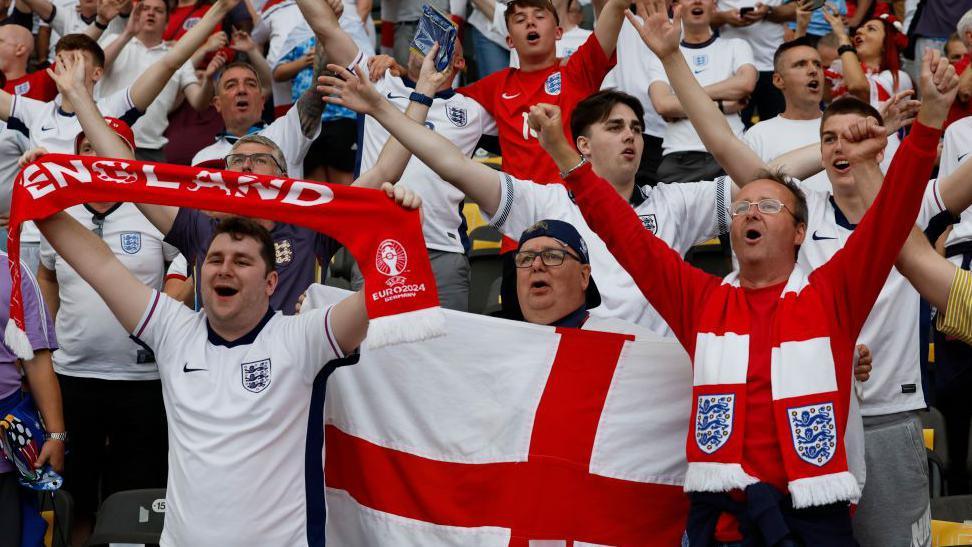
 Image source, Getty ImagesImage caption,
 England begin their World Cup campaign against Croatia on 17 June (21:00 BST)
ByDan RoanSports editor- Published38 minutes ago
UK police are sending just three officers to the US to accompany England fans at the 2026 World Cup, after American authorities refused to provide funding.
It means there will be 37 fewer 'spotters' compared to the Euros in Germany two years ago, when the hosts covered the costs.
More than 10,000 England fans have bought tickets for each of England's group games in Dallas, Boston and New Jersey, despite criticisms over the prices of tickets and travel in the US next month.
"We would like more [officers]", national football lead Chief Constable Mark Roberts told BBC Sport at a pre-tournament security briefing.
"If there was more there we could try and reduce the risk and make it a bit easier for everyone, but it is what it is and we'll clearly do the best we can with the resources we deploy.
"In Germany we sent 40, because that was the ask of the Germans and they funded it.
"In this case the Americans are not are sold on the idea of the mobile delegations. They're not funding it, so it'll be a smaller deployment.
"We're not criticising that, it's their operation, they'll police it. We see the benefit of spotters, as I think most of the European countries do, because it gives us the opportunity to have a greater coverage of really good experienced people who will liaise with the supporters and the FA.
"But if we want to monitor fans leaving the city centre and then be there to receive them at the ground, you can't be in two places at once. So it limits our ability to do that."
Roberts added that the UK police delegation at each match would ideally include two officers at the stadium, two in the city centre and two in transport hubs – with six to 10 deemed to be the ideal number on the ground. He said there had been six spotters at the World Cup in Russia in 2018 and 16 in Qatar.
The White House World Cup Taskforce has been approached for comment.
"We know fan behaviour. The States isn't necessarily a football fan culture in the same way. It's very different', said Roberts.
"There are 18,000 law enforcement agencies in the US, so they will have had different exposure to crowds managing things.
"The behaviour of our fans in tournaments over recent years has been pretty well exemplary, so we start from a good place. I think one of the key reasons we're so keen to send a team out there is that it gives us the opportunity to brief local law enforcement.
"So we always like to be there to communicate to fans if their behaviour is causing offence. Equally to say to local law enforcement, 'this isn't a problem. This is normal behaviour'. So we're going to be more limited in that."
Empty rooms and Fifa cancellations - US hotels fear World Cup washout
- Published1 day ago
World Cup transport prices cut after fan backlash
- Published13 May
Tackling the hooligans - the role of the 'spotter'
- Published13 September 2025
On Thursday, the UK Football Policing Unit revealed that between 12,000 and 15,000 England fans will be at each of England's three group matches in Dallas, Boston and New Jersey. That includes 3,000 to 4,000 from the official England Supporters Club for each game.
"We probably would have wanted that to be a bit higher", said Thomas Concannon, leader of the Football Supporters' Association England fan group.
"It feels like those numbers are a little bit disappointing given the excitement that was building up. We thought there would be more…but given the costs it's still a brilliant number of fans that have dedicated themselves to go.
"When you look at the sheer cost of it there will have been a lot of people priced out of it. We're really disappointed that the cost of attending games is as high as it is."
Roberts, meanwhile, was also critical of the government's decision to relax licensing laws during the tournament, saying it was "probably unnecessary and does increase the risk to some degree."
Pubs in England and Wales will be able to stay open late for any home nation knockout match this summer.
"We were consulted, as I have been on every tournament I can remember, and then our advice wasn't heeded," said Roberts.
"The concern over this is when you give a blanket exemption, it removes that check factor. So it will undoubtedly lead to busier, longer, later shifts for police officers.
"We know that alcohol is a factor in poor behaviour around tournaments. We know there is an increase in domestic abuse reports. There are risk factors and we think they could have been sensibly mitigated, whilst allowing a degree of freedom from licensees by relying on the tried and trusted methods."
Related topics
Follow your club with BBC Sport
- Published12 March

Listen to the latest Football Daily podcast
Get football news sent straight to your phone
- Published16 August 2025