

 PA MediaThe number of confirmed or suspected cases increased on Friday
More than 4,500 young people have been vaccinated as part of a huge drive to tackle a deadly meningitis outbreak in Kent.
Hundreds were still queuing before clinics closed their doors on Friday, while more than 10,000 have been given antibiotics to protect against the infection.
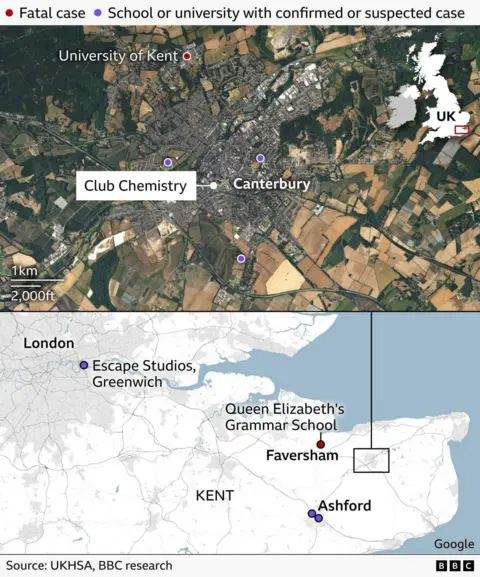
Health officials have cautioned that it was too early to say if the outbreak, which has killed two people aged 18 and 21, had reached its peak. It is thought to have originated at the Club Chemistry nightclub in Canterbury.
The UK Health and Security Agency (UKHSA) said on Friday that the number of confirmed or suspected cases had risen from 27 to 29, all of whom have been taken to hospital.
Kent County Council's public health director Dr Anjan Ghosh warned there could be more "sporadic" cases elsewhere.
Paul Hunter, professor of medicine at the University of East Anglia, said he was "fairly certain" the peak from the initial super spreader event has already passed, but that secondary cases - in which the infection was passed on further - were still possible.
Staff drafted into vaccination centres from schools and sexual health clinics have been praised by NHS bosses for their "heroic efforts".
Annabelle Mackay, a University of Kent student from Brighton, was at the club in Canterbury on 5 March.
When she started showing symptoms six days later, she said her muscles were "just in agony, I couldn't move".
 Annabelle Mackay could not walk, talk or see at one stage but is now recovering
After Annabelle's symptoms appeared, she first she thought it was Covid, but tested negative.
Then she became delirious, became "really sensitive to light", and stopped making sense, she said.
She realised something was wrong and called the NHS service 111, which told her to stay at home and to go to hospital if her symptoms grew worse.
"I just had a gut instinct that something wasn't right," she said.
Annabelle said her housemates helped her down the stairs because she had lost the ability to walk and by the time she got to Canterbury Medical Centre, she was unable to talk.
She was taken by ambulance to A&E and given antibiotics, before tests revealed she had bacterial meningitis.
"I was just in so much pain in my body that I didn't have time to process that I couldn't see, but it was definitely really scary for my family and my friends," she said.
Speaking to the BBC after leaving hospital on Thursday, she said: "I feel so grateful to be alive."
Annabelle said she was only at the nightclub for less than an hour, had one drink and did not share vapes.
She also said she was outside for "pretty much the whole time".
Four schools in the Canterbury area now have confirmed or suspected cases, after a fifth said their student had tested negative.
Those affected are Queen Elizabeth's Grammar School in Faversham, Norton Knatchbull School in Ashford, Simon Langton Grammar School for Boys in Canterbury and the Canterbury Academy.
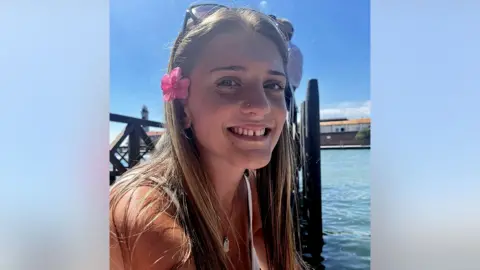 Family handoutJuliette, 18, was "fit and healthy" before she died, her father said
Juliette Kenny, a sixth form pupil at Queen Elizabeth's Grammar School in Faversham, was one of the two young people to die from the infection at the weekend.
Juliette's father, Michael, described his daughter as "a force in this world" who "spread fun, love and happiness".
He said the 18-year-old was "fit, healthy and strong" before her death, and urged the government to extend routine NHS access to the MenB vaccine to teenagers and young adults.
Who is eligible for a vaccine?
Routine vaccinations only began to be rolled out in 2015, meaning the current generation of students and others in their late teens are not protected.
Experts say the case for whether to routinely vaccinate teenagers against MenB is complicated.
"No family should experience this pain and tragedy," Juliette's father said.
UKHSA chief scientific officer, Prof Robin May, said the vaccines being deployed worked well against the strain of invasive meningitis identified in Canterbury.
He said the bacteria was also susceptible to the antibiotics being used.
But because meningitis has an incubation period of up to 10 days, more time is needed before the outbreak can be declared over, he said.
Health Secretary Wes Streeting has said the Joint Committee on Vaccination and Immunisation will revisit its advice on whether a wider catch-up vaccination programme is needed.
UKHSA has said anyone who went to Club Chemistry between 5 and 15 March can get an MenB jab.
Year 12 and 13 pupils at schools with confirmed or probable cases, students and staff at the University of Kent and anyone who has been offered preventative antibiotic treatment by the UKHSA are also eligible.
Previously, only University of Kent students living in halls of residence had been offered the vaccine.
Four clinics will be open on Saturday, with two in Canterbury, one in Faversham and one in Ashford. With high demand continuing, people are being asked to bring water.
Health workers have said there is no shortage of vaccines, but organisers need to calculate how many people they can get through under current staffing.
NHS Kent and Medway said 4,514 vaccines had been administered in Kent as of Friday afternoon.
The health trust's website also said 10,561 antibiotics had been handed out so far.
A Level student Isla Chambers, a pupil at Simon Langton Girls Grammar School has said people have returned to pandemic behaviours.
"It's like Covid again where everyone is socially distancing and not making plans to go out," she said.
But the 18-year-old said she and her friends had become less worried, as they now know "meningitis is not very transmissible".
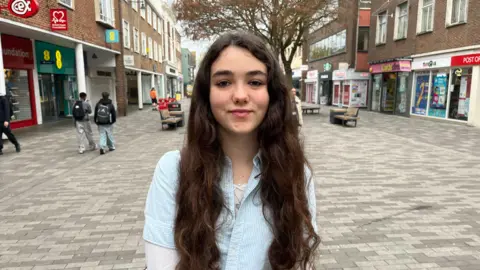 Isla Chambers (pictured) said the situation felt like "Covid again"
The UKHSA has issued a public health alert for doctors in England to watch out for meningitis symptoms.
Chief executive Susan Hopkins previously said it looked as though there had been a super spreader event, with the outbreak ongoing within university halls of residences, where there would have been parties and social mixing.
She said she could not yet confirm where the initial infection came from.
Hopkins said in her 35 years in medicine, it was the most cases she had seen in a single weekend with this type of infection.
"It's the explosive nature that is unprecedented here - the number of cases in such a short space of time," she added.
Follow BBC Kent on Facebook, on X, and on Instagram. Send your story ideas to [email protected] or WhatsApp us on 08081 002250.


