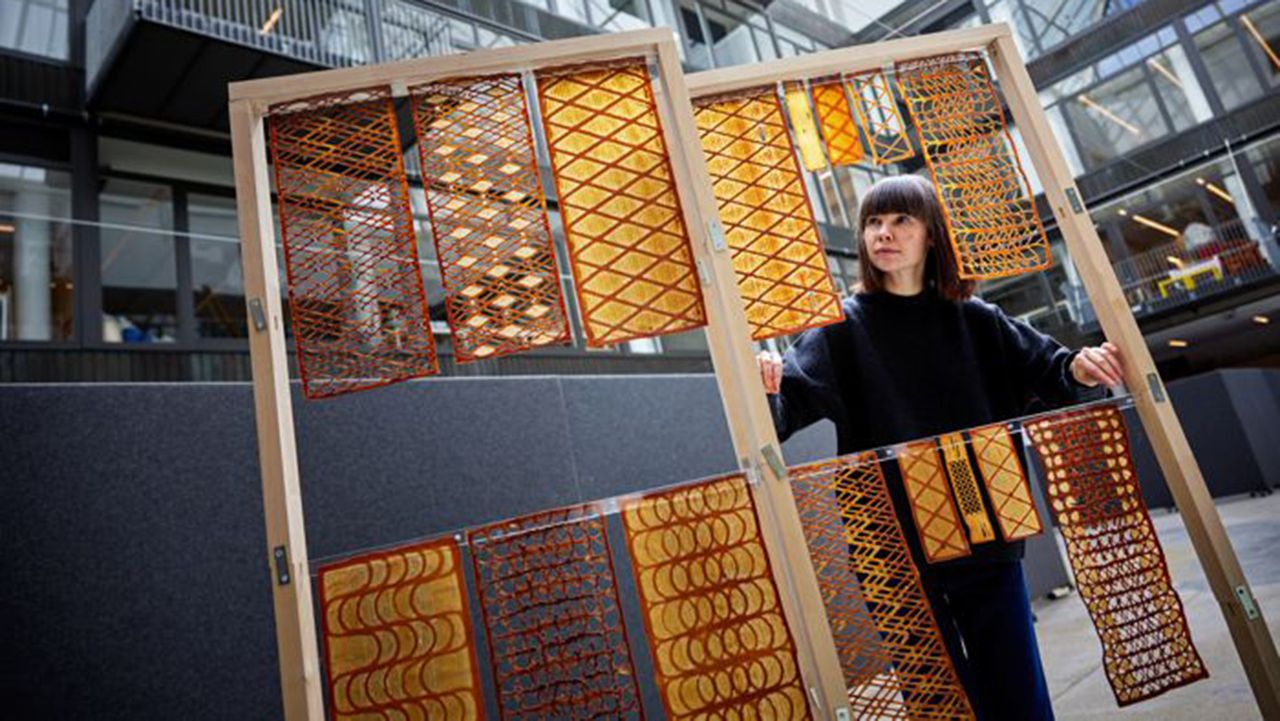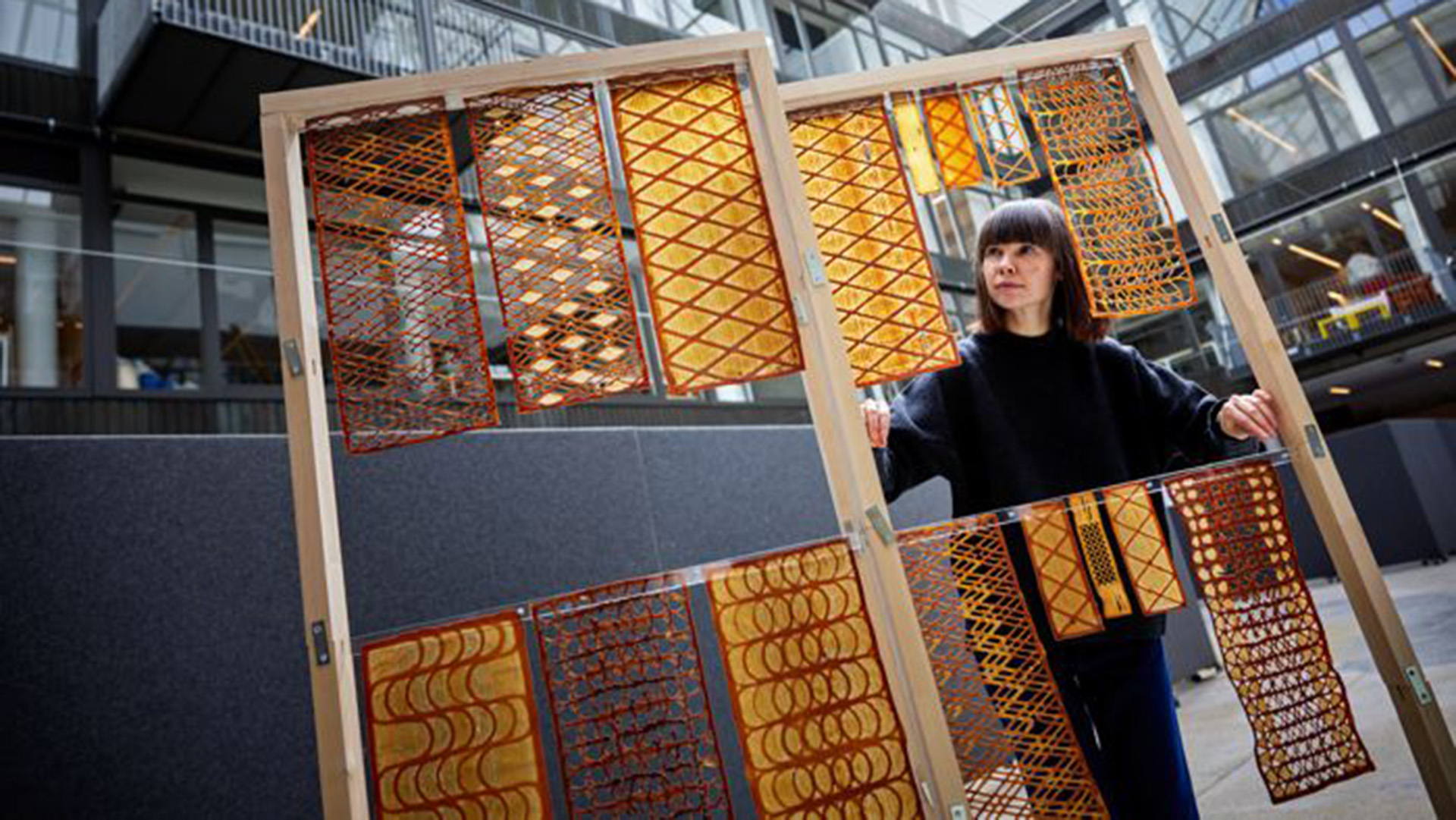
Professor Malgorzata Zboinska of Chalmers stands next to displays of the new 3D-printed yeast-based material. (Image credit: Chalmers/Henrik Sandsjö)
Share this article Join the conversation
Follow us Add us as a preferred source on Google Newsletter Subscribe to our newsletter
Scientists have cooked up a new kind of building material from an ingredient more often found in bread, beer and pizza dough: baker's yeast.
The squishy, yeast-based paste can be squeezed through a 3D printer, dried at room temperature and turned into lightweight architectural pieces, such as wall panels, room dividers and screens that soften harsh sunlight.
Unlike concrete, plaster, or many plastics used in interior decorating, which all use plastic and are difficult to recycle, the new material is designed to minimize waste as it uses renewable ingredients and could eventually draw on industrial leftovers from brewing, agriculture or other yeast-rich processes.
"The interest stemmed from a broader goal of combining circularity-oriented architectural design, sustainable biomaterials, and digital fabrication to develop a fully bio-based architectural material from abundant, renewable resources," Malgorzata Zboinska, a professor of architecture at Chalmers University of Technology in Sweden and an author of the study, told Live Science in an email.
The study was published on March 5 in the journal Frontiers of Architectural Research.
Building with yeast
To make the biomaterial, the researchers first heated up the yeast to deactivate it, so it would not be alive in the finished product. They then mixed it with wood-derived cellulose fibers, algae-derived gel, called alginate, plant-based sugars and water. The mixture resulted in a smooth hydrogel, a soft jelly-like material that can hold a specific shape and be molded with a 3D printer.
"We use pressure-based 3D printing at room temperature, which is important due to its sustainable aspects — it does not require energy-intensive heating or additional support structures," Zboinska said.
Sign up for the Live Science daily newsletter now
Get the world’s most fascinating discoveries delivered straight to your inbox.
Contact me with news and offers from other Future brandsReceive email from us on behalf of our trusted partners or sponsors
After printing, the pieces were left to dry in room temperature conditions. As the water left, the gel stiffened into a stable, lightweight solid. The strongest versions reached an average tensile strength of 2.7 megapascals (391.6 psi) — around the strength of a fruit roll-up (or fruit leather) — and stretched up to 25.2% before breaking. While the material isn't that strong, it is effective at holding its shape, which is key for making products like screens and wallpaper.
"Structurally, we found that yeast contributes differently depending on how it is processed," Zboinska said. "This allows us to tune the material’s properties through relatively simple formulation changes."
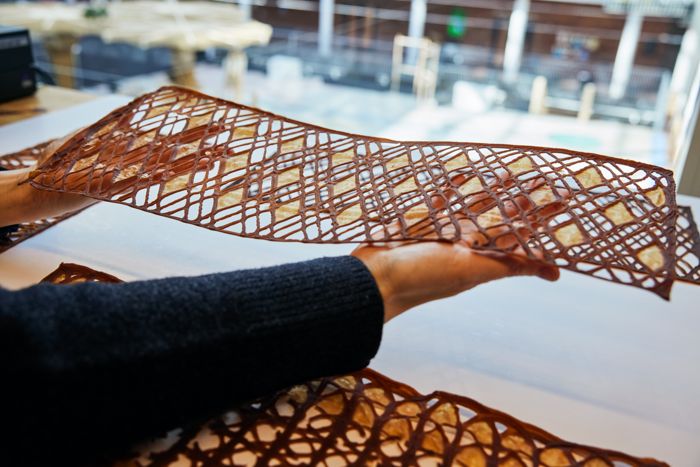
The 3D-printed material has the tensile strength of a fruit leather.
(Image credit: Chalmers/Henrik Sandsjö)
The researchers found that when the yeast cells remain intact, they act mostly like a filler, giving the material volume. But when the yeast is deactivated, they release internal components that help bind the mixture together.
By changing the recipe and printing pattern, the team could alter the material's color, texture, porosity and translucency. In the study, printed prototypes measured 7.87 by 19.69 inches or (20 by 50 centimeters), and let through between 5.6% and 31.6% of light, depending on their design.
A greener future for interior designers
The construction sector uses huge amounts of raw material and energy, and researchers are hunting for lower-impact alternatives. Zboinska and her team hope yeast-based materials could replace some fossil fuel-derived interior products, like synthetic tiles, drapes or plastic panels, rather than load-bearing materials like steel and concrete.
"Biomaterials are … commonly viewed as safer for the environment upon disposal," Timothy Long, center director and professor for the Biodesign Center for Sustainable Macromolecular Materials and Manufacturing at Arizona State University, who wasn't involved in this study, told Live Science via email. Long cautioned that even if biomaterials like this yeast-based product are designed to minimize waste, they only work if protocols are in place to help with proper disposal.
"So even though they are biobased materials, we need to focus as a community to collect, recycle, and reuse these materials," he said.
Yet, Long believes that even if there aren't proper recycling practices for these special materials, they can still have a positive impact on the environment.
"There is also evidence that if biomaterials remain in a biological environment then their decomposition products are more likely to be safer to humans and safer for the Earth" than non-biodegradable materials, he said.
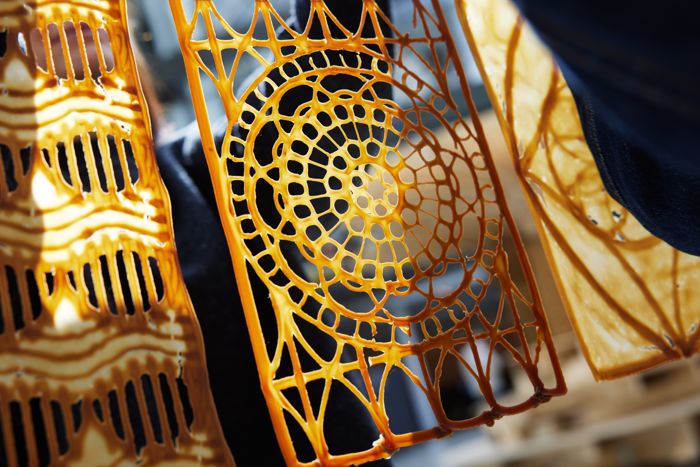
Thanks to 3D printing, the new material can have a series of different, custom made, designs.
(Image credit: Chalmers/Henrik Sandsjö)
Still, for the yeast-based material, big questions remain. The team has not tested how long the material lasts, how it handles moisture over time or how it behaves thermally or acoustically. They have also not explored whether the deactivated yeast could trigger reactions in people with yeast allergies.
Related stories
Before the material could move into real buildings, the researchers would also need to improve printing precision, scale-up methods and further fine tune how the material bends and shrinks as it dries, Zboinska said.
But for now, the work suggests that the future of interior design could begin with a vat of humble yeast.
"The research points toward new ways of thinking about circular design and sustainable manufacturing in architecture, where fabrication processes, material behavior, and environmental considerations are closely integrated from the outset," Zboinska said.
Article Sources
Bektas, Y., Zboinska, M. A., Geijer, C., Nypelö, T., & Hefny, Z. (2026). Novel 3D printable yeast-based materials for architectural applications. Frontiers of Architectural Research. https://doi.org/10.1016/j.foar.2026.01.003
TOPICS
 Kenna Hughes-Castleberry
Content Manager, Live Science
Kenna Hughes-Castleberry is the Content Manager at Live Science. Formerly, she was the Content Manager at Space.com and before that the Science Communicator at JILA, a physics research institute. Kenna is also a book author, with her upcoming book 'Octopus X' scheduled for release in spring of 2027. Her beats include physics, health, environmental science, technology, AI, animal intelligence, corvids, and cephalopods.
View More
You must confirm your public display name before commenting
Please logout and then login again, you will then be prompted to enter your display name.
Logout