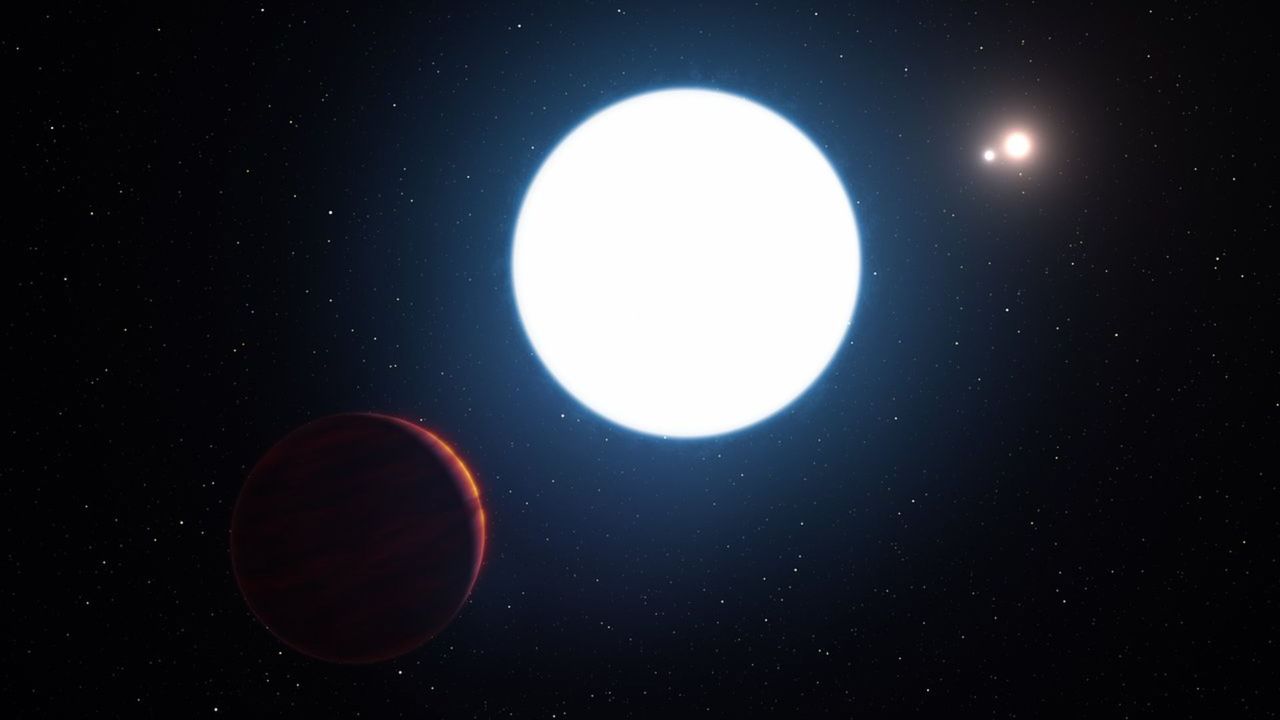
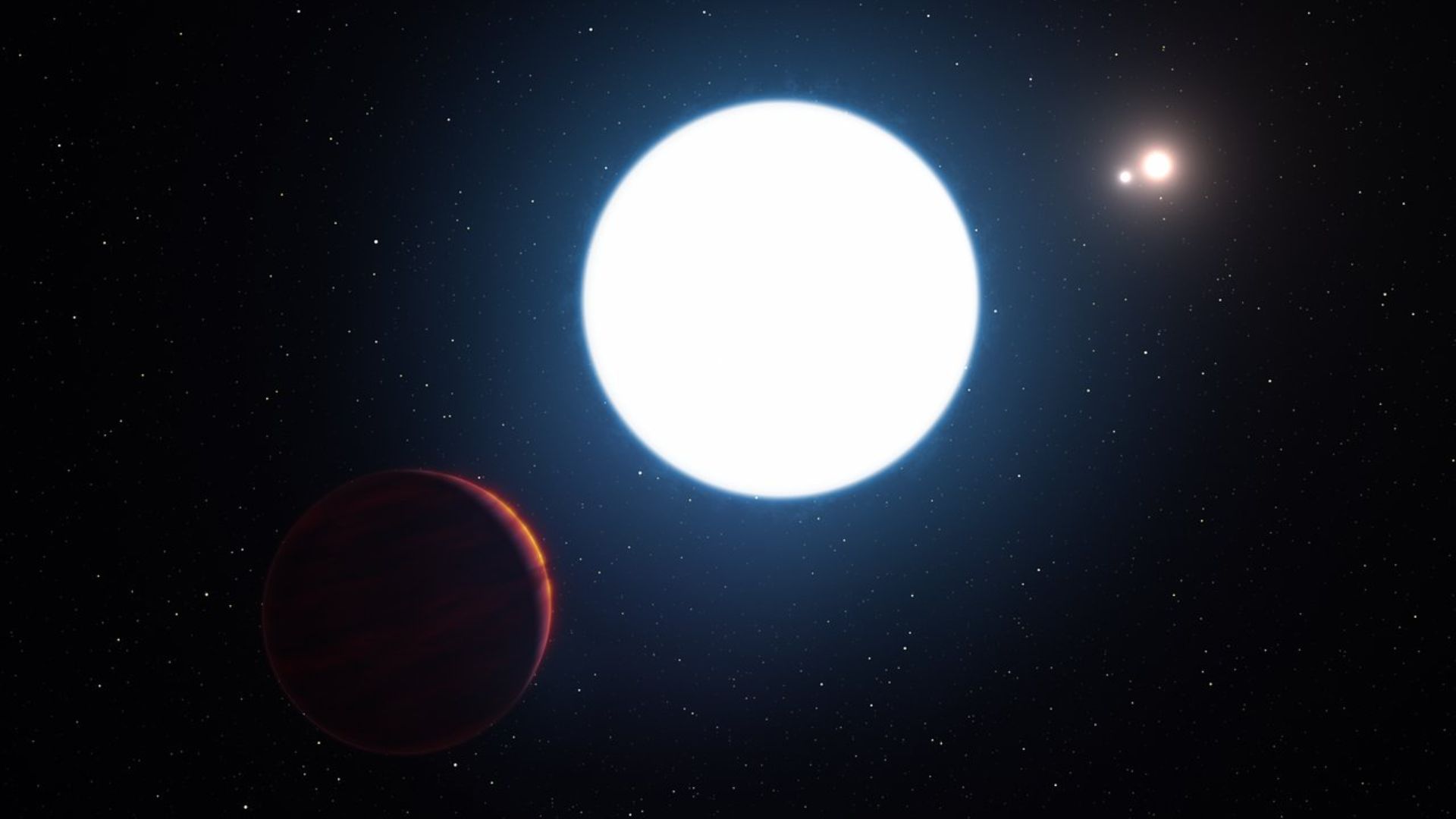
 An artist's impression of a planet orbiting a star in a triple system. (Image credit: ESO/L. Calçada/M. Kornmesser) Share this article 0 Join the conversation Add us as a preferred source on Google Newsletter Subscribe to our newsletter
 A triple star system in which the stars all eclipse one another from our vantage point is standing out as one of the best studied stellar trios; as the stars age, they could even merge.
The triple system, known as TIC 295741342, is 3,080 light-years from Earth and was found by NASA's TESS (Transiting Exoplanet Survey Satellite) mission. It features a binary system composed of two stars almost identical to the sun, orbited by a larger third star of 1.7 solar masses.
Triple star systems abound in the galaxy, but what makes TIC 295741342 more remarkable is that all three stars orbit each other in the same plane, and that plane is aligned edge-on to us.
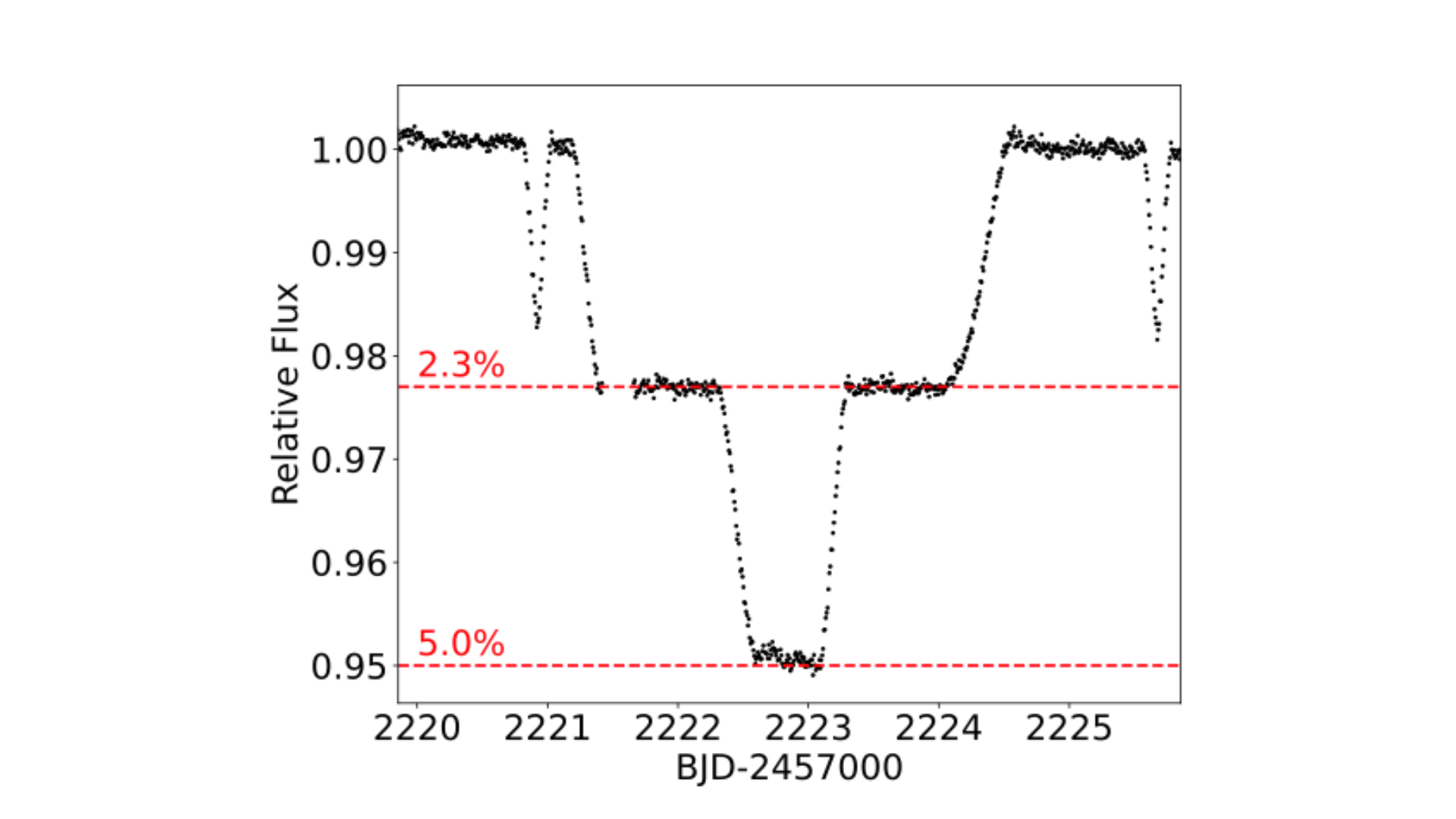
TESS charts the light curves of stars, which is essentially a graph of brightness versus time. Typically, it is looking for the small dip in light as an exoplanet moves in front of, or transits, its star, but TESS also excels at witnessing stars in binary and triple systems also moving in front of each other — not just transiting, but eclipsing.
The light curve for TIC 295741342 is described by Brian Powell, who is an astronomer at NASA's Goddard Space Flight Center, as having a "head-and-shoulders" pattern, especially when inverted. TESS detects a dip in light as the stars of the binary at the heart of the TIC 295741342 eclipse one another. This dip is one of the "shoulders." Then, TESS detects another, deeper dip in light as the third, outermost star moves in front of the binary and eclipses both its stars, creating the "head."As the binary moves out from behind the third star while still eclipsing each other the light curve steps back up to the initial dip in light – the other "shoulder" — and finally back to full brightness when no stars are in eclipse.
Powell told Space.com that "very few known triple star systems are so near-perfectly coplanar as TIC 295741342, especially for being such a wide system."
Disk fragmentation
By coplanar, Powell means that all three stars orbit in the same plane, just as the planets of the solar system orbit in more or less the same ecliptic plane. Our planets are found in the same plane (or more specifically, within six degrees of it) because they formed from a disk of gas and dust that ringed the young sun. Powell suspects the stars of TIC 295741342 also formed from a disk, but one that fragmented.
"The protostellar disk broke into pieces to form stellar companions," said Powell.
Not all triple systems form this way. In many cases, the third star orbits at an angle to the central binary — but in those scenarios, the third star was gravitationally captured by the binary while they were all still in the close confines of their birth cluster.
Disk fragmentation is not a rare phenomenon, however. Hundreds of coplanar triple systems have been found, their numbers enhanced in particular by the discoveries made first by NASA's Kepler Space Telescope and now TESS. Yet few triple star systems are as well studied as TIC 295741342.
The two sun-like stars that make up its binary component have an orbital period of just 4.75 days. Separated by a distance of about 6.61 million miles (10.6 million kilometers); their masses were deduced from radial velocity measurements by the spectrograph on the 1.5-meter Tillinghast reflector at Whipple Observatory in Arizona. The third, outer star takes 412.8 days (1.13 years) to orbit the binary pair, at a distance of 157.7 million miles (253.7 million kilometers).
This is considerably wider than many other triple eclipsing stars that have been found, such as Lambda Tauri, which was identified in 1956 as the first known eclipsing triple where the outermost star has a 30.5-day period. Even closer is TIC 290061484, an eclipsing triple found by TESS in 2024, where the central binary has a period of 1.8 days and the outer star has a period of only 24.5 days.
Dangerous ground for planets
Could such triple systems harbor planets? There's an exclusion zone for planets in circumstellar orbits around binary stars in which a planet can get no closer than four times the binary period. In the case of the inner binary in TIC 295741342, that would result in a zone of instability out to an orbital period of 19 days, which is still pretty close to the binary stars. However, the presence of the outer third star at just a little further than the distance of Mars from the sun will curtail many possible planetary orbits further out from the binary. The third star could have its own planets, but again the binary would make any on larger orbits unstable.
However, in wide triple systems it's possible there could be stable planetary orbits, with some caveats.
"The orbit of a planet would have to be very wide," said Powell. "And it would be difficult to find."
One of the widest eclipsing triple systems is TIC 99013269, where the outer star is on a 604-day orbit at a distance of about 230 million miles (370 million kilometers) — less than half the distance of Jupiter from our sun.
It's fun to speculate about what inhabitants of any worlds or moons that exist around an outer star would experience during the eclipses. Picture a world with a habitable moon, tidally locked to its planet. For most of the time it will be in some form of daylight, whether from its star, which is the outermost star, or from the binary star a little further away, or even reflected light from the planet. However, at certain times a series of eclipses will line up — the outer star will eclipse the binary star, and the planet will eclipse the outer star as seen from the moon.
It would only be on these occasions when the planet-facing hemisphere of the moon would be in total darkness.
A future nova
While the coplanar nature of TIC 295741342 tells us about its beginnings, what we have learned about the stars thanks to them being coplanar is also telling us about how they will end.
The outer star in the TIC 295741342 system is beginning to age. It has moved off from the main sequence of hydrogen-burning sun-like stars and has turned into a red giant. It has already swollen to a diameter 10.6 times larger than our sun, and it will continue to expand. Eventually, it will grow so large and diffuse that the gravity of the binary star will begin to steal matter away from the red giant, which could lead to all manner of shenanigans.
Its diffuse outer layers may form a common envelope of stellar material encapsulating all three stars. This could cause the binary's orbit to become unstable and potentially merge. Then in the future, when the binary star component enters the red giant phase, long after the outer star has become a compact white dwarf, the mass transfer could begin again in the opposite direction, with matter falling onto the surface of the white dwarf. This would trigger explosive outbursts on the white dwarf, which would be seen across the galaxy as a nova eruption.
So its seems that the story of the three stars of TIC 295741342 has already been written, thanks to the careful observations including four years of radial velocity studies to calculate the mass of the planets, the observations of the eclipses by TESS, and the determination of the shape of the orbit of the outer star.
"The value in this system is the comprehensive data," said Powell. "This makes the system an excellent candidate for evolutionary studies."
The observations of TIC 295741342 are described in a paper currently on the pre-print archive arXiv.
View MoreYou must confirm your public display name before commenting
Please logout and then login again, you will then be prompted to enter your display name.
Logout Keith CooperContributing writer
Keith Cooper is a freelance science journalist and editor in the United Kingdom, and has a degree in physics and astrophysics from the University of Manchester. He's the author of "The Contact Paradox: Challenging Our Assumptions in the Search for Extraterrestrial Intelligence" (Bloomsbury Sigma, 2020) and has written articles on astronomy, space, physics and astrobiology for a multitude of magazines and websites.