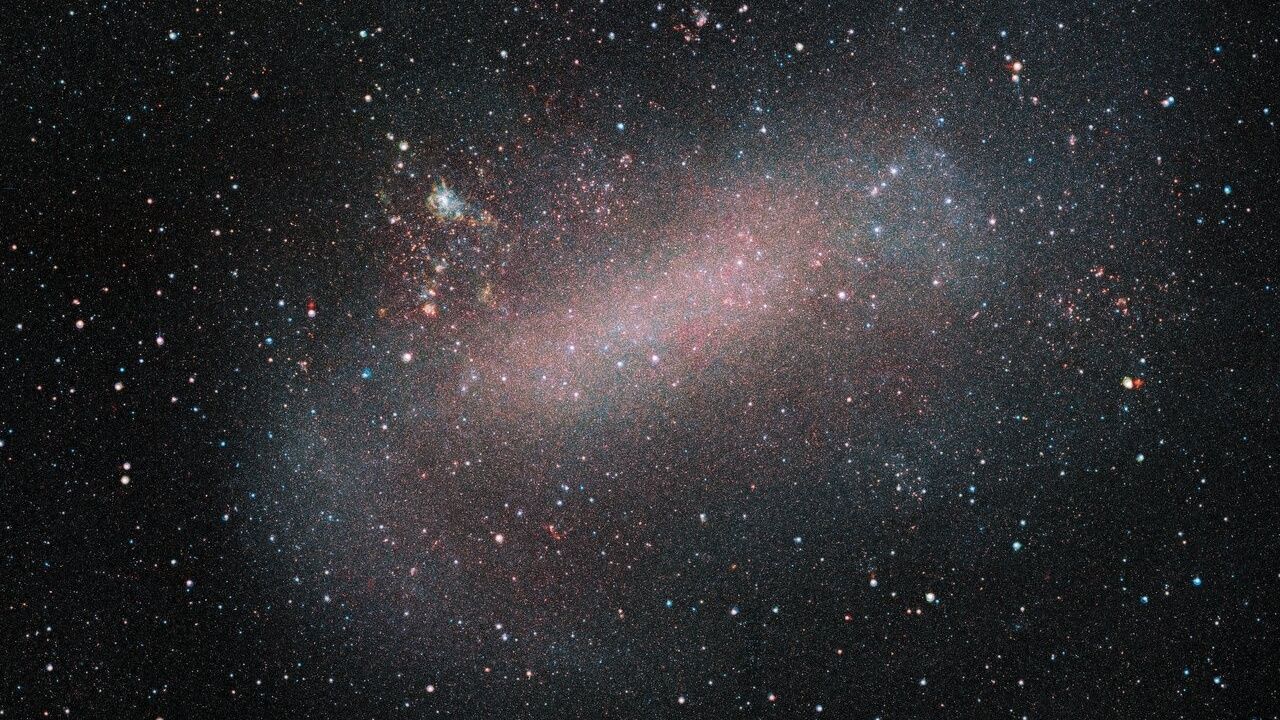
 The Large Magellanic Cloud is the origin of the most ancient and pristine star ever seen. (Image credit: ESO/VMC Survey) Share this article 0 Join the conversation Follow us Add us as a preferred source on Google Newsletter Get the Space.com Newsletter
 Breaking space news, the latest updates on rocket launches, skywatching events and more!
Contact me with news and offers from other Future brands Receive email from us on behalf of our trusted partners or sponsors By submitting your information you agree to the Terms & Conditions and Privacy Policy and are aged 16 or over.You are now subscribed
Your newsletter sign-up was successful
Want to add more newsletters?
An account already exists for this email address, please log in. Subscribe to our newsletterA pristine star found to be devoid of almost any elements heavier than hydrogen and helium might be the immediate descendent of one of the first stars in the universe.
If stars were like myths, then the first generation of stars to have existed in the cosmos would be like the gods of ancient Greece — massive, mysterious and profoundly influential on what came after them.
Yet no one has ever seen one of these first stars either, "because they were massive, lived fast and died young, or the lowest-mass Population III stars that could persist to the present day are extremely rare," said Kevin Schlaufman of Johns Hopkins University in a statement.
So while we still haven't seen a Population III star, a star called SDSS J0715-7334 is the next best thing – a star that formed from an almost pristine cloud of gas that had been tainted by heavy elements formed in the supernova blast of a Population III star.
SDSS J0715-7334 was initially identified by Schlaufman in data from the Sloan Digital Sky Survey in 2014, and then independently discovered in 2025 by a team of students led by Alexander Ji of the University of Chicago.
In the first three minutes after the Big Bang, only three elements existed: hydrogen, helium and the tiniest traces of lithium. This is all that the universe had to work with to form the first stars. All the other elements in the periodic table had to be subsequently formed by stars, beginning with the supernova explosions of the most massive Population III stars.
Get the Space.com NewsletterContact me with news and offers from other Future brandsReceive email from us on behalf of our trusted partners or sponsorsThe heavy elements produced in the violent death of one first generation star swiftly polluted a primordial cloud of molecular hydrogen and helium that subsequently collapsed to form SDSS J0715-7334. This would have happened during the first couple of hundred-million years after the Big Bang.
Using the high-resolution Magellan Inamori Kyocera Echelle spectrograph on the 6.5-meter Magellan Clay Telescope at Las Campanas Observatory in Chile, a team led by Ji and including Schlaufman followed up on SDSS J0715-7334 to quantify its abundance of heavy elements, which astronomers refer to as "metals" but which include elements such as carbon and oxygen as well as the likes of aluminum and iron.
Our sun is made of 74.9% hydrogen, 23.8% helium and 1.3% metals, indicative of the many generations of stars across cosmic time that have built up the abundance of heavy elements in the universe. On the other hand, Ji and Schlaufman's team found that SDSS J0715-7334 is almost exclusively hydrogen and helium with only 0.005% the abundance of metals that our Sun possesses. No other star has been found to be so pristine with so few heavy elements. The previous record holder, a star in our Milky Way cataloged as SDSS J1029+1729, has twice the abundance of heavy elements that SDSS J0715-7334 has.
"The star [SDSS J0715-7334] has so little carbon that it suggests an early sprinkling of cosmic dust is responsible for making it," said Ji in another statement.
"While this star does not have a primordial composition itself, it is the closest that astronomers have ever gotten to the Population III stellar generation on this particular metric," added Schlaufman.
From its chemical composition, Ji and Schlaufman's team were able to work backwards to deduce the mass of the star and the energy of its supernova that produced the debris to pollute SDSS J0715-7334’s birth cloud. They found that the Population III star that died had a mass of at least 30 times that of our sun, and that its supernova explosion was more energetic than is typical today.
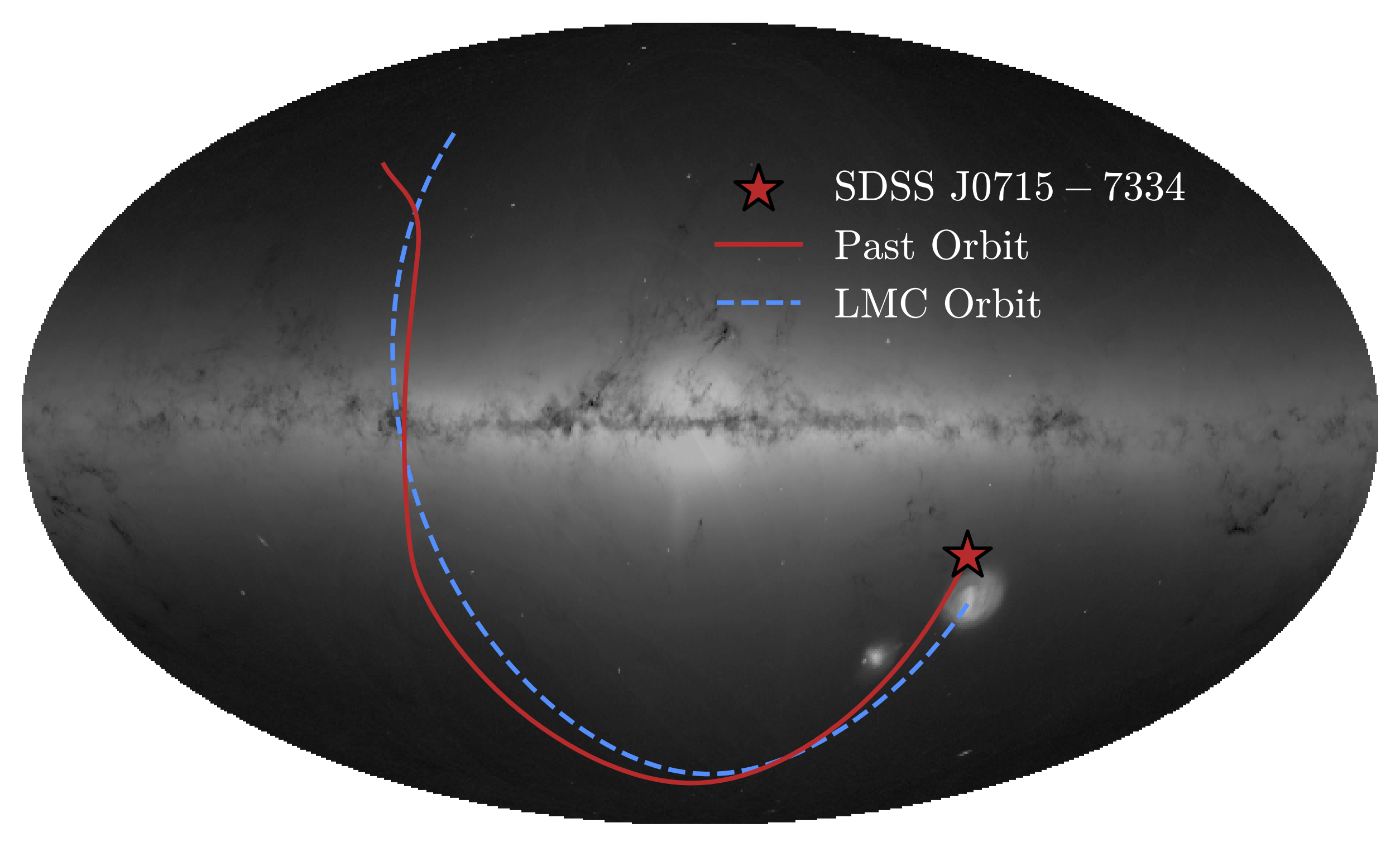
SDSS J0715-7334 was discovered 80,000 light-years away, where it appears to be migrating from the outer halo of the Large Magellanic Cloud (LMC), hence why Ji's students nicknamed the star the "Ancient Immigrant."
Along with its companion the Small Magellanic Cloud, the LMC is a recent arrival to the Milky Way's shores, and for much of their history the Magellanic Clouds were not forming stars and building up their chemical inventory. It's only since they've been close to the gravitational influence of the Milky Way that things have really kickstarted within them.
"It's possible that we're going to find a relatively higher proportion of ultra-metal-poor stars in galaxies like the Magellanic Clouds than in our own Milky Way galaxy," said Schlaufman.
The Sloan Digital Sky Survey is an excellent tool for hunting down ancient, pristine stars such as SDSS J0715-7334. Located at Apache Point Observatory in New Mexico, it performs sweeping surveys of the night sky, making optical and infrared spectroscopic measurements of millions of stars and galaxies.
"There is still lots to be done to understand what actually was going on in that era long, long ago when the Milky Way was young," said Schlaufman. "We've only scratched the surface with this current phase of the Sloan Digital Sky Survey."
The research was published in the April 3 edition of Nature Astronomy.
 Keith CooperContributing writer
Keith Cooper is a freelance science journalist and editor in the United Kingdom, and has a degree in physics and astrophysics from the University of Manchester. He's the author of "The Contact Paradox: Challenging Our Assumptions in the Search for Extraterrestrial Intelligence" (Bloomsbury Sigma, 2020) and has written articles on astronomy, space, physics and astrobiology for a multitude of magazines and websites.
View MoreYou must confirm your public display name before commenting
Please logout and then login again, you will then be prompted to enter your display name.
Logout MORE FROM SPACE... 1Space junk cleanup tech that could 'shepherd' debris into Earth's atmosphere gets US patent
- 23D dark energy map is mind-blowing | Space photo of the day for April 16, 2026
- 3How to see once-in-a-lifetime Comet PanSTARRS tonight before it disappears for good
- 4Max Space unveils new expandable space habitat for the moon and beyond: 'We need real estate that is scalable'
- 5A new Earthrise: An Apollo historian experiences Artemis 2


