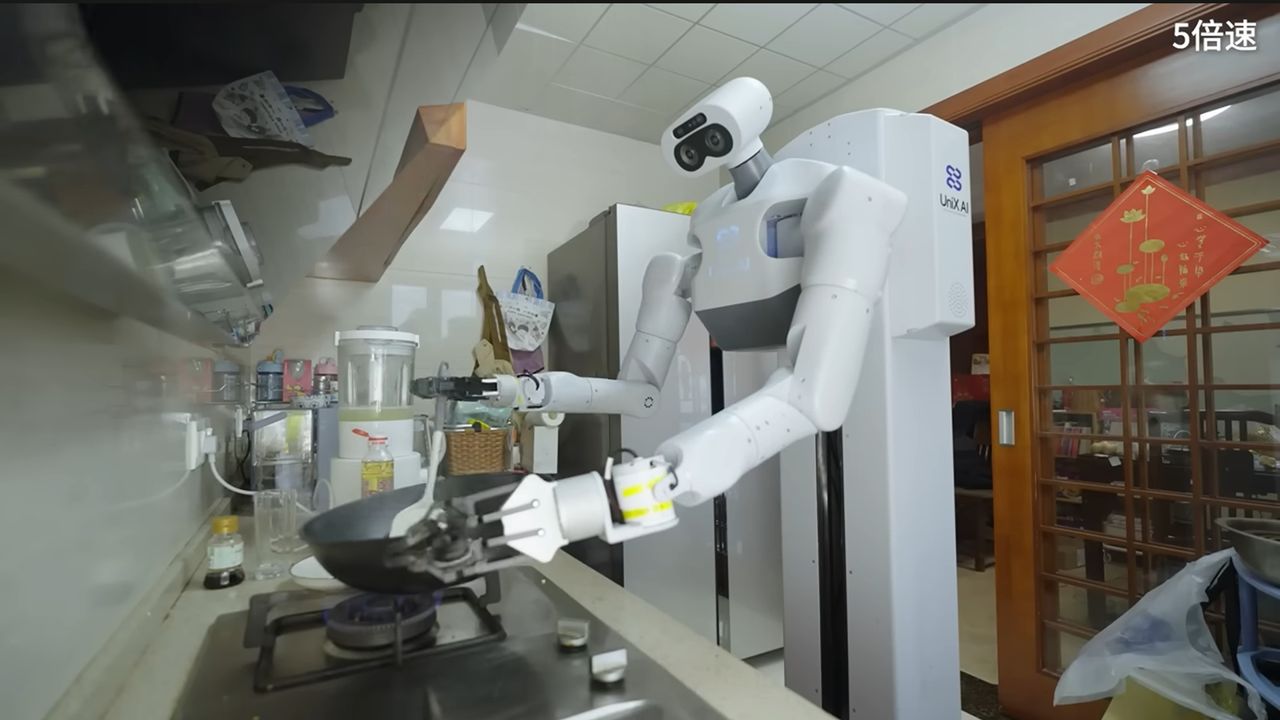
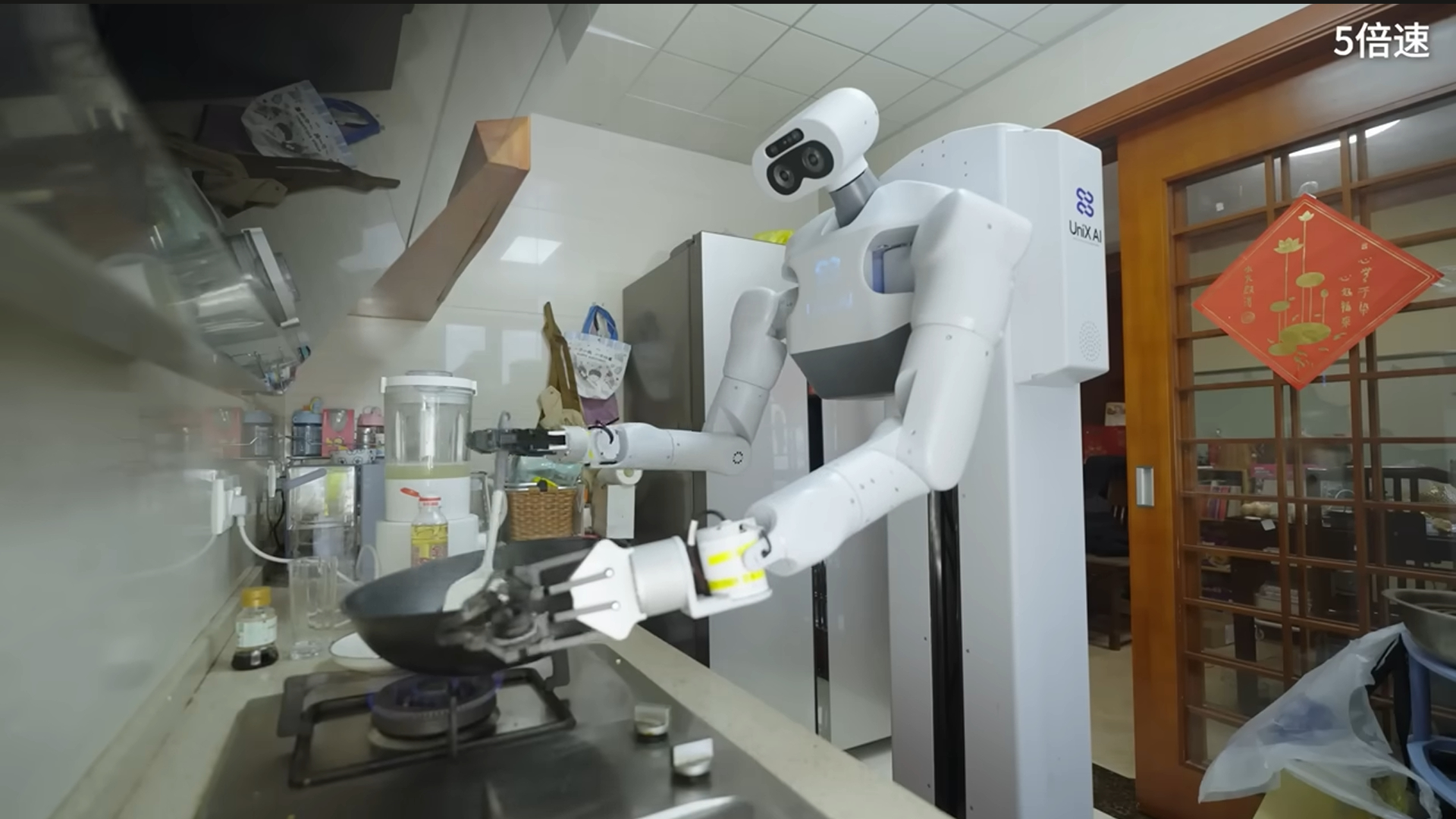
 UniX AI's humanoid Panther robot cooks breakfast in the kitchen. (Image credit: UniX AI) Share this article 0 Join the conversation Follow us Add us as a preferred source on Google Newsletter Sign up for the Live Science daily newsletter now
 Get the world’s most fascinating discoveries delivered straight to your inbox.
Become a Member in Seconds
Unlock instant access to exclusive member features.
Contact me with news and offers from other Future brands Receive email from us on behalf of our trusted partners or sponsors By submitting your information you agree to the Terms & Conditions and Privacy Policy and are aged 16 or over.You are now subscribed
Your newsletter sign-up was successful
Want to add more newsletters?
Join the club
Get full access to premium articles, exclusive features and a growing list of member rewards.
Explore An account already exists for this email address, please log in. Subscribe to our newsletterCould a humanoid robot perform household chores for you? Soon, that might be the case. Chinese robotics company UniX AI has announced the release of Panther, a humanoid service robot designed to help with common household tasks.
The robot — which weighs 176 pounds (80 kilograms) and stands 5 feet, 3 inches (1.6 meters) tall — can operate for up to 12 hours on a charge, its engineers announced in a statement. In addition to releasing a promotional video showing Panther performing chores like making the bed, cleaning countertops and toilets, and cooking breakfast, UniX AI has started commercial deliveries of the model — suggesting it's ready to be deployed in a real-world setting.
Article continues below UniX AI's humanoid Panther robot makes the bed. (Image credit: UniX AI)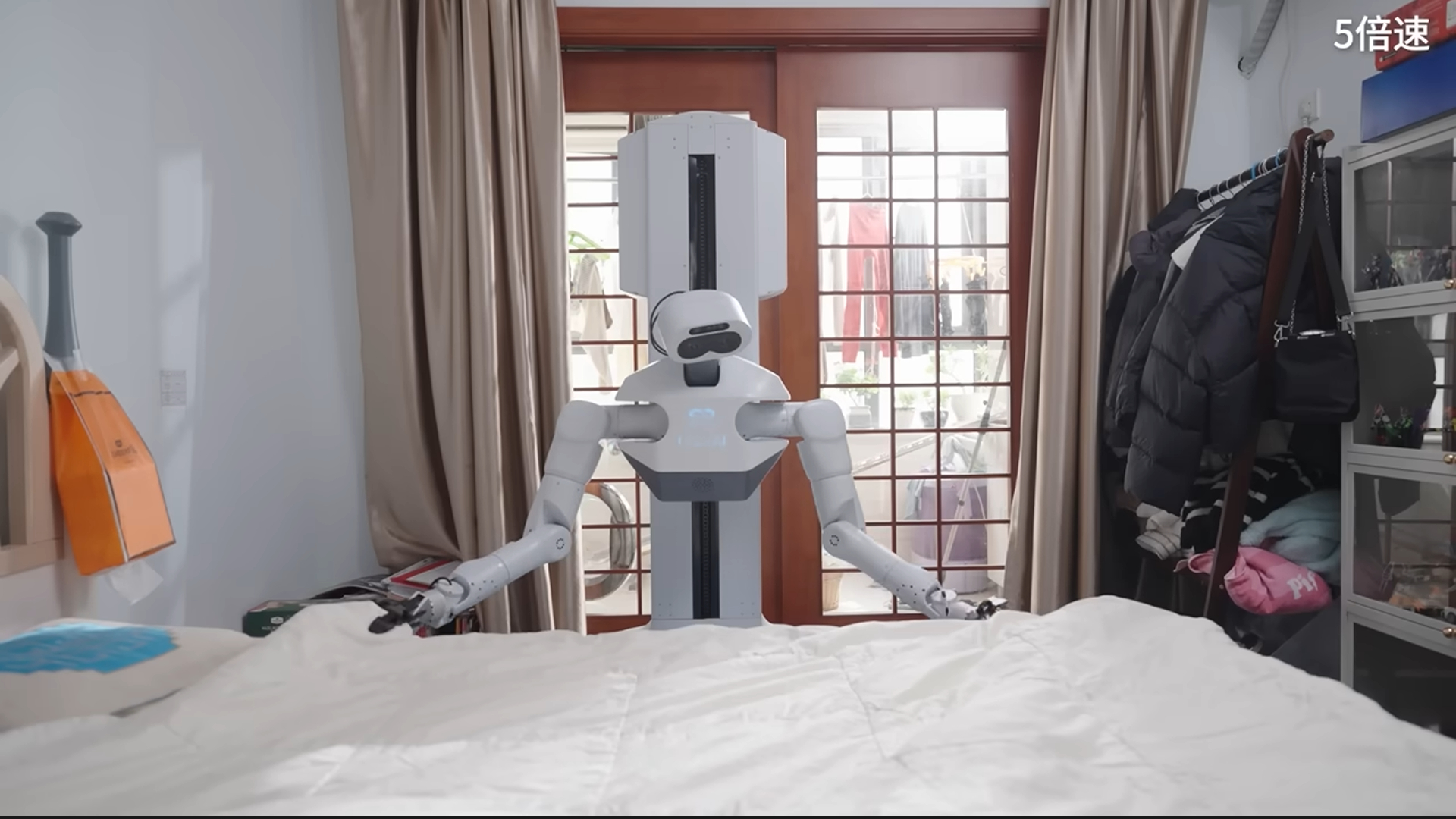
A stable service robot
To accomplish household chores, Panther uses two of the world's first mass-produced 8-DoF bionic arms, which give the robot joints with 34 degrees of freedom, UniX AI representatives said.
At the end of its arms are intelligent "grippers" that adapt to different shapes and sizes of items that the robot can grab. In the promotional video, Panther is seen holding a plastic spatula when frying an egg and a toilet brush when cleaning the toilet. The robot even washes its hands in the sink at the end of the video, drying off its grippers on a bath towel.
Panther's body can extend vertically by 31 inches (80 centimeters) to access hard-to-reach areas from tall shelves to ground level. It uses binocular vision and a webcam to see its surroundings.
Whereas other humanoid robots rely on legged locomotion and thus have a higher tendency of falling, Panther uses an omnidirectional four-wheel steering and four-wheel drive (4WS+4WD) chassis, allowing it to smoothly maneuver varying indoor environments.
Sign up for the Live Science daily newsletter nowContact me with news and offers from other Future brandsReceive email from us on behalf of our trusted partners or sponsorsIt uses both lidar and ultrasonic sensors to determine its spatial position and moves around 6 feet (1.89 m) per second — roughly the speed of a brisk walk. UniX AI representatives noted in the statement that engineers focused less on building the "most human-like robot" and more on making sure the model could accomplish a variety of tasks with stability and flexibility.
Taking on multiple tasks
RELATED STORIES- AI compressed billions of years of evolution into seconds to create 'Lego-like robots' that can recover even when they lose limbs
- Humanoid robots show off creepily impressive kung-fu moves during Lunar New Year festival in China
- Watch awkward Chinese humanoid robot lay it all down on the dance floor
In early tests and demonstrations, Panther handled multiple prompts, including making tea, cleaning the kitchen, and operating a washing machine. To do this, Panther runs on UniX AI's integrated technology stack, which includes imitation learning and long-term task planning so that it can perform tasks seamlessly one step at a time.
Engineers designed Panther for a wide range of applications in addition to housework, including assistance in retail, reception, guided tours, elderly care, companionship, research and education.
The price of this model could not be found on UniX AI's website.
 Kenna Hughes-CastleberryContent Manager, Live Science
Kenna Hughes-Castleberry is the Content Manager at Live Science. Formerly, she was the Content Manager at Space.com and before that the Science Communicator at JILA, a physics research institute. Kenna is also a book author, with her upcoming book 'Octopus X' scheduled for release in spring of 2027. Her beats include physics, health, environmental science, technology, AI, animal intelligence, corvids, and cephalopods.
View MoreYou must confirm your public display name before commenting
Please logout and then login again, you will then be prompted to enter your display name.
Logout LATEST ARTICLES 1Ancient process that created rare earth elements discovered — and it could help us locate desperately needed deposits
- 2Strange mammal ancestor laid huge, leathery eggs — and it was key to surviving the world's worst mass extinction
- 373 moon landings? NASA's 'Moon Base User's Guide' reveals the agency's 'most ambitious space project' will be fraught with challenges
- 4Diagnostic dilemma: A woman heard voices telling her she had a brain tumor — and scans confirmed she did
- 5Triassic croc relative from Ghost Ranch, New Mexico finally identified after nearly 80 years in museum basement


