Economy
They graduate to six figure salaries, and grueling work May 9, 20266:00 AM ET
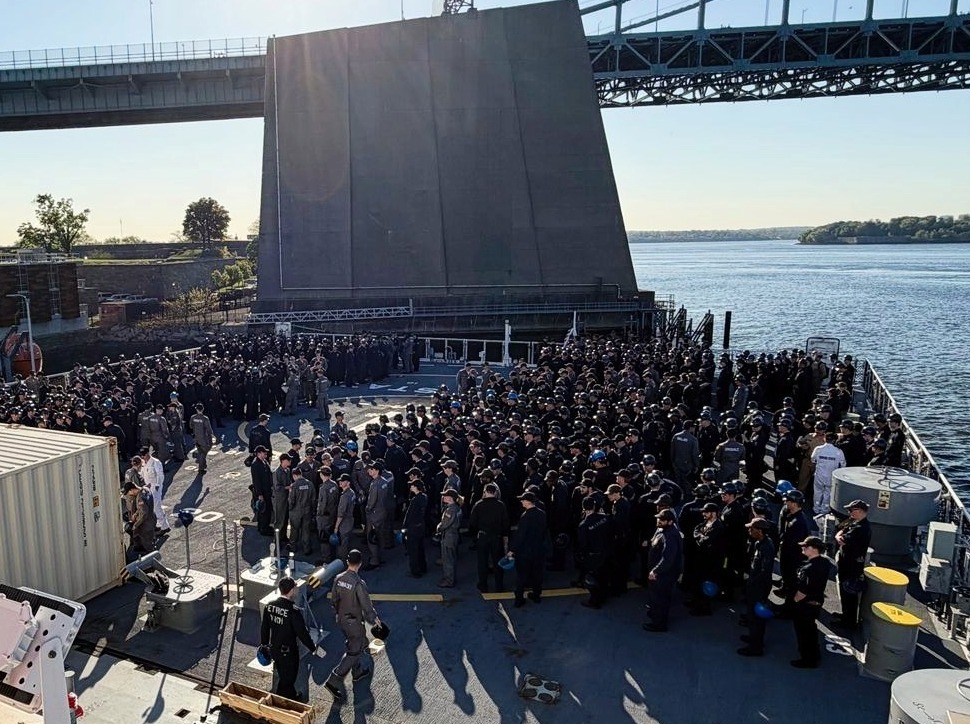
Students on the aft deck of the Empire State VII preparing for this year's summer cruise. They'll sail to Charleston, S.C., Málaga, Spain and Belfast, Northern Ireland before returning to New York. SUNY Maritime College hide caption
toggle caption SUNY Maritime CollegeThe gangway up to the Empire State VII slopes from the dock at Fort Schuyler in the Bronx, where the East River meets the Long Island Sound. The ship is massive — 530 feet, nine decks - and it's being prepped for its annual summer teaching cruise.
Tom Murphy, SUNY Maritime College's Chief of Staff and a 1993 alumnus, has spent a lot of time on vessels at sea. But this one is different. "This is the first ship purposely built for training cadets," he said. "This isn't just a working ship, this is a school on water."
SUNY Maritime is one of six state-run maritime academies in the country. Most are run like quasi-military academies. Students wear uniforms, follow regimented schedules, and learn through a curriculum that blends traditional engineering and seamanship coursework with the Coast Guard-required licensing classes students need to work aboard a ship.
"Each student is required to do three summer sea terms to accumulate their 360 days of sea time," Murphy explained, "required to sit for the license." A U.S. Coast Guard license can open the door to lucrative careers in the maritime industry, and right now, the country doesn't have nearly enough people who hold one.
Most students pursue one of two tracks. One leads to positions running a ship's systems and the engine room. The other is focused on seamanship and maritime shipping. Opportunities for work are wide and varied; from cargo ships to oil tankers, from the private sector to government work supplying ships in the U.S. Navy.
Without enough mariners, navy ships could run dry in days
Industry groups say there are roughly 8,000 open positions across the U.S. maritime sector. More than 5,000 are with the Military Sealift Command, the federal agency responsible for keeping Navy ships stocked with fuel, food, and ammunition in waters around the world. Without enough supply ships operating in the Persian Gulf, some Navy vessels near the Strait of Hormuz could exhaust their provisions in as few as five days.
John Okon, SUNY Maritime's president and a 1991 graduate, puts it plainly. "The Navy does not have global reach, our national defense does not have global reach, without the logistical supply chain, which is our merchant marine," the retired U.S. Navy Admiral said from his office inside Fort Schuyler.

The Empire State VII, a first of its kind training ship, at SUNY Maritime College by the Throgsneck Bridge in the Bronx. Steve Kastenbaum/NPR hide caption
toggle caption Steve Kastenbaum/NPRSUNY Maritime College and the other state-run maritime academies are trying to fill that gap. The school asks a lot of its students. They take between 18 to 24 credits a semester, and grind through a course load the SUNY cadets describe as a double major: traditional engineering or operations classes stacked on top of all the Coast Guard-required licensing coursework.
"Our kids graduate highly educated, focused," Okon said. " When they graduate, their biggest problem is how are they going to manage all the money they're making and all the opportunities that they're going to have?" Starting salaries for entry-level officers are running well over $100,000.
Longer stretches at sea close and closer to conflict
The need to staff vessels that supply U.S. Navy warships is so urgent, Military Sealift Command is offering signing bonuses of up to $54,000 for a three-year contract and starting salaries that can exceed $170,000. But those ships can sometimes operate for months at a stretch and venture into conflict zones. Videos posted on social media, showing missiles flying over the Persian Gulf, illustrated the inherent risk of working alongside the Navy during the Iran war.
Graduating senior Finn Mahan said the additional money is appealing to students who want to serve their country in a civilian role while filling a critical need. "That also makes us heavy targets," he said, "because the enemy knows just as well how valuable and how important these supply ships are to our active-duty Navy vessels."

SUNY Maritime College Seniors attended the commencement ceremony at Fort Schuyler in the Bronx, N.Y. Steve Kastenbaum/NPR hide caption
toggle caption Steve Kastenbaum/NPRFaced with a shortage of merchant Marines, the Trump administration unveiled the Maritime Action Plan in February. It aims to grow the pipeline of licensed mariners to meet that need. Admiral Okon framed the stakes in terms that stretch beyond the current graduating class and the conflict with Iran. "Name something you went to purchase at a store," he said, "or that miraculously showed up through an Amazon truck. Just know that there is an army of mariners on the ships, moving those goods around the world."
Maxwell Cappella is part of that army. He graduated from SUNY Maritime last year and recently wrapped up a four-month cruise as a third assistant engineer on a ship under a federal contract, but not part of the Military Sea Lift Command. (He's not at liberty to discuss the ship's operations.) He and a crew of five others managed the engine room and all mechanical systems. "We're like the heart of the ship," Cappella said.
The lure of a $50,000 signing bonus wasn't enough to draw him away from a shorter cruise, 24/7 internet access and other benefits that come with the job. While at sea he had almost no expenses. "You don't have to drive to work. You don't have to cook your meals, no rent," the 22-year-old said. The work below deck is the same, regardless of a ship's purpose — 12 hours on, 12 hours off, 7 days a week without interruption, even on holidays.
The Empire State VII will sail this summer with hundreds of cadets aboard, logging sea time toward their Coast Guard licenses, moving closer to the moment when they'll have to decide what kind of mariner they want to be, and where they're willing to go.