
More than 50 people with a fainting disorder have now undergone an innovative procedure to tackle the root of their condition. (This is a stock image.)
(Image credit: CRISTINA PEDRAZZINI/SCIENCE PHOTO LIBRARY via Getty Images)
Share this article Join the conversation
Follow us Add us as a preferred source on Google Newsletter Subscribe to our newsletter
For Sarah Hall, every mealtime was dangerous.
She has a rare condition called cardioinhibitory syncope, which causes overactive nerve signals to tell the heart to stop beating in response to subconscious bodily processes, such as swallowing. Swallowing food caused Hall's heart to stop beating up to 12 times a day, often making her faint.
Hall's condition wasn't improving with any treatments, but an innovative procedure has changed her life, as well as the lives of dozens of others.
In work presented at the British Cardiovascular Society's annual conference, scientists reported that 25 people with the condition dramatically improved after an experimental procedure. The early findings, which have not been peer-reviewed yet, are promising but require validation.
"It's important to note that this is still a relatively new therapy and that larger studies and longer-term follow-ups are still needed to provide a better understanding of its durability and help identify which patients benefit most," said Dr. Sirisha Vadali, a cardiologist at HonorHealth who was not involved in the research.
When "rest and digest" goes haywire
The autonomic nervous system handles the electrical signals the body relies on to complete subconscious, everyday processes, like eating or sleeping. This includes the body's complementary "fight-or-flight" and "rest-and-digest" responses.
The latter system send the bulk of its signaling through the vagus nerve, which starts in the brainstem and extends through the chest and abdomen. As the body senses changes, like food entering the throat or the legs bending into a crouch, the vagus nerve updates the brain on what's happening, enabling it to subtly alter digestion, breathing and heart rate in response.
Sign up for the Live Science daily newsletter now
Get the world’s most fascinating discoveries delivered straight to your inbox.
Contact me with news and offers from other Future brandsReceive email from us on behalf of our trusted partners or sponsors
In some animals, vagal activation is involved in a more dramatic bodily process: hibernation. Hibernating mammals, like bears, experience a strong wave of signaling through the vagus nerve when they enter their winter den, which lowers their metabolic rate for weeks.
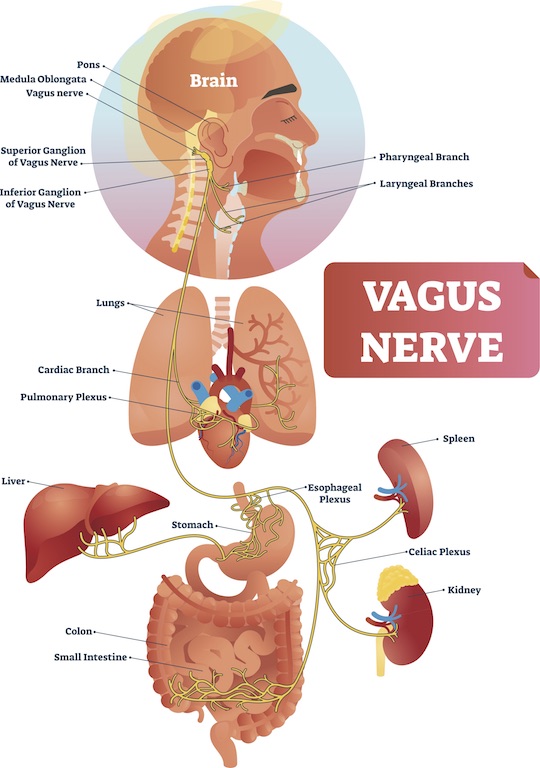
The vagus nerve runs to many organs in the chest and abdomen.
(Image credit: Shutterstock)
People with cardioinhibitory syncope "go into a hibernation response" because their vagus nerve signals are too strong, Dr. Boon Lim, a consultant cardiologist at Imperial College Healthcare NHS Trust who led the new work, told Live Science.
The vagus nerve transmits signals to the ganglionated plexi, a web of nerve endings on the surface of the heart. The signals then reach the body’s built-in system for maintaining heart rate — and when they're too strong, it briefly shortcircuits this system, causing the heart beat to pause entirely.
There are many ways this hyperactive vagal response can be triggered. For 50-year-old Hall, the trigger was swallowing, while for others with the condition, sudden abdominal pain can flip the switch.
Why we faint
Syncope, the medical term for fainting, is common. Lim estimates that 40% of people faint at some point in their lifetimes, and for most, it is because signals from the vagus nerve temporarily reduce their blood pressure. Without enough blood flowing to the brain, people briefly lose consciousness.
But in cardioinhibitory syncope, the heart pauses entirely for a few seconds due to hyperactive vagal signaling. The strength of the vagus nerve's signaling to the heart is determined largely by genetics. Fewer than 5% of people who seek treatment for syncope have cardioinhibitory syncope.
The condition generally isn't life-threatening, Vadali said, but its unpredictability is highly disruptive. "Many patients may experience anxiety about when the next episode might occur," she said.
Boon described a patient named Rob, who had reported frequent fainting episodes. A diagram tracking the waves of Rob's pulse on a normal afternoon showed the churning rhythm of his heartbeat becoming still — one of several daily episodes. "It suddenly pauses for close to five seconds for no reason," Lim said.
For people with cardioinhibitory syncope, the best option previously had been to have a pacemaker implanted, Lim said. But this isn't a permanent solution; pacemaker batteries need to be replaced every decade or so. Patients who get pacemakers at younger ages can face long-term health risks as the devices deteriorate, and battery replacement operations can cause infections.
Now, Lim and colleagues have shown that a procedure called cardioneuroablation could drastically improve the lives of patients like Rob.
In the procedure, Lim snaked a thin wire through Rob's body that eventually reached his heart, specifically the ganglionated plexi on the organ's surface. Lim then delivered a pulse of radio-frequency energy to the plexi, which destroyed the tissue, thus reducing disruption of the heart's built-in pacemaker.
Lim's team carried out the procedure on 25 people at Imperial College London between 2013 and 2023. On average, the patients had had fewer than one fainting episode in the following year. This translated to significant improvements in the patients' quality of life, they reported.
Related stories
Three patients required additional procedures, because the ganglionated plexi can sometimes regrow. The procedure is fairly invasive, but compared to repeated pacemaker maintenance, it could still offer a more appealing solution to patients, the researchers say.
By now, Lim's team has used cardioneuroablation to treat 52 people. Vadali said the early data presented at the conference is promising but more research is needed to see how well its effects last.
For Hall, the procedure changed her life. She has not fainted since, even at mealtimes.
"I can drive; I can work," she said in a statement. "It feels like everything has come full-circle."
What do you know about the body's hardest-working muscle? Find out with our heart quiz!
 RJ Mackenzie
Live Science Contributor
RJ Mackenzie is an award-nominated science and health journalist. He has degrees in neuroscience from the University of Edinburgh and the University of Cambridge. He became a writer after deciding that the best way of contributing to science would be from behind a keyboard rather than a lab bench. He has reported on everything from brain-interface technology to shape-shifting materials science, and from the rise of predatory conferencing to the importance of newborn-screening programs. He is a former staff writer of Technology Networks.
View More
You must confirm your public display name before commenting
Please logout and then login again, you will then be prompted to enter your display name.
Logout