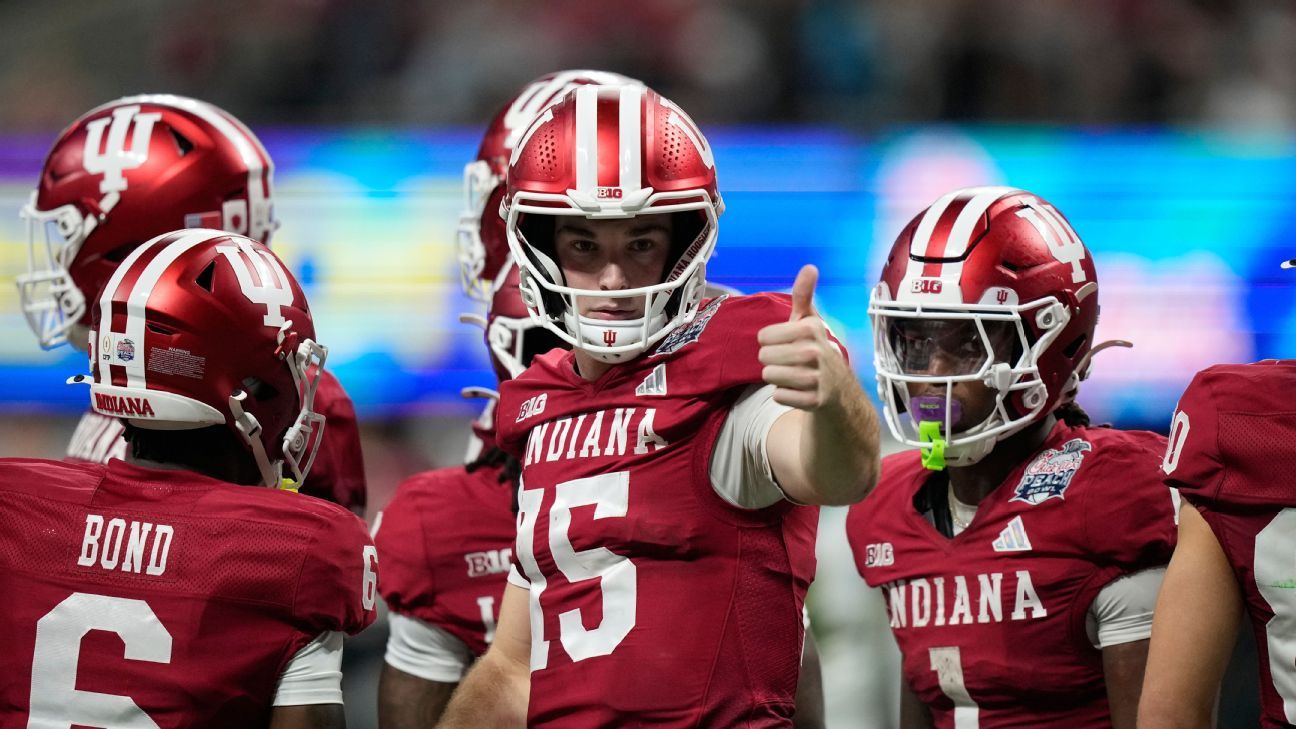
Ryan McFadden details comments by Raiders coach Klint Kubiak about Indiana QB Fernando Mendoza. (0:36)
The 2027 class of NFL draft-eligible quarterbacks is going to be one of the most talked about ever. (That's saying something, of course, considering how much we talk about every class.) But between Arch Manning, Julian Sayin, Dante Moore, LaNorris Sellers, Jayden Maiava, Trinidad Chambliss and others, next year's group will be overloaded with both upside and narrative potential.
But first, there's 2026. This year's draft class might feature only one first-round pick and, for that matter, two QBs in the top 50. Indiana's Fernando Mendoza will go No. 1 to the Las Vegas Raiders, of course, but beyond that are quarterbacks who feature either low upside as mostly dink-and-dunk passers or players with epic upside and epic bust potential. No one is ever a sure thing, but let's just say this group is less sure than others.
Still, the quarterback position is the most important in team sports. Teams will scoop up a good number of QBs on hope alone (or, perhaps, the need for a second-stringer), and said hope might actually pay off for a couple. So for the top 10 QB prospects, let's look at why each could succeed and why each could (probably) fall short.
(Note: Unless otherwise noted, all rankings below are based on a sample of 83 QBs with at least 15 FBS starts in 2024-25.)
Jump to a QB: Mendoza | Simpson | Beck | Nussmeier | Green Allar | Payton | Klubnik | Altmyer | Robertson
Raw 2024-25 stats: 27 starts, 538-for-765 passing, 6,539 yards, 70.3% completion rate, 57 TDs, 1.6% INT rate, 7.9% sack rate, 52% success rate, 7.5 yards per dropback, 111 non-sack rushes for 784 yards and nine TDs
Why he might succeed: He just keeps improving. I like the approach of using two years of data for a piece like this because it gives us a broader sample and takes away the impact of a shorter hot (or cold) streak. But when it comes to Mendoza, it's not so much that he got hot in 2025 -- it's that he kept getting hotter all season.
If we break Mendoza's 35 college starts -- 19 in two years at California, then 16 in one season at Indiana -- into chunks, we get the profile of a guy who was not yet to his ceiling when he left college.
Starts 1-15: 60.4 Total QBR, 65.2% completion rate, 6.3 yards per dropback
Starts 16-20: 70.9 Total QBR, 68.4% completion rate, 7.0 yards per dropback
Starts 21-25: 88.1 Total QBR, 74.6% completion rate, 9.0 yards per dropback
Starts 26-30: 91.8 Total QBR, 75.2% completion rate, 8.8 yards per dropback
Starts 31-35: 92.4 Total QBR, 69.3% completion rate, 7.6 yards per dropback
His last five games included Indiana's Big Ten championship game win over top-ranked Ohio State and College Football Playoff wins over Alabama, Oregon and Miami; you'd expect the raw numbers to falter a bit against such a high level of competition, and they did, but his opponent-adjusted Total QBR kept rising.
Honestly, watching Mendoza in 2025 was like watching a guy master a video game. He'd make a mistake, internalize it, and never make it again. Even one of his worst performances became one of his best moments when he led an incredible, 80-yard two-minute drill, complete with four utterly perfect throws, to pull off an escape against Penn State.
By the end of the season, Mendoza was showing almost robotic timing and accuracy and was placing nearly every pass where only his receivers could catch it, often perfectly on their back shoulder. And in his last six college games, he completed 74% of his passes with 15 TDs to only one interception. He even showed a willingness to fight for yards himself: In the games in which his passing wasn't perfect, he was happy to take off running. He scrambled five times for 35 yards in a tight win over Iowa and seven times for 74 yards in CFP wins over Alabama and Oregon, and his most famous play in Indiana's title game win over Miami also happened with his legs:
He was so good that though his two-year numbers were certainly strong, it was easy to decide that a full, two-year sample didn't really apply to him -- it mattered only what he looked like at the end.
Why he might fail: He's going to take a lot of hits. Mendoza's ability to learn from mistakes was otherworldly, but when a team was able to pressure him, it could surprise him a bit.
The national average for the ratio of sacks to pressures was 17.2% in 2024-25 -- meaning, basically one in six pressures turned into sacks on average -- but Mendoza far exceeded that (in a bad way) both years. His ratio was 25.3% as he took 41 sacks at Cal in 2024, and though he was protected far better at Indiana in 2025 (his pressure rate fell from 38.4% to 28.3%), he still took 25 sacks with a 22.5% sacks-to-pressures ratio.
And for all the stats that got better down the stretch, this one didn't: In his final seven games of 2025, he was sacked 18 times (a massive 10.4% sack rate) with a 30.5% sacks-to-pressures ratio. This is important because while your college stats don't always follow you to the NFL -- we can generally say that you won't top your college rate stats, but we can't say how close you will get to them -- that sacks-to-pressures ratio is pretty sticky. It follows you more than most stats do.
Granted, a couple of other recent No. 1 picks bucked this trend a bit. Among No. 1s, Mendoza's ratio isn't that far from that of Caleb Williams and Kyler Murray, and they haven't suffered egregiously terrible sack rates in the pros. They're far more elusive, though: more pocket-based No. 1 picks such as Joe Burrow and Cam Ward have indeed been hit a lot.
With Mendoza going to a Raiders team that went 3-14 last season and saw Geno Smith sacked 55 times, it's safe to say he could take a ridiculous number of hits in 2026 and, perhaps, beyond. There's nothing saying he won't learn and adapt as he has to everything else -- it's his strongest trait -- but taking too many hits can wreck a QB's development like almost nothing else, and it's something Mendoza will have to prove he can overcome.
Raw 2024-25 stats: 15 starts, 319-for-498 passing, 3,734 yards, 64.1% completion rate, 28 TDs, 1% INT rate, 5.5% sack rate, 44.6% success rate, 6.6 yards per dropback, 69 non-sack rushes for 348 yards and three TDs
Why he might succeed: Pocket presence. This draft has a lot of passers who can deliver short, safe passes and keep things moving, even if they haven't proved themselves capable of making the big-time, tight-window, downfield passes NFL scouts crave. Among those in this archetype, Simpson is the safest of the bunch. He operates well in a crowded pocket, and his interception rate (1%) was easily the best of anyone in this 84-QB sample. (His TD-to-INT ratio of 5.6 was second.) He manages to extend plays well -- he was 66th in average time to throw (2.90) -- without taking loads of hits. There's obvious value in that, and it's why he still has a chance of being selected in the first round.
Why he might fail: Minimal NFL throws. Despite the fact that he was a fourth-year junior in 2025, he hasn't had as many reps as most of the players on this list. In the past two seasons, he attempted only 562 dropbacks (67th out of 83) and only 142 against man coverage. (He averaged only 6.3 yards per dropback against man, which ranked 59th.) And though he almost never turned the ball over, he was taking the easy way out most of the time: He ranked just 54th in yards per completion (11.7) and 55th in yards per dropback (6.6), and he threw only 12.7% of his passes 20-plus yards downfield (54th).
Plus, though the film certainly suggests good pocket technique, Simpson still ranked 44th in sack rate (5.5%) -- despite being protected by likely top-15 pick Kadyn Proctor at left tackle -- and 48th in sacks-to-pressures ratio (17.2%). There's a chance we're overrating that facet of his game, and if he gets hit a lot while never attempting big-time throws downfield, where exactly is the upside here?
Matt Miller explains why he doesn't have Ty Simpson being drafted in the first round.
Raw 2024-25 stats: 29 starts, 628-for-915 passing, 7,298 yards, 68.6% completion rate, 58 TDs, 2.6% INT rate, 3.8% sack rate, 47.4% success rate, 7.3 yards per dropback, 81 non-sack rushes for 380 yards and three TDs
Why he might succeed: Pitch and catch. Over the past two seasons, no one started more games than Beck, and only new Indiana quarterback Josh Hoover threw for more yards. Beck will turn 24 during his rookie season this fall; he's a grizzled veteran by prospect standards.
That makes sense when you watch him play: He was basically the college version of late-career Tom Brady or Aaron Rodgers. The ball came out of his hands the moment it arrived. He was second in average time to throw (2.51 seconds), first in pressure rate (19.2%) and third in both sack rate (3.8%) and contact rate (17.6%). The ball wasn't going very far -- he was 61st in average air yards per pass (7.7), and 30.5% of his passes targeted players at or behind the line of scrimmage (11th most) -- but he played the point guard role well.
Why he might fail: If you're looking for raw upside, look elsewhere. At Miami, Beck played for the same offensive coordinator (Shannon Dawson) who helped to make Cam Ward the No. 1 pick last year, but though Ward was a big-play machine (14.1 yards per completion), Beck played a totally different game and ranked only 56th in yards per completion (11.6).
Beck's passing bins chart pretty definitively shows you where he went with his passes.
Beck was a quick pitch-and-catch guy in all ways good and bad, and if the read wasn't there, something bad was happening. He never extended plays -- only 7.1% of his passes were outside the pocket (second lowest in the sample), and though he rarely was pressured, those pressures frequently turned into sacks (21.7%, 64th). Plus, despite rarely going deep, he still ranked 54th in interception rate (2.6%).
Give Beck a nice tight end and some quick options, and he'll use them. But when opponents adjust to that (and they always do), it's not clear he'll be able to develop further.
Raw 2024-25 stats: 22 starts, 531-for-813 passing, 5,979 yards, 65.3% completion rate, 41 TDs, 2.1% INT rate, 3.7% sack rate, 46.2% success rate, 6.8 yards per dropback, 32 non-sack rushes for 178 yards and four TDs
Why he might succeed: 2025 was a growth opportunity. If you think Nussmeier's numbers above are terribly mediocre, you're right. His stats were dragged down by a messy, injury-plagued 2025 season in which he was rumored to be fighting any number of (non-specific) injury issues and his supporting cast didn't help him out enough.
After hinting at solid upside in 2024, Nussmeier spent most of 2025 playing things inordinately safe. He cut his average time to throw by a quarter second (from 2.84 to 2.58), and though he raised his completion rate from 64.2% to 67.4% and cut his interception rate from 2.3% to 1.7%, he basically traded all upside to do so: His yards per completion shrank from 12.0 to a paltry 9.9, and his yards per dropback fell from 7.2 to 6.0.
Why was that last paragraph in the "why he might succeed" section? Because that change in mentality could help him if he finds himself fully healthy but facing NFL defenses in the coming months or years. He did a solid job of taking what he could, and if he can combine that with some occasionally threatening downfield passing, 2025's struggles could produce a bit more upside overall.
Why he might fail: The upside is still theoretical. It's probably worth noting that, despite having a far more dangerous receiving corps (and good health) in 2024, his numbers that season weren't amazing. Among 2024 QBs specifically, he ranked 35th in yards per dropback (7.2), 42nd in completion rate (64.2%), 46th in interception rate (2.3%) and 70th in yards per completion (12.0). He's also smaller than a lot of other QBs on this list -- 6-foot-2, 203 pounds -- and you squint to see the requisite upside, even watching him in his good season.
Raw 2024-25 stats: 24 starts, 428-for-707 passing, 5,868 yards, 60.5% completion rate, 34 TDs, 2.8% INT rate, 7.7% sack rate, 48% success rate, 7.4 yards per dropback, 236 non-sack rushes for 1,837 yards and 16 TDs
Why he might succeed: All the upside and athleticism in the world. In a sea of prospects with easy pitch-and-catch ability and almost no ceiling whatsoever, let Green serve as an oasis. Bask in his willingness to simply try stuff. Of the FBS quarterbacks in this piece, no one averaged more yards per carry than Green, and almost no one averaged more yards per completion.
Green was fifth out of the 84 quarterbacks in yards per completion (13.7) and combined explosiveness with solid efficiency: He also was 13th in success rate (48%). He rarely threw passes at or behind the line of scrimmage -- he was a Bobby Petrino quarterback, after all -- and when he caught a glimpse of an open field in front of him, he took it. He was 19th in scramble rate (9.7%) and first in yards per scramble (10.8). In this sample, only one quarterback averaged more overall yards per non-sack carry, and that was UTSA's Owen McCown who never actually runs. Green was equally effective against man and zone coverage, and I'm almost positive no one else in this draft class could do something like this.
End Zone! Taylen Green scores 64-yard rushing touchdown
Taylen Green outruns the Aggies' defense for a 91-yard touchdown to secure the win for the Broncos.
Why he might fail: So, so many mistakes. After the sales job I just did, you might be wondering why Green isn't a first-round prospect. That's because his bad plays were worse (and more frequent) than anyone else's on this list. That's a bit of a hindrance.
Green was 59th in completion rate (60.5%) and 63rd in interception rate (2.8%), and he took all the hits you would expect from a QB who averaged 3.15 seconds to throw (second most): He was 71st in sack rate (7.7%), 66th in contact rate (38.5%) and 65th in sacks-to-pressures ratio (21.7%). Arkansas went 2-10 last season despite a top-25 offense, and while that tells you everything you need to know about the Razorbacks' awful defense, Green's knack for making devastating mistakes at just the wrong time contributed to the team's 1-9 record in one-score finishes over the past two seasons. He's absurdly fun and impossible to trust.
Raw 2024-25 stats: 22 starts, 365-for-553 passing, 4,427 yards, 66% completion rate, 32 TDs, 2% INT rate, 4.3% sack rate, 50.1% success rate, 7.4 yards per dropback, 107 non-sack rushes for 638 yards and seven TDs
Why he might succeed: Big arm, big dreams. He was a five-star golden-boy recruit, and at 6-foot-5, 230 pounds, he's an NFL prototype. He waited his turn at Penn State, led the Nittany Lions to the CFP semifinals in 2024 and returned to school to try to take them even further in 2025. It didn't work out, to say the least: Penn State crumbled after a loss to Oregon, and Allar was lost for the season because of injury after a third straight loss.
Still, Allar learned how to play steady, efficient ball -- he was sixth out of 83 in success rate (50.1%) and 16th in completion rate (66%) -- while taking free yards with his legs: He was 18th in scramble rate (9.8%) and averaged a healthy 7.5 yards per scramble. That's a useful combination.
Why he might fail: He doesn't actually use the big arm. There's value in risking interceptions sometimes, and Allar did have a couple of glitchy games in that regard -- he threw five interceptions combined against USC and Oregon in 2024 -- and unfortunately for him, maybe his two most memorable passes were picks: the one that set up Notre Dame to win in the 2024 semifinals and the one that ended PSU's comeback attempt against Oregon in 2025.
But those mistakes weren't his biggest problems. For the most part, he played like someone far more physically limited. He ranked 42nd in yards per completion (12.1) over these two seasons, and he threw only 8% of his passes 20 or more yards downfield, the lowest percentage in the 83-player sample. That shouldn't happen. What should have been his biggest strength was in a way his biggest weakness.
Raw 2024-25 stats: 13 starts, 171-for-240 passing, 2,842 yards, 71.3% completion rate, 18 TDs, 2.1% INT rate, 8.4% sack rate, 10.4 yards per pass attempt, 135 non-sack rushes for 1,069 yards and 14 TDs
Why he might succeed: He aced the lower levels. In a draft loaded with safe, low-upside talent, why not take a risk on a prospect with great stature (6-foot-3, 233 pounds) and stats that put those of Carson Wentz (No. 2 pick in 2016) and Trey Lance (No. 3 in 2021) to shame?
Wentz in 2015: 7.4 yards per pass attempt, 62.5% completion rate, 6.2 yards per carry*
Lance in 2019: 9.1 yards per pass attempt, 66.9% completion rate, 7.4 yards per carry*
Payton in 2025: 10.6 yards per pass attempt, 71.9% completion rate, 7.8 yards per carry*
(* I counted sacks as pass attempts, not rushes, because that's the way it should be done.)
I mean, nothing says "well-rounded prospect" like an almost perfectly rounded HudlIQ radar chart.
Despite a stunning upset loss to Illinois State in the round of 16 in the FCS playoffs, NDSU fielded its best team last fall since Lance's 2019 unit. Payton used his big frame to great effect in the run game, and he hunted big plays in a way we haven't often seen from NDSU QBs. There's a ton of potential here.
Why he might fail: He was playing a different game. Payton was Mendoza-like in another way: He was so comfortable that he sometimes ran himself into trouble. The only glitch in the radar chart above was a big one: His sack rate was 8.6% in 2025, higher than anyone else in this batch of QBs, despite the advantages stemming from playing at a lower level. Payton was happy to scramble a lot, take a long time to throw and look for bomb opportunities downfield.
Payton's most telling game might have been his last: In that shocking loss to Illinois State, he threw a 78-yard touchdown pass on the Bison's first snap but completed only three more passes while taking four sacks the rest of the game. ISU had played NDSU earlier in the season, and in their second exposure to Payton, the Redbirds figured out how to attack him, force him to look to extend plays, and create loads of lost yardage. Payton's raw tools are awfully exciting, but ISU proved how much learning he still has to do.
Raw 2024-25 stats: 26 starts, 565-for-878 passing, 6,582 yards, 64.4% completion rate, 52 TDs, 1.4% INT rate, 4.4% sack rate, 44.9% success rate, 6.9 yards per dropback, 162 non-sack rushes for 851 yards and 11 TDs
Why he might succeed: Another solid pitch-and-catch guy. Like Allar, Klubnik is a former top recruit with a strong arm and a nice ability to steal yards with his legs. He escapes pressure well -- he was 17th in sacks-to-pressures ratio (13.1%), and he's super experienced, with 40 career starts and over 10,000 career passing yards. And like Simpson, he's safe in the turnovers department: He ranked sixth in interception rate (1.4%) and fifth in TDs-to-INTs (4.3). There were far worse QBs than Klubnik during his time in the college football universe.
Why he might fail: He's not going to elevate his supporting cast. With the best receiving corps he had at Clemson, Klubnik established a high level of play in 2024: He produced six games with a Total QBR of 88.0 or higher and nine games with at least three touchdown passes. His 262 yards and four TDs in the ACC championship game helped the Tigers nab a CFP berth.
With his receivers banged up in 2025, he reverted to previous form. And in his four seasons in Clemson, his Total QBR by year was 57.1 (as a non-starter), 55.0, 78.7 and 60.1, respectively. That makes 2024 look like a pretty big outlier. Over the past two seasons, he was a decent 28th in completion rate (64.4%) but a mediocre 42nd in success rate (44.9) and 55th in yards per completion (11.7). He didn't use his athleticism as much as he could have either: He was just 63rd in scramble rate (4.7%) and 35th in designed runs (10.8%). Solid? Yes. But he never lived up to blue-chip hype.
Raw 2024-25 stats: 26 starts, 457-for-712 passing, 5,724 yards, 64.2% completion rate, 44 TDs, 1.5% INT rate, 8.2% sack rate, 47% success rate, 6.9 yards per dropback, 135 non-sack rushes for 890 yards and nine TDs
Why he might succeed: He didn't play on easy mode. In 12 seasons from 2012 to 2023, Illinois averaged 4.3 wins per season with an average offensive SP+ ranking of 88.9. That average was 90.0 in Bret Bielema's first three seasons. But with Altmyer healthy and leading the way, the Illini jumped to 55th in 2024, then 27th last fall despite a mediocre run game. And over the past two seasons, they won 19 games despite playing in the conference with the best average defensive SP+ rating in FBS.
Throughout this lovely run, Altmyer made safe, solid decisions and moved the ball with above average efficiency. He was 10th in interception rate (1.5%), 21st in success rate (47%) and 33rd in completion rate (64.2%). He produced Klubnik-like numbers at worst despite a less impressive supporting cast. (He did have third-round receiver Pat Bryant in 2024, for what that's worth.)
Why he might fail: When extending plays goes wrong. Yes, his efficiency numbers were decent, but he ranked just 44th in yards per dropback (6.9), in part because of a lack of big plays and in part because he got hit a lot. He was 59th in average time to throw (2.85 seconds), and there weren't enough explosive passes to offset rankings of 50th in contact rate (33.9%), 76th in sack rate (8.2%) and 73rd in sacks-to-pressures ratio (23.1%).
Raw 2024-25 stats: 23 starts, 533-for-872 passing, 6,752 yards, 61.1% completion rate, 59 TDs, 2.3% INT rate, 4.1% sack rate, 46.2% success rate, 7.1 yards per dropback, 82 non-sack rushes for 500 yards and seven TDs
Why he might succeed: He has seen things. In two years as Baylor's starter, Robertson won games with scores of 48-45, 59-35, 49-35, 37-34 and 35-34. He lost games with scores of 55-28, 42-36, 44-31 and 34-28. A huge portion of his work was done in pretty close games, and he threw more touchdown passes than anyone in this sample. He was also pretty good at getting the ball out of his hands quickly and efficiently: He was 13th in average time to throw (2.58 seconds) and was therefore fourth in pressure rate faced (25.8%) and ninth in contact rate (21.3%). Despite that, he still averaged a solid 12.7 yards per completion (27th). He also has solid stature -- 6-foot-4, 216 pounds -- and as a sentimental bonus, he's Mike Leach's last QB.
Why he might fail: Where does he stand out? Robertson's volume stats were good, but he was 56th in completion rate (61.1%), 39th in interception rate (2.1%), 55th in catchable ball rate (76.1%) and 56th in QBR against man coverage (56.9). He also doesn't do anything of note outside the pocket -- he's 66th in scramble rate (4.4%) and 82nd in percentage of passes thrown outside the pocket (8.7%). There are a lot of guys in this batch who throw quickly and don't put the ball at risk. He's not the safest of the bunch.