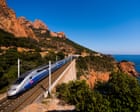
 Some Britons are turning to rail services such as France’s high-speed TGV to get them to Europe this summer. Photograph: Enzojz/Getty ImagesSome Britons are turning to rail services such as France’s high-speed TGV to get them to Europe this summer. Photograph: Enzojz/Getty Images‘There’s too much risk’: Britons on changing holiday plans amid Iran war
Prospect of flight cancellations and petrol shortages prompt people to switch from air and road to rail and bus
The Middle East crisis, now in its 11th week, has resulted in higher fuel prices for drivers and prompted fears of jet fuel shortages, rising air fares and cancelled flights.
Given the uncertain outlook, prospect of higher travel costs and potential disruption, we asked whether people had changed their holiday plans.
Here are some of the responses.
‘There’s too much uncertainty to book a holiday’
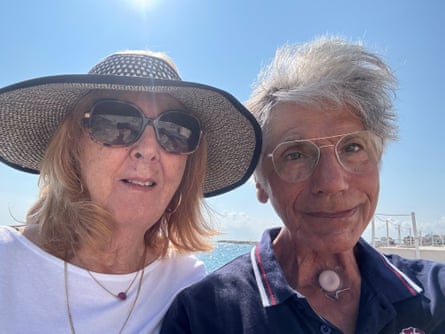 Linda and Raffaele last summer in Puglia, Italy.
Raffaele Brancati, 77, who is retired and lives in Wiltshire, says he delayed making a holiday booking “because of Trump’s war with Iran”.
He and his wife, Linda, 78, had planned to travel to Italy to visit relatives, or to Sicily, “in June, July, or September”, but have held off because of the geopolitical situation.
“It looks like there’s still too much uncertainty about a permanent ceasefire to make a booking with any confidence,” he says.
“I believe there is too much risk that flights will be subject to change or cancellations. There would also be difficulty and extra cost involved in securing additional accommodation or alternative means of travel and sudden travel cost increases, all driven by war in the Middle East.”
The couple has not made any other holiday plans but may consider having a break in the UK in late June or July, or investigate “travelling by train via Eurostar”.
“We are frustrated and disappointed as we needed a break after my wife’s health problems,” says Raffaele. “But it’s nothing compared with what the victims of Trump and Netanyahu’s war are suffering.”
‘We realised it was going to cost a fortune’
Danie Jones*, a senior administrator from East Anglia, has changed her travel plans this year amid rising costs and uncertainty. She and her husband had planned two trips – one to see friends in Rotterdam and Munich next month and another to Gdańsk in August. For the first trip, they planned to drive but have since decided to travel by train.
“When all the headlines about the strait being closed and all of that started coming in … we began to worry about driving. We were worrying about where we’re going to find fuel as friends in France have told us about shortages,” she says. “We were looking at the cost of fuel as well because of the distance that we were going to drive, we realised it was going to cost a fortune.”
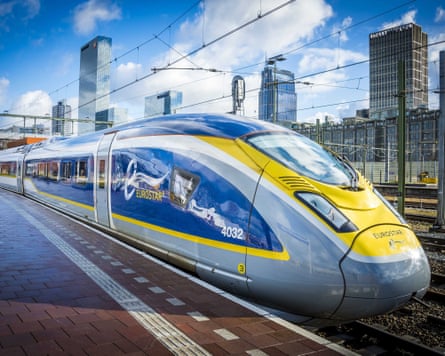 The couple are now planning to make their journey to Rotterdam by train. Photograph: Lex van Lieshout/EPA
The couple are now looking forward to their train adventure. “I think it will be fun and also allow my husband to enjoy the trip from the start rather than having to worry about driving,” she says.
The couple have, however, decided to cancel their annual Gdańsk trip altogether owing to the risk of disruption after reading that airlines were cancelling flights. “Our friend has caring responsibilities … he can only get carers for a set amount of time,” she says. “He can’t risk getting stuck somewhere.”
Jones says global events have made travel feel more uncertain, but also opened up new options. “It’s a bit of a pain … but on the other hand, it’s giving us a wonderful new experience doing long-distance train travel in Europe.”
‘We are calling it our race across the world’
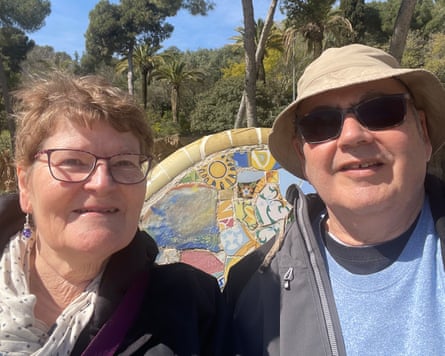 Alison and Phil in Barcelona.
Phil and Alison Cantor, from rural north Essex, have decided to travel overland to try to avoid any flight delays or cancellations that could derail their non-refundable dream holiday.
“We took the plunge and booked a trip-of-a-lifetime cruise in Norway, spending much more than we’ve ever spent on a holiday,” says Phil. The trip includes five nights in Oslo, a three-day train journey through Flåm to Bergen, followed by a six-night coastal cruise.
But when they began reading reports about potential fuel shortages, they reconsidered. “When we heard about possible cancellations for lack of jet fuel we realised if the flight doesn’t go, we would lose all the money we had already paid,” he says. Their insurer confirmed they would not be covered, as disruption would be classed as an “indirect act of war”.
They created an alternative route via Eurostar, an overnight coach and a ferry through Denmark, building in flexibility to ensure they could still reach Norway even if flights were cancelled.
Phil says they are now embracing the change and that their “keep-me-up-at-night panicky fear has transformed into an anticipated added journey of discovery … We are calling it our race across the world.”
“I just hope the war comes to a better conclusion. There are far worse things going on than holidays being disrupted,” he adds.
‘I’m now looking forward to a railway journey with no driving stress’
Ash, 33, from London, was planning a driving and camping holiday in the Alsace region of France this month after competing in an ultramarathon, but the rising fuel costs prompted a rethink.
“I looked at flying to Zurich and hiring a car, but again, costs had gone through the roof,” they say.
They then investigated travelling by rail, expecting it to be “prohibitively expensive”.
“I was pleasantly surprised to find that I can do London to Strasbourg, which would mean taking the Eurostar to Paris Nord, a short walk to Paris Est station and then taking the TGV to Strasbourg, in under six hours, for £230 return,” they say.
Ash’s potential fuel costs – if they had driven as initially planned – would have come to £220, but they would also have had to add on the cost of their Eurotunnel ticket.
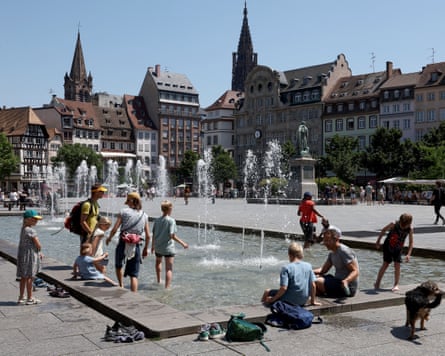 Ash decided to have a city break in Strasbourg. Photograph: Frederick Florin/AFP/Getty Images
“The Eurotunnel ticket for my car was approximately £230, so that would be about £450 in total at current fuel prices,” says Ash. “I estimated (prewar) that the trip would cost £330-£350, so the rise in fuel prices has increased the price of that journey by about 30%, if my maths serves me right.”
While the camping holiday is no longer an option for this trip, Ash has now decided to have a city break in Strasbourg instead – once they have completed their 50km (31 miles) run, that is.
“I’m really looking forward to a railway journey with no driving stress or fear of fuel costs, and I can feel smug avoiding the CO2 impact of air travel,” they say.
*Name has been changed
Explore more on these topics- Travel & leisure
- Airline industry
- Flights
- Consumer affairs
- US-Israel war on Iran
- Eurostar
- Petrol prices
- features