 ByGuillem BalagueBBC Sport columnist
- Published17 minutes ago
Back in 2011 Qatar Sports Investments were deep in negotiation for the sleeping giant that was Paris St-Germain.
PSG had finished 13th in Ligue 1 the previous season and Nasser Al-Khelaifi, leading the negotiations for QSI, regularly checked the results because there was a fear they could end up buying a second division club.
The Parisians survived and the deal went through, although the club bore almost no resemblance to the modern European contender people know today.
Over the next decade and a half, PSG would undergo one of the most dramatic cultural rebuilds in modern football. Money was about to be spent, stars were going to arrive, but the deep transformation was about reshaping their identity.
The journey unfolded in phases - each necessary, each flawed in its own way, but at the same time each contributing to the club PSG eventually became. The club who will bid to defend their Champions League title against Arsenal on Saturday.
From non-league to Champions League - Raya's fairytale rise
- Published14 hours ago
The 7,000 minutes difference - why PSG could have edge over Arsenal
- Published1 day ago
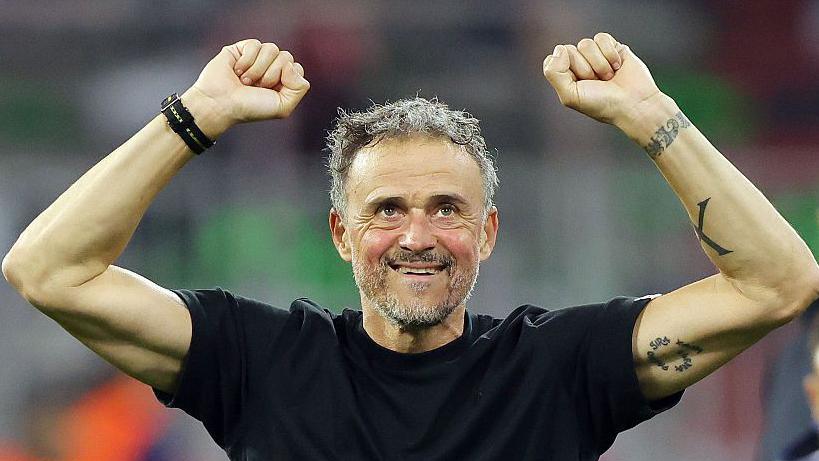 Image source, Getty ImagesImage caption,
 Luis Enrique is bidding to take PSG to a second successive Champions League triumph
In 2011, PSG were a paradox: a major European capital with a vast talent pool, yet a club lacking structure, prestige and stability.
They had no stars, no sustainable model and no clear footballing philosophy.
Despite having had big names like Ronaldinho, Pauleta, Ludovic Giuly and Claude Makelele in the first decade of the 21st Century, PSG needed to be seen in the eyes of the football world as relevant and credible before they could even dream of competing with Europe's elite.
The ultras were banned after violence ended in the death of a fan, leaving the Parc des Princes without its most passionate supporters for the first five years of the new era. They only came back in 2016 when Al-Khelaifi decided the majority could not be held responsible for the actions of a few.
The early years of QSI were defined by aggressive spending. Critics labelled it the 'bling‑bling era' but internally it was seen as the quickest way to get to the top.
As is the case with Newcastle and Manchester City, PSG have had to answer questions about the source of their funding and their owners have been accused of 'sportswashing', which is when nations invest in sports to help clean up their tarnished reputations.
Signing global superstars - Zlatan Ibrahimovic, Neymar, Kylian Mbappe, Lionel Messi - helped force PSG into the global conversation.
This phase brought domestic dominance and deep Champions League runs. But it also created internal tensions. Stars dictated dressing‑room dynamics, influenced tactical decisions and sometimes overshadowed the collective with inane disputes over things like training schedules or even who should take penalties.
The 18-year-old Mbappe and his family told club representatives he would join PSG instead of Real Madrid only if he was guaranteed to play every game - and Neymar had it written into his contract that he had the power to decide not to travel to some games.
When basketball legend Kobe Bryant visited the old training ground, Neymar and Mbappe wanted to break with the schedule prepared by then head coach Unai Emery.
He had them resting. They wanted to train with a sometimes-missing enthusiasm to impress Kobe. That battle was won by Emery - but those clashes left scars.
This era built PSG's global brand but it also exposed the limitations of a star‑centric model.
Learning from Pochettino & aiding Okocha - how PSG loan shaped Arteta
- Published7 May 2025
To play this video you need to enable JavaScript in your browser.
This video can not be played
Figure caption,'It's been written' - Arsenal players look ahead to UCL final
Al‑Khelaifi publicly declared the end of the bling‑bling era.
Instead of asking how to win the Champions League, the starting question became, "What kind of football do we want to play?" The answer was attacking football with French players at its heart.
This reshaped everything that followed. The man appointed to lead PSG into the new dawn was Luis Enrique.
For the first time in the QSI era, the club chose a footballing identity first, then selected the coach, then built the squad.
What happened next was a mixture of a needed change in club mentality and the arrival of the Spanish manager - a force of nature.
Messi, Neymar, Mbappe, Marco Verratti, Sergio Ramos - icons of the previous era - were moved on. The club was not punishing them; they had to reset the order of priorities and no player would be above the team.
Luis Enrique enforced discipline with a clarity PSG had lacked for years. He asked Mbappe to work harder and when his request fell on deaf ears was pleased to see him depart.
A defining moment occurred at the end of September last season when Ousmane Dembele arrived late for training before the Champions League league phase game against Arsenal. It was only 10 minutes but the coach dropped him immediately. Dembele would go on to win the 2025 Ballon d'Or.
Players responded. When Dembele was substituted, he encouraged his replacement rather than sulking. Injured players were required to attend training sessions.
The results were visible in the shape of titles but also in the little details. PSG became the team with the fewest yellow cards in Europe's top leagues as players stopped arguing with referees, stopped indulging in theatrics and embraced a disciplined, unified approach.
Luis Enrique much prefers to have five players scoring 10-12 goals each over one player scoring 40. This season, PSG had 20 different goalscorers - a testament to the collective approach.
There have been some bumps along the road but the most striking cultural change has been the club's refusal to panic.
In previous years, a run of poor results would trigger a flurry of signings or internal upheaval. Not any more. PSG now stayed loyal to the squad and the project.
In January 2025 with the French media clamouring for five or six new signings after Champions League defeats against Arsenal, Bayern and Atletico, they made just one... Kvicha Kvaratskhelia.
And perhaps most importantly there was a unified leadership structure. An alignment between the club's three central figures: Luis Enrique, sporting director Luis Campos and president Al‑Khelaifi.
Stability at the top created stability throughout the organisation.
Each figure has a clear role and they work together constantly. Luis Enrique defines the footballing vision, Campos manages recruitment and squad construction while Al‑Khelaifi oversees the broader project.
This unity has replaced years of internal friction, when coaches, directors and executives often operated with conflicting priorities.
Of all things that have been achieved at the club the one investment Al‑Khelaifi is most proud of is the new training centre that has been created at a cost of about 350million euros (£304m).
A key objective of the cultural reset was restoring PSG's connection to French identity. Nearly half of the team's playing time now goes to French players, many from the academy.
This season the average age of PSG's starting XI was 23 years and 363 days, the lowest recorded by the clubs in Ligue 1 and the second youngest among teams in Europe's top five leagues. Six academy graduates made their first-team debuts this season.
In a wider footballing context, Al‑Khelaifi's stance against the European Super League also reflected his increasing power and belief in raising the club's presence.
He argued that if football became a closed system, PSG would never have risen from their Europa League days.
And as leader of the European Club Association, he led the search for peace in European football, making key calls to Barcelona president Joan Laporta and Real Madrid counterpart Florentino Perez to convince them to return to the fore and abandon the Super League project.
PSG are not yet the finished article. The challenges ahead remain significant. Their stadium is too small for a club of PSG's stature (about 46,000 capacity) and French TV rights lag far behind the Premier League - the top five in the Premier League will receive in the region of 200m euros (£174m) in TV money this season, while PSG will earn about 9m euros (£7.8m).
But at least, for the first time in the QSI era, PSG are a club who know what they want to be and which way they want to go.