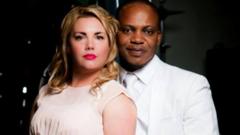
Charmain Speirs was 40 years old when she met prophet Eric Adusah.
For several years Charmain had been part of one of the fastest-growing Christian movements in the world, Pentecostalism.
Through her faith, she appeared to discover the happiness she'd been struggling to find but there was still something missing.
"She'd just had enough of normal men," her friend Anne-Marie says.
"She wanted that man of God. She wanted what was promised for her.
"Then she said: 'I've met someone, a famous preacher'."
Her new love interest was the head pastor of Global Light Revival Church.
Originally from Ghana, Adusah appeared regularly on Christian television channels.
He wasn't just a pastor. In his church he was called a prophet, and was believed to receive and share divine revelation directly from God.
Charmain met the prophet in spring 2014 and after a whirlwind romance they married in September that year.
Six months later Charmain was dead. Her body found in a bathtub in a hotel in Ghana.
Adusah was arrested on suspicion of murder but was later released due to lack of evidence.
He has denied any involvement in Charmain's death.
More than a decade on, a BBC Disclosure investigation has uncovered significant omissions from his account of what happened at the hotel where Charmain died.
The documentary series – Charmain and the Prophet – also hears from Adusah's former partners who claim he is a danger to women.

 FacebookCharmain became the wife of Prophet Eric Adusah
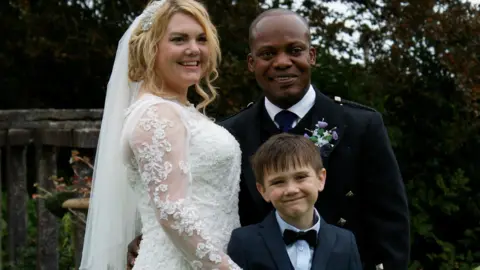 Charmain and Eric Adusah married in September 2014
Charmain grew up in Arbroath, a small fishing town on Scotland's east coast, in the 1970s and 80s.
Her mum Linda was a cleaner and her dad Peter was a plumber.
Friends describe her as a "social butterfly" who people gravitated towards.
At 19 she moved to Glasgow where she had numerous jobs in shops, restaurants and bars.
Her friend Linsey tells the documentary that Charmain had several relationships, some volatile, and she briefly ended up in a women's refuge.
Back home, her family also faced tough times.
She lost one brother in a car crash, then her youngest brother became addicted to heroin.
About the age of 30, Charmain moved to Swansea to start a new life and to study photojournalism.
A few years later, in 2007, she had a baby boy who she named Isaac.
As a single mum, Charmain struggled with post-natal depression - that's when she found religion.
She joined the newly-established Liberty Church and became an enthusiastic member.
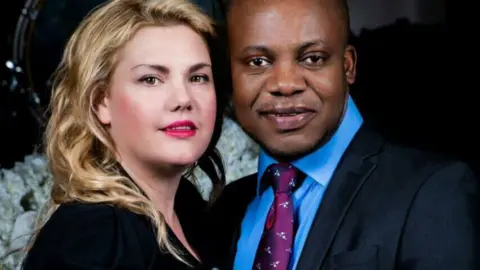 FacebookCharmain and Eric Adusah were married for just six months before her death
Adusah was mainly based in London, preaching as head pastor of another Pentecostal church.
They met through a Christian dating site and within weeks, an engagement was announced.
Charmain's mum Linda Speirs was stunned when her daughter contacted her to say she was getting married - because she hadn't even told her she had a boyfriend.
Friends told the BBC that, as the relationship progressed, they went from seeing her daily to barely at all.
About six months after first meeting, Charmain was married and had become the wife of a prophet, referred to as the first lady by members of the church.
Bridesmaid Mehrunissa Thomas says: "She had gone from just being a normal person and suddenly she was this celebrity."
 FacebookCharmain's status in the church changed when she got married
Charmain appeared to embrace the role.
But her friend Anne-Marie says that when she visited, she got a different picture of Charmain's married life.
Anne-Marie told the programme: "She said basically: 'He doesn't show me any love. There's no love, there's no passion' was her words."
Charmain, now pregnant with Adusah's baby, travelled back to Arbroath to spend some time with her mum.
It was the first time Linda had seen her since the wedding.
She confided in her mother that their marriage was on the rocks and she was planning to move home.
But then she got on the bus to London before flying out to Ghana. Her mum would never see her again.
Visitors in the night
Police records state that Adusah was the last known person to see Charmain alive.
In police statements, seen by the BBC, he described going out for lunch with Charmain before visiting the pool with her.
He said they then returned to their hotel room for the evening and had "a nice time together".
Adusah said he left the hotel after midnight to travel to Accra for a 6am meeting before a scheduled flight back to the UK.
He claimed Charmain wanted to stay longer in Ghana.
A witness who was working at the hotel that night says the Prophet's account leaves out a crucial detail.
Edward - not his real name - says that late at night two tall men arrived with Adusah and went with him to room 112 where Charmain was staying.
He says he remembers one of the men was holding a briefcase.
Edward says he and his colleagues were suspicious about why the men were going to the room but he didn't dare question them.
According to Edward, the men stayed for up to an hour and afterwards they helped Adusah load bags into his car.
About 1am, Adusah left the hotel, telling staff not to disturb his wife.
Edward says the last time he saw Charmain alive was about five hours before Adusah and the men left.
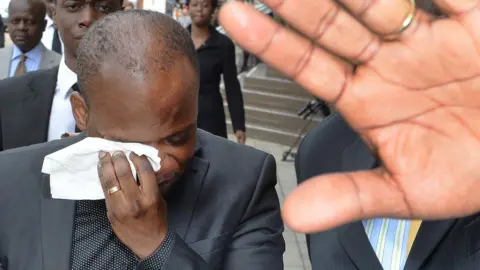 PA MediaEric Adusah leaves an inquest into the death of his wife Charmain Speirs
Adusah never mentioned these visitors to Ghanaian detectives.
Police documents confirm witnesses reported the presence of three men.
Two men of these men were later traced and confirmed they were there that night and knew Adusah through his ministry.
They each claim to have been in the room praying.
One of these men said Charmain was "vibrant and all kicking, moving up and down" when they were in the room.
Another man only confirmed Charmain was present.
A third man seems to have never been tracked down and interviewed by investigators in Ghana.
BBC Disclosure asked retired Scottish Detective Superintendent Allan Jones to review the Ghanaian police files.
He describes Adusah's omission as highly suspicious.
"You have the hotel attendant [Edward] speaking at various times with various people going in and out," the detective says.
"And for him [Adusah] not to mention that once is very strange.
"If you've got that many people coming to that room potentially even as defence witnesses, you should be mentioning them."
Questionable alibi
Adusah told police he left his wife in the middle of the night to meet a reverend in Ghana's capital Accra at 6am.
The BBC tracked down this reverend. He did not corroborate Adusah's story.
There is no evidence the Ghanaian investigators ever tested Adusah's alibi - the whole reason for his middle-of-the night departure.
"In a modern police investigation in the UK, everybody that is mentioned through the course of a statement is traced," says former Dept Supt Jones.
"The person that he says he's going to meet at 6am is an important person to see, to verify whether or not this meeting is true.
"And if that's not happened, that's a poor reflection on the investigators of the time."
The BBC approached the Ghana Police Service for comment. They did not respond to our questions.
The heroin mystery
Shortly before the post-mortem examination of Charmain's body, Adusah told police that his wife was deeply troubled, suicidal and had a history of drug abuse.
This narrative would play a central role in Adusah's release.
Six days after her body was found, leading pathologist Dr Afua Abrahams conducted the post-mortem.
"There was no mark of violence or trauma on the body," she says.
"If there was a sign of struggle then it wasn't obvious."
Dr Abrahams says she was surprised to find that there was heroin - actually a metabolite of heroin - in her blood and in her liver samples.
Her probable cause of death was recorded as a heroin overdose.
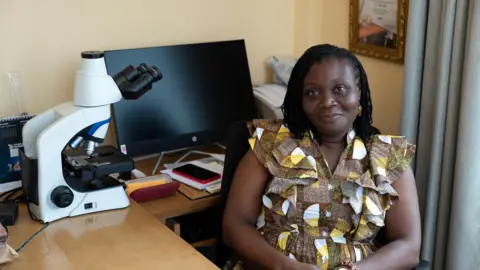 Rolf AndreasonDr Afua Abrahams conducted the post-mortem examination
Heroin is extremely rare in Ghana, especially in smaller cities like Koforidua, where Charmain was staying.
Dr Abrahams asked detectives how a tourist could obtain heroin.
She says they told her: "People who use drugs know where to find them."
Police found no drug paraphernalia, no traces of heroin in room 112, and nothing among Charmain's belongings.
As part of the decision to release Adusah, Ghana's attorney general's office referenced text messages indicating Charmain was suicidal.
Families and friends interviewed by the BBC deny that Charmain used drugs or was suicidal.
"She hated anybody on drugs," says Charmain's mum Linda.
"She just couldn't stand it. She says: 'why would anybody do that to their body?'."
More than 20 people close to Charmain gave similar accounts - she did not use drugs and was not suicidal.
"First of all, she hated drugs," says her bridesmaid Mehrunissa Thomas.
"Secondly, there is no way she would have any sort of drug in her system knowing she was pregnant.
"It is completely unlike her, totally out of character."
A second UK post-mortem examination later analysed Charmain's hair.
It was negative for opioids, confirming she was not a long‑term drug user.
Who is the Prophet?
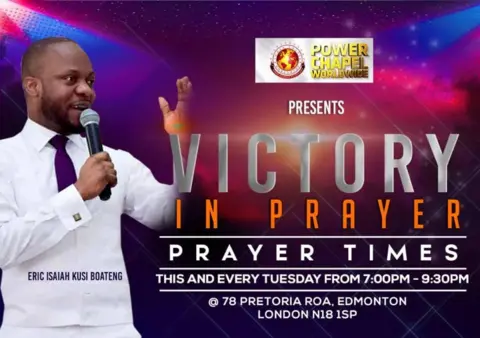 Facebook
During the BBC's investigation, it became clear that Eric Adusah has multiple identities.
In Ghana, locals know him as Eric Adu Brefo.
In Maryland, USA - where he now lives - he goes by Eric Isaiah Kusi Boateng.
Former partners say Adusah went by different names and ages.
Lynne, who had what she describes as an emotionally abusive relationship with him, knew him only as "Daniel" until another woman contacted her.
She didn't know he was a preacher.
The woman who contacted Lynne, and another former partner, told us they would later warn Charmain about Adusah too.
Another partner, Emily, not her real name, says Adusah controlled every aspect of her life.
"He gradually, very slowly, started to change," she says.
"My hair needed to be styled a certain way, I had to be dressed in a certain way, everything had to be strictly how he said it had to be.
"I had to stay home, I couldn't go out, he also took my phone away, because he didn't want me to call my family."
Emily says the real Eric was very different to the pious preacher he portrayed himself to be.
"In reality I was very vulnerable and I wasn't realising that months were going by and he had brainwashed me," she says.
"I was manipulated by the fact it was God's will. I was afraid of going against God's will."
She says Adusah used faith to manipulate and isolate her, describing his power as "mental, not physical".
 Charmain's son Isaac says he witnessed Adusah punch his mum in the face
However, Charmain's son, Isaac, said Adusah hit him and his mother.
"I could hear my mum screaming and crying," says Isaac, who is 19.
"And he came into my room trying to hit me.
"My mum stood between me and him and he ended up punching her in the face."
Isaac says: "He called himself a prophet. What prophet would hit their wife? What prophet would lay a finger on a child?
"I don't think any prophet would do something like that."
"The way he talked to my mum, the way he treated her, he wasn't a bloody prophet.
"He was an evil human being. He didn't deserve a fraction of the praise he got in that church."
According to Isaac, there was psychological abuse too.
"Every aspect of her life was controlled by him," Isaac says.
"He controlled her phone, her money, her clothes, her eating habits.
"Her happiness was controlled by him. It wasn't a relationship. It was just him dictating her life."
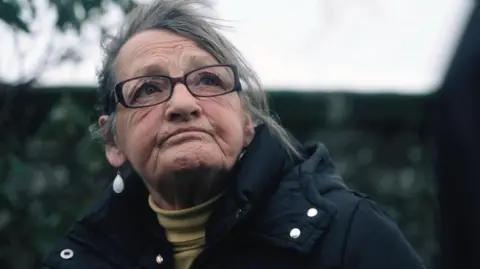 Linda, Charmain's mum, also claims to have witnessed signs of domestic violence
Charmain's mother also claims to have witnessed signs of domestic violence.
While cutting Charmain's hair, Linda says she discovered bald patches she says were inflicted by Adusah.
" I was brushing the back of her hair and when I lifted her hair up. There was all bald patches at the back. I say, 'why have you got bald patches in your hair Charmain and on your skull?'," Linda says.
At first her daughter was reluctant to say more, Linda says, before eventually claiming her husband pulled her hair.
"I said, 'why is he pulling your hair'? And of course, my voice was getting louder and I was getting angry," Linda says.
Multiple sources told the BBC they'd seen signs of a broader pattern of coercive control.
Charmain's final days
While she was in Ghana, Charmain's loved ones struggled to reach her.
One woman from Adusah's church - who later gave a statement to UK police - said Charmain had secretly obtained a second phone because Adusah had confiscated her main one.
Charmain told her she had discovered Adusah used another name, lied about his age, and had another wife in Ghana.
The witness said Charmain was considering divorce, and planned to confront her husband about "his conduct towards her".
The woman says she received a call from Charmain the night before she was last seen alive.
She told police she could hear the couple arguing. She said Adusah was shouting and Charmain was submissive.
"Each time Eric [Adusah] spoke I could hear the bang of a table as though he was hitting a table with his hand to emphasise what he was saying," the woman says.
This witness says, after 15 minutes, she heard "another bang and the call ended".
Ghanian police never saw this statement because UK police do not assist countries that have the death penalty.
The search for answers
The BBC documentary tracked Adusah down to Maryland in the USA where he lives with his wife and children and is still preaching with the Global Light Revival.
He told the BBC that the investigation and attempts to question him have caused him "severe emotional distress" and that he "endured profound personal trauma" after losing his wife and child.
He did not answer our questions about the treatment of his former partners.
The truth about what happened in room 112 may never be fully known.
Charmain's son Isaac is still searching for answers as he navigates life without his mother.
"I have to live the rest of my life knowing that my mum is never going to see what I do in my life. It really gets to me," he says.
ScotlandGhanaArbroath