
Politics
The park service says Trump's arch would obstruct historic sites. Could it be moved? August 6, 20262:19 PM ET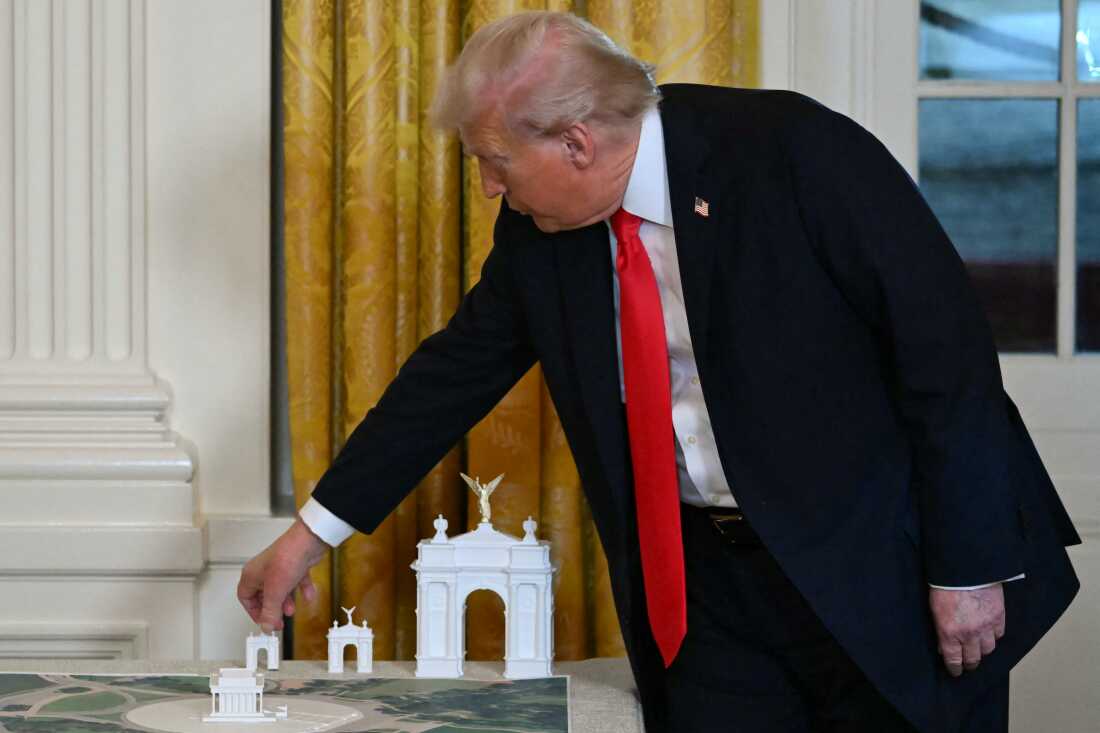
President Trump stands near models of his arch during an October 2025 event with White House ballroom donors. The administration's proposed design and location for the structure have changed little since then. Andrew Caballero-Reynolds/AFP via Getty Images hide caption
toggle caption Andrew Caballero-Reynolds/AFP via Getty ImagesThere's widespread opposition to the 250-foot arch President Trump wants to build near the National Mall, which would tower over a historic area already packed with monuments.
This week, even Trump's own administration raised concerns. The National Park Service released a document listing 37 historic properties that it says would be adversely affected by the construction of an arch in Memorial Circle, a traffic roundabout just below Arlington National Cemetery.
"The significance of these properties derives not only from their individual architectural or commemorative importance, but also from their spatial, visual, symbolic, and ceremonial interrelationships," reads the report.

National
Critics say adding Trump's arch to D.C. would take something away: the view
The National Park Service findings were released as part of an ongoing review process known as Section 106. Under this section of the National Historic Preservation Act, federal agencies must evaluate the impact their actions could have on any historic properties and try to minimize harm.
The assessment finds that an arch would interfere with dozens of historic sites in the area, particularly the key connection between the Lincoln Monument and Arlington House, the former home of Confederate Gen. Robert E. Lee.
"The bridge alignment and associated ceremonial landscape were intended to physically and symbolically unite North and South through a coordinated monumental composition extending across the Potomac River," the report reads.
The traffic circle where the arch would sit is right between the two landmarks. Critics say it would not only interfere with that view, but with the solemn atmosphere near the cemetery itself.
A group of Vietnam War veterans has already sued to stop the arch's construction, stating that it would be a visual affront and needs congressional approval, which Trump denies and has not sought.

The Trump administration wants to build its arch in Memorial Circle, a traffic island on the bridge between the Lincoln Memorial and Arlington National Cemetery. Julia Demaree Nikhinson/AP hide caption
toggle caption Julia Demaree Nikhinson/APThe White House insists that Memorial Circle is an ideal place to locate the arch. In an email to NPR, it called the arch a "fitting addition to the monumental axis between the Lincoln Memorial and Arlington House." The administration has repeatedly stated that the arch will "enhance the visitor experience at Arlington National Cemetery."
This insistence frustrates Greg Werkheiser of the law firm, Cultural Heritage Partners, which is handling several lawsuits against the Trump administration's other D.C. construction projects.
"It's as if the president is saying: 'Only if I jam my arch between Arlington Cemetery and the Lincoln Memorial and make it tower over everything else in the city will it be noticed,'" he said.

National
Trump's arch clears another hurdle, setting up a big debate: Do height limits apply?
Preservationists say there are places in Washington, D.C., where an arch this size would impact far fewer historic properties.
"I think people are opposed to the absurdity of locating an arch this size and of this design in the middle of what is almost a civil sacred landscape," Werkheiser said. "I think had he chosen an alternative, not only would some of the folks who are opponents now not be opponents, but I think they would be supporters."
The National Park Service and the Department of the Interior did not answer NPR's questions about whether other locations were or are being considered. But the department downplayed critics' concerns about adverse effects.
"The Arch will offer stunning views of Washington, D.C. from its observation deck, and the Arch itself will be visible from other historic properties, adding a monumental structure to the viewshed in a location that is currently a barren piece of grass," an Interior Department spokesperson told NPR in an email.
Critics say the lack of discussion about alternative locations is just one flaw in a review process they see as happening both too quickly and too late.
The Section 106 review only started in June, after the arch had already received final design approval from the first of two federal arts commissions reviewing it. That sequence of events is unusual, said Ed Stierli, the vice president of government affairs at the nonprofit National Parks Conservation Association.
"We're talking … not a whole lot of transparency, not even a meeting of the consulting parties has genuinely taken place," Stierli said. "And unfortunately, as this continues, it feels like more of a box-checking than an actual, legitimate process."
Location, location, location
Typically, conversations about new memorials and monuments start with the question of where to put them.
"Even looking at some of the more recent memorials — like the Women's Suffrage National Monument that's still in the planning process — they weigh the pros and cons," Stierli said. "And they have to evaluate the alternatives, as well as what the impact is for visitors, before any of these are cited."
He said a proposal for any sort of project in Memorial Circle deserves careful scrutiny because of the location's significance and symbolism.
National
A few people have played a big role in 'jamming through' Trump's arch, critics say
"Anything that would be built there would be controversial," Stierli said. "But I think what makes this so controversial is the pure scale … We're talking about one of the largest monuments to ever be built in Washington, D.C."
At 250 feet tall, the arch would be more than double the height of the nearby Lincoln Memorial. The National Park Service says its harms would extend much farther, to dozens of historic sites including the National Mall, U.S. Capitol and Washington Monument and its grounds.
"They skipped over real consideration of alternatives and just went to what arguably is the most concentrated collection of important historic sites and landscapes and settings in the country," Werkheiser said.
One of the people who did propose an alternative site was David Maloney, D.C.'s state historic preservation officer.
He wrote a letter to the National Park Service in June suggesting the arch be located in a newly created traffic oval near the Frederick Douglass Bridge, which crosses the Anacostia River in southeast D.C.
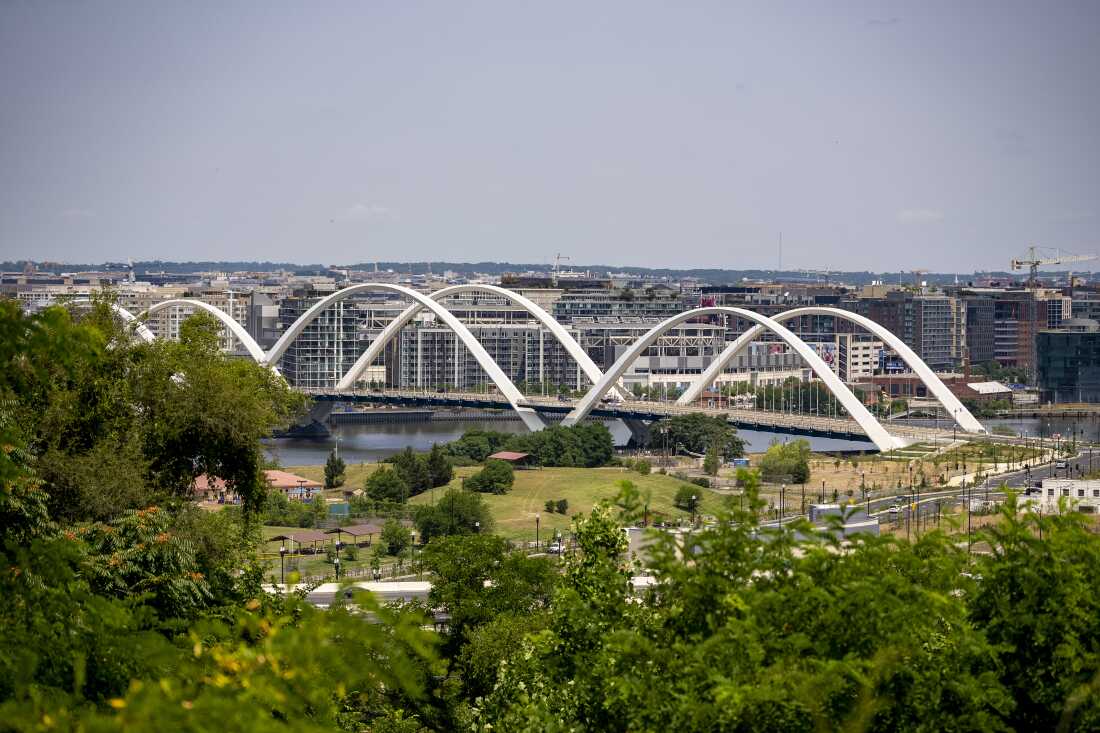
David Maloney, D.C.'s state historic preservation officer, suggested the arch could be built near the Frederick Douglass Memorial Bridge in southeast D.C. with fewer negative consequences. Andrew Harnik/AP hide caption
toggle caption Andrew Harnik/APThe neighborhoods east of the river are predominantly Black, with a rich cultural history but higher poverty rates than the rest of D.C.
Maloney said an arch there would be well positioned between Nationals Park and Audi Field, two of the city's sports venues, to "create an energizing focal point for a still-emerging neighborhood, suitable for a celebratory crowd." It would mark an entrance to D.C. on a direct axis with the Capitol, he said, and its height would be "more in scale" with the 288-foot tall Capitol dome.
"And importantly, it would enhance … the city's monumental landscape rather than detracting from it," he wrote.

National
Veterans and relatives see no place for Trump's arch near Arlington National Cemetery
Maloney said he was highlighting that particular location not as an endorsement of building an arch there, but "to emphasize the need to avoid the adverse historic effects as part of the Section 106 process." He did not respond to NPR's interview request.
Maloney's suggestion was mentioned briefly at the July meeting of the National Capital Planning Commission, the second federal panel reviewing the proposal.
"I've been intrigued and interested in this idea about bringing something that might strengthen Anacostia River East by bringing it to an area that would [have] an impact on our community that could be positive, maybe," said Arrington Dixon, a planning commissioner who grew up in that neighborhood.
But the topic of location went largely unexplored at the meeting. After two hours of public pushback and many unanswered questions, commissioners voted to advance the arch to the next phase of review.
The National Capital Planning Commission next meets in early September. Its Trump-appointed chair has said the commission could potentially grant the arch final approval then — though its own rules say it can't do so until the Section 106 review is complete.
Weakening the review process
As it stands, the Section 106 review process is one of few procedural hurdles the arch has yet to clear. And the Trump administration is poised to weaken it.
In late July, the Advisory Council on Historic Preservation — which is made up of a majority of Trump allies — voted to rewrite Section 106 to make it easier for the federal government to build on historic properties anywhere in the country.
National
Trump allies vote to weaken protections for historic sites — not just in D.C.
The council argues that the existing Section 106 rules create confusion and delays in federal construction. It wants to limit what kinds of sites are considered historic, what counts as an adverse effect and the amount of public input required for that process. That would have implications for the arch, among other things.
"Even if they did consult [the public], they wouldn't have to consider the obvious harm to the setting of putting an arch that's this tall literally jammed in the middle of the sight lines between Arlington Cemetery and the Lincoln Memorial," Werkheiser said.
The new Section 106 language is currently working its way through the federal rule-making process, which involves a 30-day public comment period. Werkheiser said legal challenges are inevitable at a later stage.
Congress theoretically has the power to block the new monument — and a group of House Democrats have introduced a bill to do so. But the Republican majority is unlikely to vote to kill the arch.


